MLR Excellence in Medtech: Improving Speed, Consistency, and Compliance

Establishing medical, legal, and regulatory (MLR) excellence is a priority for many medtech organizations, but achieving it is rarely straightforward. In practice, MLR is often built while work is already underway, with teams navigating complex, constantly changing regulatory requirements and asking a familiar question: Where do we even begin?
Derrick Greene, director of marketing content and operations management at Fresenius Medical Care, shared perspectives grounded in real-world MLR experience and his involvement in an industry working group. He highlighted the challenges teams face today and how medtech organizations are thinking about MLR excellence, workflow efficiency, and the role of AI in supporting faster, more consistent review.
The operational realities of MLR today
The challenges facing MLR teams are familiar because they are experienced every day. As content continues to move through review, teams must manage multiple pressures at once:
- Evolving regulatory requirements: Regulations continue to change making it difficult to standardize workflows while content is actively moving through review.
- Excessive reviewer burden: Medical, legal, and regulatory reviewers frequently balance MLR responsibilities alongside their primary roles, creating bottlenecks and friction that slow every stage of approval and increase the time and effort required to review content.
- Document overload: Traceability and requirements documentation must be created, reviewed, and maintained, adding significant overhead to the review process.
- Fragmented tools and data: Disconnected systems limit visibility into review timelines and performance, making it difficult to identify operational constraints or address inefficiencies early. Reviewers often spend valuable time on low-value checks and rework.
- Audit and inspection readiness: Even after content is approved, teams must remain prepared for audits and inspections, extending MLR well beyond the review cycle itself.
Why pharma best practices don’t translate to medtech
Many MLR challenges in medtech stem from applying pharmaceutical best practices to an industry that operates differently. While the pharmaceutical industry has a more established regulatory landscape, medical devices follow a different path. Medtech manufacturers often face less stringent clinical evidence requirements and enjoy greater promotional flexibility, especially for lower-risk Class 1 or Class 2 devices.
Medtech content also places greater emphasis on usability and human factors, while pharma review models tend to focus more heavily on labeling and dosing. As a result, medtech MLR often involves a broader group of reviewers beyond medical, legal, and regulatory, including clinical and engineering experts. As Greene noted, “For medtech, there are just more people involved. That alone makes it more challenging to navigate.”
Together, these differences make pharma-based MLR models difficult to apply directly and reinforce the need for an approach designed specifically for medtech.
Defining MLR excellence and the path forward
- Claims and statements must be precise and aligned with approved labeling, technical specifications, and regulatory submissions
- Content must adhere to internal processes and market-specific regulations
- Content should be intentionally built for its intended channel, audience, and market
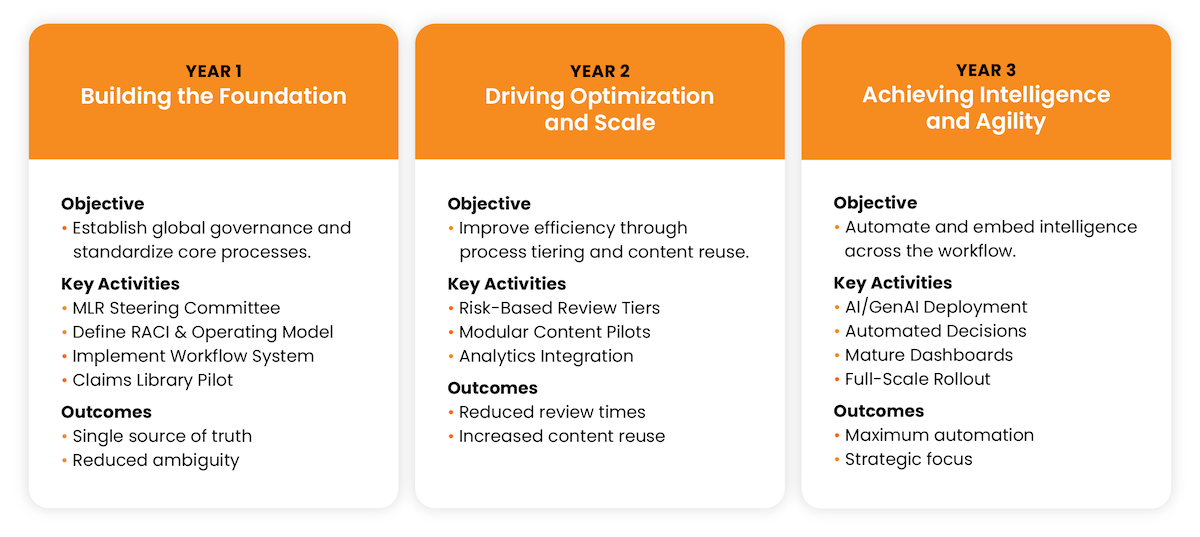
Greene described MLR excellence as a progression over time, with teams moving from establishing governance and standardizing core processes, to driving efficiency through reuse and analytics, and eventually embedding AI and automation to achieve greater agility. The framework below illustrates how these focus areas often evolve as MLR maturity increases.
MLR excellence as a strategic advantage
When built intentionally, MLR shifts from a bottleneck to a strategic capability. Clear governance, defined roles, and a single source of truth reduce ambiguity and enable scale without increasing compliance risk.
As the model matures, the focus moves from process stability to measurable performance. Structured claims, consistent decisions, and governed data create the foundation for AI & automation. This ensures that AI is not simply layered onto existing complexity, but is instead integrated into a well-defined, transparent process.
Veeva AI for PromoMats accelerates this stage by improving content quality earlier and reducing manual effort during review. The result is stronger compliance, faster speed to market, and a review process that becomes a competitive advantage rather than a constraint.
To learn more about Veeva AI for PromoMats watch this demo.