Accelerate Market Entry With Strategic Regulatory Operations
Executive Briefing: The Medtech Strategic Regulatory Operations Scorecard
Evolving regulatory reform proposals and shifting political landscapes are fundamentally redefining global compliance expectations. The implementation of regulatory ‘stop-the-clock’ mechanisms during conformity assessments now directly threatens commercial launch timelines, elevating submission accuracy to an indirect financial variable. In this high-stakes landscape, right-first-time (RFT) submissions and enterprise-wide data visibility are no longer just goals, but strategic prerequisites for safeguarding the product pipeline. Failure to meet quality standards risks significant delays, relegating product to the back of the queue and compromising market access.
As regulators shift towards continued compliance assessment, with for-cause audits and pre-determined change control plans, maintaining audit-ready technical documentation has become a necessity to mitigate compliance and business risks. To thrive in this evolving landscape, Regulatory Affairs (RA) must transition from a reactive, document-heavy cost center at the end of the product development chain, into a strategic business partner involved at all stages of a device’s lifecycle, pivoting the organization toward a data-driven framework that accelerates sustained global market access.
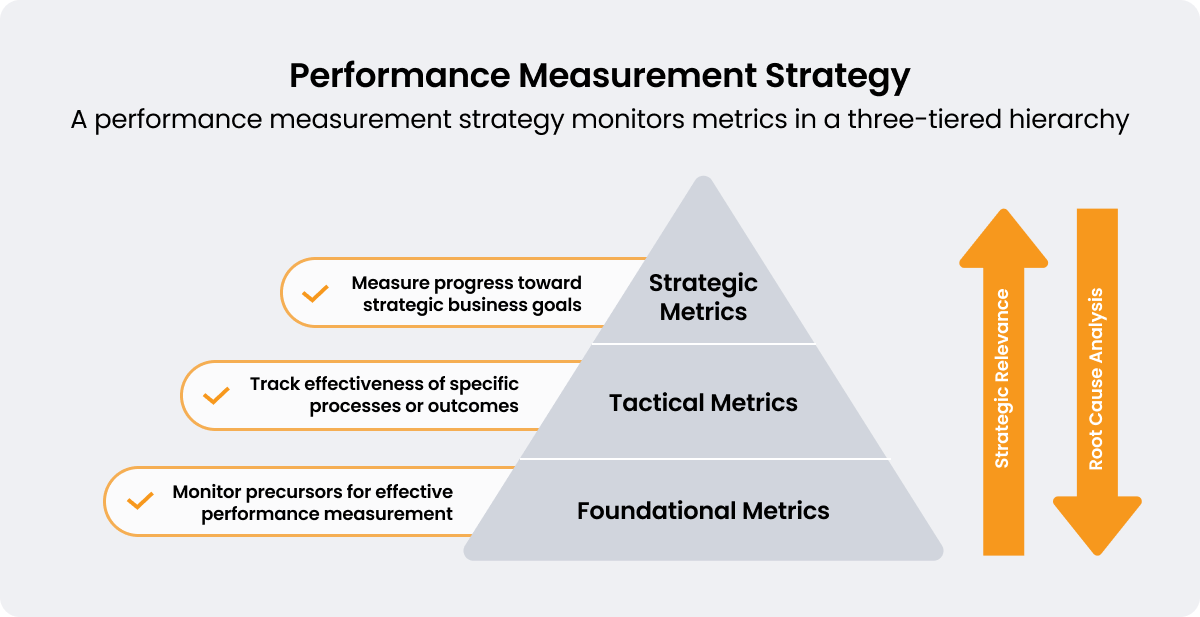
Historically, regulatory functions have operated without quantitative measures, which masks true impact on business performance. To bridge this gap, regulatory functions should establish a performance measurement strategy that cascades down from high-level strategic metrics through to day-to-day operational foundational metrics.
By measuring continuous compliance, operational risk, and commercial predictability, Regulatory Operations (RegOps) metrics transform regulatory activities into strategic business drivers that protect market access, enhance enterprise agility, and drive predictable timelines for revenue generation.
Metrics Matter
Establishing strategic metrics within RegOps is not an administrative exercise, but rather a fundamental evolution in corporate business logic. In an era of continuous compliance, these metrics act as key sensors, safeguarding the legal right to sell while identifying operational drag. They are the connection between the operational reality and the overarching corporate strategy.
Quantifiable performance indicators, particularly submission cycle times, technical file health scores, and change management efficiency, are essential for this evolution. By quantifying regulatory performance, executive leadership gains the transparency to transform a historic bottleneck into a predictable engine for growth and innovation.
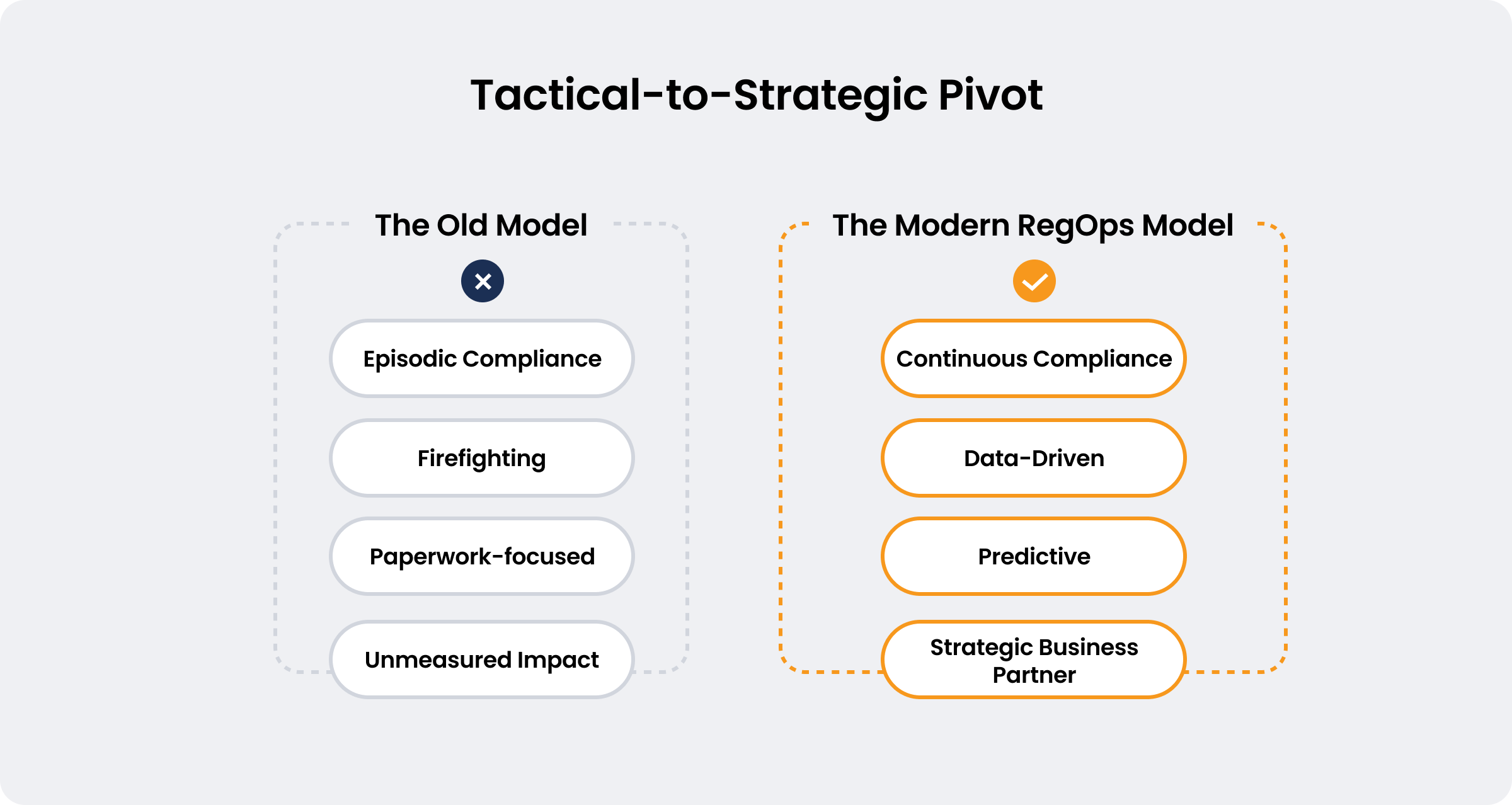
1. Continuous Compliance
Continuous compliance requires shifting from deadline-reacting work to real-time activity measurement in order to maintain the live status of an entire global portfolio. This creates a permanent state of audit-readiness, reducing resource-spikes as work gets distributed across the product lifecycles, as well as enabling more efficient supply chain management, global market roll out, international regulatory reliance and parallel conformity assessments.
2. Risk Management
Metrics shed light on formerly opaque regulatory processes, turning them into visible operational steps. Tracking the cycle times of impact assessments, certifications, and change controls goes beyond monitoring documentation to measure enterprise agility. These metrics reveal how quickly an organization can qualify new suppliers or navigate global supply chain disruptions and product changes without compromising compliance, and identify blockers that lengthen cycle times.
3. Predictability for Commercial Planning
By defining metrics such as average time for regulatory approval or submission yield, RA provides the business with high-confidence windows for revenue generation. Simply put: regulatory clearance is the gateway to commercial realization. This allows for accurate budgeting of marketing launches and sales force expansions for commercial success.
To operationalize this pivot, medtech RegOps should align their metric framework in a three-tiered hierarchy:
- Strategic metrics: executive-level metrics that measure progress towards strategic business goals.
- Tactical metrics: functional metrics that monitor the effectiveness of specific processes or outcomes.
- Foundational metrics: operational metrics that monitor precursors for effective performance measurement i.e. track baseline task execution, transactional cycle times, and raw operational throughput.
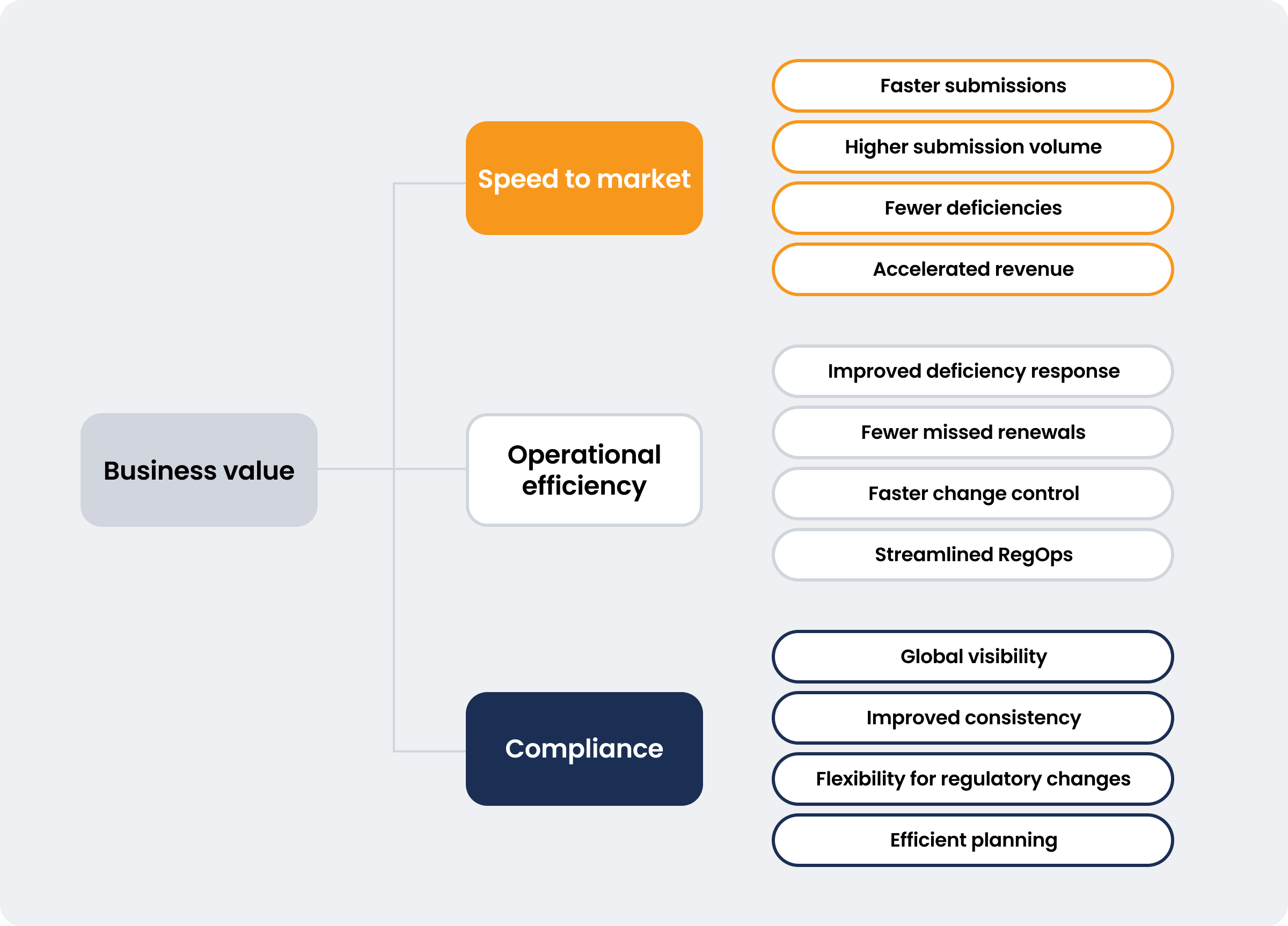
When teams effectively implement a performance measurement strategy, they drive value across the three strategic pillars of a modern RegOps solution.
The Value Framework
To move toward a data-driven model, it’s essential to categorize how regulatory activities translate into commercial impact. Each metric ‘tier’ (strategic, tactical, foundational) will typically have performance measures across the core medtech business value drivers of speed, productivity, and quality and compliance.
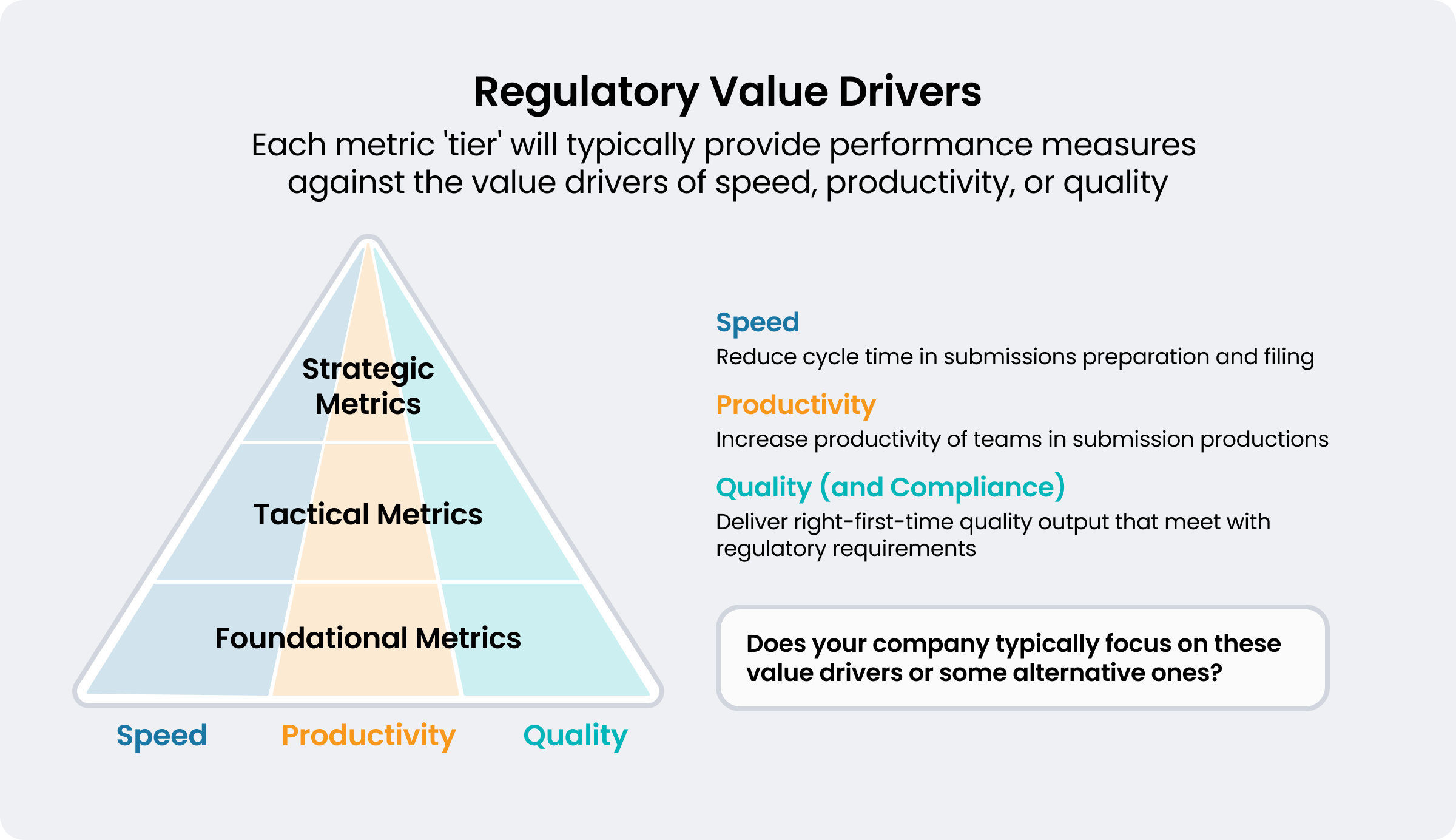
Medtech business value depends on three core pillars: speed to market, efficiency, and compliance. The focus of each regulatory department should reflect corporate operational strategy. While these drivers are universal, their relative priority is dictated by a medtech’s unique business context and culture, portfolio complexity, and geographic footprint. Whether an organization is driving aggressive growth through rapid global launches or optimizing through lean operations and legacy maintenance, RegOps plays a critical role.
By defining and tracking the right set of metrics within these pillars, companies can move from subjective reporting to a quantitative demonstration of value. This requires acknowledging the inherent tension between time, quality, and cost. These three dimensions are naturally antagonist; optimizing for one often requires strategic compromises on another. True regulatory agility means acting as an option provider for the business. For speed-critical projects, RegOps must design pathways that accept higher costs to fund parallel contingency plans.
Conversely, for lower-risk submissions, success means avoiding the trap of over-engineering documentation—ensuring the team does not sacrifice speed or resources simply to avoid health authority questions that were unlikely to be asked. Choosing the right solution and industry partner is key to setting this baseline. This partnership delivers a vital horizontal view of collective medtech challenges and successes, backed by mature RegOps frameworks. Benchmarked across the medtech sector, here are six enterprise KPIs to bridge the execution gap between daily RegOps and corporate growth strategies:
Speed to Market
Improving time to market requires a dedicated set of KPIs that isolate and measure the specific stages of the submission and approval process that most significantly impact market access. In major jurisdictions where certification cycles average 18 to 24 months, there’s a tight window for establishing a competitive advantage, making it critical to isolate bottlenecks within the submission and approval pipeline, particularly with the introduction of stop-the-clock conformity review processes. By tracking targeted KPIs, organizations shift from a reactive to a proactive posture, effectively optimizing the operational white space to anticipate regulatory demands and synchronize global launches. This granular visibility allows RegOps teams to anticipate authority needs and ultimately compress the time between clinical studies and the first commercial sale.
Achieving this level of predictability and speed requires tracking a specific set of operational KPIs:
- Strategic alignment and right-first-time (RFT) yield (strategic metric): A balanced metric measuring submission acceptance against target launch objectives. Rather than over-preparing submissions at the expense of speed or budget, this metric tracks whether the regulatory strategy delivered the optimal path, balancing acceptable risk, cost, and time-to-clearance for the specific commercial asset.
- Regulatory lead-time predictability (strategic metric): This measures the variance between forecasted and actual market clearance rates. High predictability provides leadership and commercial business partners with the high-confidence window necessary for revenue generation, allowing for precise budgeting of marketing launches and sales expansions.
Operational Efficiency
Operational efficiency serves as the primary lever for resource optimization and productivity. By automating high-volume, low-complexity tasks, organizations with complex product and geographic portfolios can reclaim thousands of expert hours to focus on strategic growth rather than administrative cycles.1 This allows for a transition from a linear scaling model, where headcount must grow with every new market entry, to a platform-based approach that enables parallel global launches and breakthrough innovation without proportional increases in overhead.
- Change management speed (tactical metric): Measuring the cycle time required to complete regulatory impact assessments and execute changes for manufacturing, product, or supplier changes helps ensure that regulatory isn’t a bottleneck for cost of goods sold improvements or global supply chain pivots. Change management speed also supports supply chain sustainability initiatives that reduce (for example) supplier materials’ composite carbon footprint.
- Submission cycle throughput (strategic metric): Quantifying the volume of regulatory objectives handled relative to headcount enables medtechs to shift from a linear headcount-scaling model to an asset-leverage platform approach, decoupling global expansion from overhead growth.
Compliance
The financial burden of non-compliance remains largely invisible on standard earnings statements until a system failure occurs, often resulting in reactive remediation costs that far exceed preventive investment. Historically, the costs of maintaining a compliant state aren’t fully factored into budgeting until the system fails, resulting in large remediation bills, legal liabilities, and income loss associated with product recalls, market withdrawals, or health authority fines. Remediating these costs after they manifest is significantly more expensive than investing in prevention. Adopting a metric-driven model helps teams quantify liability and proactively mitigate it through always-ready technical documentation and predictive KPIs.
Key metrics to measure and mitigate these financial risks include:
- Technical file health score (strategic metric): Implementing a real-time risk index that reflects the percentage of active files which are globally compliant replaces episodic compliance with perpetual audit-readiness, protecting the organization from revenue loss due to recalls or remediation.
- Zero-missed renewals (foundational metric): Providing 24/7 visibility and automating registration lifecycles to eliminate interruptions in the legal right to sell ensures that core revenue streams are not compromised by administrative oversights in legacy product maintenance.
1 Ref: https://www.veeva.com/medtech/resources/biomerieux-cuts-change-management-tracking-time-in-half-with-veeva-rim/
Conclusion
Shifting from episodic to a continuous compliance model allows medtechs to replace reactivity with predictable, strategic market access. Within this framework, technical documentation evolves from static records into structured, real-time data, providing a dynamic picture of the entire product lifecycle. The market will increasingly divide into two camps: organizations that treat compliance as a recurring regulatory hurdle and forward-thinking medtechs that utilize it as a strategic growth engine.
Winning organizations will leverage integrated digital infrastructure to transform regulatory hurdles into a measurable competitive advantage. Empowered by hard metrics, regulatory leaders can provide a highly predictable path to revenue, transforming regulatory into a visible driver of enterprise value and patient access, aligned with corporate strategy.
Shifting from episodic to continuous compliance allows medtechs to replace reactivity with predictable, strategic market access. Within this framework, RA transcends its traditional role as a passive gatekeeper to become an agile option provider, aligning regulatory pathways with core project drivers, whether prioritizing speed through contingency funding or optimizing cost of goods sold through lean execution.
Appendix: Other metrics of interest
Driving Growth (Speed to Market)
- Submission Cycle Time: Reduction/simplification of the dossier assembly process.
- Time to Approval: Directly measuring the reduction of days until market clearance. Submissions Handled per Month: Tracking the throughput capacity to support a growing portfolio and provide your commercial partners with visibility into your operational status.
- Rounds of questions/deficiencies: Reducing the number of rounds of Health Authority Questions: fewer rounds result in fewer rounds and imply increased submission quality, thus shaving off many months off the certification cycle.
- Regulatory Objectives Approved: Increasing the total volume of successful approvals per month to support global expansion goals.
- Global Launch Synchronicity: Variance between first-market launch and subsequent country entries.
Operational Efficiency
- Average Time to Respond to HAQs: Decreasing response time ensures projects stay on track and authorities view the firm as highly responsive.
- Expiration Tracking (Zero-Missed Renewals): This is the core of continuous compliance which enables the elimination of missed renewals to ensure sales are never stopped.
- Volume of Changes in Progress: Monitoring the pipeline of manufacturing and supplier changes to ensure RA never becomes the bottleneck for COGS improvements.
- Faster Change Control: reduction in average time to complete a change control ensures companies can operate in hundreds of countries with complex portfolios without grinding to a halt due to regulatory complexity.
- Number of Manual Handoffs: Measuring the reduction in friction between teams. Fewer handoffs equal a lower risk of data error, which is essential for data integrity compliance.
- Time-to-Dossier Completion: Reduction in manual hours per submission via both workflows improvements, automation and artificial intelligence.
- Regulatory Lead-Time Predictability: Accuracy of forecasted approval dates vs. actual dates for approval can help highlight product line or country challenges in go to market.
Compliance
- Questions per Submission: Filing dossiers that anticipate authority needs, thereby reducing the friction of the approval process.
- Registration Visibility: Ensures 24/7 visibility on legal orderability to prevent trade compliance violations. In a continuous compliance model, this is an instant query, not a multi-day research project.
- Time to Close HAQs: Measuring the efficiency and consistency of responses to global authorities.
- Adaptability to Regulatory Changes: Faster adaptation to new requirements through digital impact assessments, ensuring the product pipeline is never stalled by new laws.
- Incomplete Submission Rate: Reducing planned but failed submissions through better resource allocation and planning.
- Technical File Health Score: Real-time audit-readiness percentage of active files.
| Value Driver | Strategic Metrics | Tactical Metrics | Foundational Metrics |
|---|---|---|---|
| Speed to Market |
• Time to Approval • Global Launch Synchronicity • Regulatory Objectives Approved |
• Rounds of Questions / Deficiencies • Submission Cycle Time |
• Submissions Handled per Month |
| Operational Efficiency | • Regulatory Lead-Time Predictability |
• Average Time to Respond to HAQs • Faster Change Control • Time-to-Dossier Completion |
• Expiration Tracking (Zero-Missed Renewals) • Number of Manual Handoffs • Volume of Changes in Progress |
| Compliance | • Technical File Health Score |
• Time to Close HAQs • Questions per Submission • Adaptability to Regulatory Changes • Incomplete Submission Rate |
• Registration Visibility |
Learn how Alcon leverages an end-to-end regulatory intelligence system to increase visibility, ensure audit-readiness, and drive measurable results.