From Friction to Flow: A Modern Approach to Medtech Commercial Excellence
Medtech companies have invested heavily in digital ecosystems to empower their commercial organizations. From enterprise CRM platforms to a myriad of integrated IT tools, the goal was a truly comprehensive view of the customer. Yet, amid rising costs and margin pressures, leaders are facing a difficult reality. Are we actually better off? Has the investment generated the promised scale and opportunity? And most importantly, do our teams feel empowered—or hindered—by the tools we’ve provided?
The gap between high-level connectivity and daily field friction reveals a fundamental paradox in medtech’s technology strategy. Achieving true commercial excellence requires a shift from horizontal, “one-size-fits-all” platforms toward a purpose-built strategy that prioritizes field adoption, marketing agility, and actionable leadership insights.
The Current State: A Disconnected Ecosystem
Medtech organizations have invested hundreds of millions into modernizing their commercial ecosystems, yet 50% of C-level executives now describe their CRM as “below functional” – viewing it as a passive archive rather than a driver of proactive commercial strategy.
While the industry has shifted from simple sales to complex, stakeholder-driven engagement, the underlying technology hasn’t kept pace.
This disconnect forces teams to navigate a fragmented landscape of separate tools and conflicting data. The resulting administrative burden is something that 100% of VP+-level leaders recognize as a high-impact drag on commercial growth.
To drive real performance, forward-thinking medtechs are moving beyond disconnected tools and toward a unified platform that connects the entire customer lifecycle.
Bridging the gap requires a deeper look at the unique challenges facing those on the front lines, those driving the strategy, and those responsible for the bottom line.
The Field View: A System of Record or a System of Value?
For the field representative, the CRM often feels like an administrative burden rather than a tool for success. Reps spend excessive time on manual data entry but lack the integration needed to identify new opportunities. When a platform is viewed primarily as a tracking system—requiring documentation of interactions and business plans without offering clear utility in return—productivity inevitably stalls. This “value gap” is the primary driver behind low adoption across the industry.
To truly empower the field, the CRM must evolve from a passive system of record into an agentic engagement platform that actively guides field actions. By using Agentic Voice, reps can effortlessly dictate notes in natural language to capture the full qualitative context of every clinical interaction. This generates real-world Commercial Evidence™ – surfacing the critical intent signals and treatment barriers reps need to instantly prioritize engagements, focus their time where it matters most, and simplify their daily workflow.
The New “Day in the Life” for a Field Sales Representative
Instead of starting the day navigating disconnected systems and manually triaging tasks, reps with a modern commercial solution lean on their AI co-pilot to do the heavy lifting. This shift from manual navigation to guided action ensures that every interaction is optimized for success.
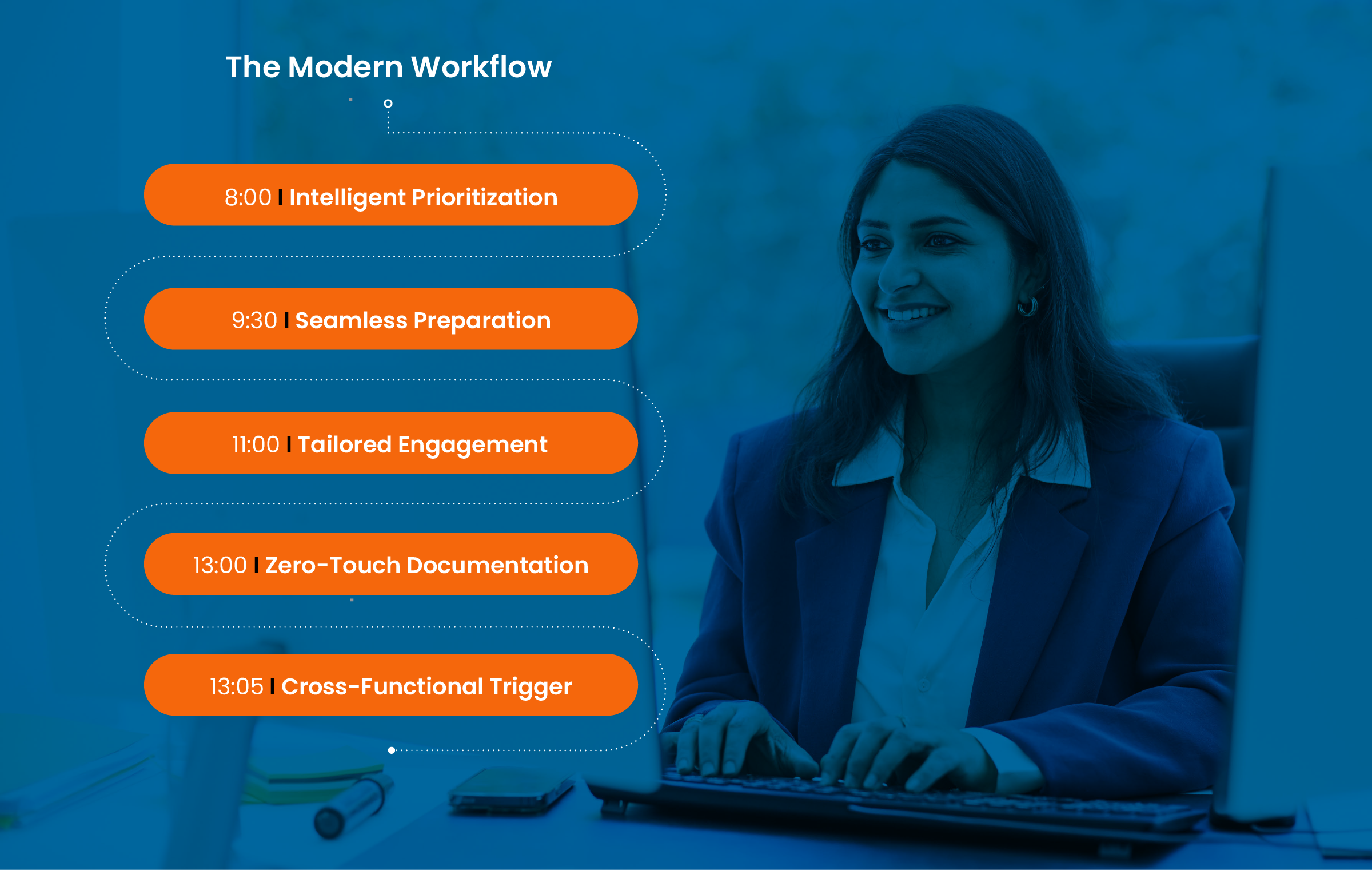
- Intelligent Prioritization: Instead of sifting through disconnected data, the rep opens an AI-powered Hot List. The system analyzes recent engagements and clinical data to present a prioritized feed of the highest-value accounts in the territory.
- Seamless Preparation: Before entering the clinic, the Pre-Call Agent provides a data-driven briefing. The rep reviews a summary of recent marketing interactions and individualized “Next Best Action” recommendations to ensure they walk in fully prepared.
- Tailored Engagement: During the meeting, the rep launches up-to-date and approved marketing content directly from their device. If a physician has a specific clinical question, the system identifies the exact study or patient education material needed, ensuring a coordinated, customer-centric experience.
- Zero-Touch Documentation: Leaving the facility, the rep uses Agentic Voice to dictate a detailed customer call report. The system transcribes, checks compliance, and transposes notes directly into structured CRM fields. Then it automatically takes the correct action in the customer journey including sending relevant follow-up materials. This Agentic Call Report™ is a commercial enabler for the field and saves them time from typing, remembering, and detailing call notes days later.
- Cross-Functional Trigger: The system automatically notifies the medical and marketing teams of the interaction, triggering follow-up actions and ensuring the HCP sees one unified team rather than a fragmented organization.
This loop doesn’t just benefit the sales rep; it fundamentally changes the game for the entire organization and aligns all functions putting the customer at the center of all activities. And when field data is captured instantly, it eliminates the traditional intelligence gap that has long hindered marketing strategy.
The Marketing View: Closing the Insight Gap
Insights from the field are the lifeblood of commercial success. However 68% of medtech leaders rank the insight gap – data that fails to provide actionable guidance – as their #1 strategic challenge. While 39% of organizations have optimized basic activity logging in their CRM, a mere 16% have achieved a level of maturity for customer intelligence. Without the real-world context needed to see what truly drives clinical adoption, marketing teams are often left with fundamental questions:
- Can we see in real-time which approved materials the field is actually using?
- Which content is generating a positive reaction from healthcare providers?
- Can our reps easily share compliant content and receive back-end analytics, such as open rates and engagement?
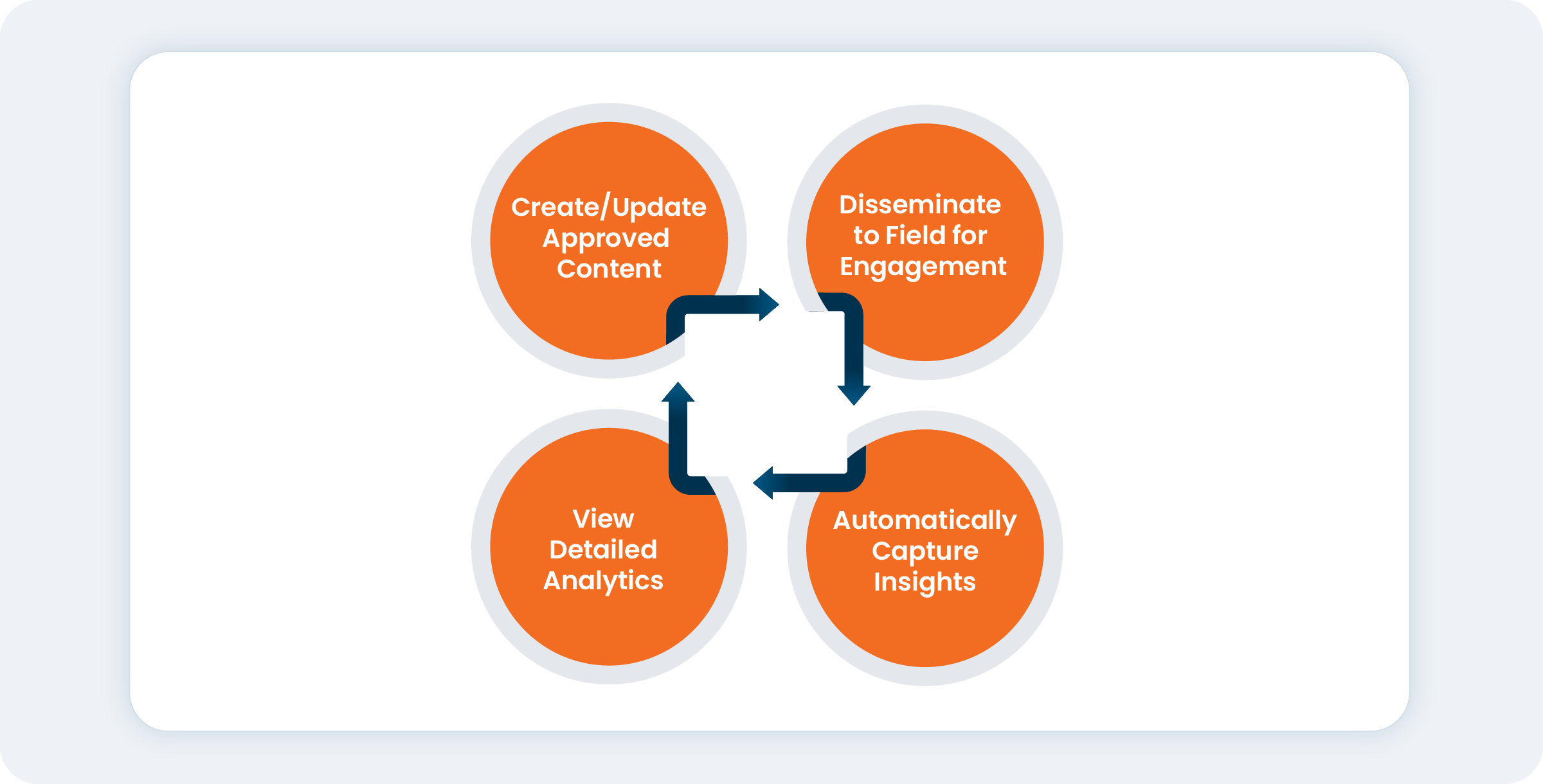
A unified ecosystem closes the loop and provides real-time feedback:
This level of visibility transforms the marketing function from a content producer into a strategic intelligence hub. Marketing can more closely work with field teams to deliver the personalized experiences that deepen stakeholder relationships and help patients access life-improving innovations faster.
The C-Suite View: The Cost of Complexity
Persistent friction between departments highlights a costly executive reality: legacy enterprise CRMs often become perpetual custom projects, with hidden maintenance and customization costs reaching up to five times the initial license fee1.
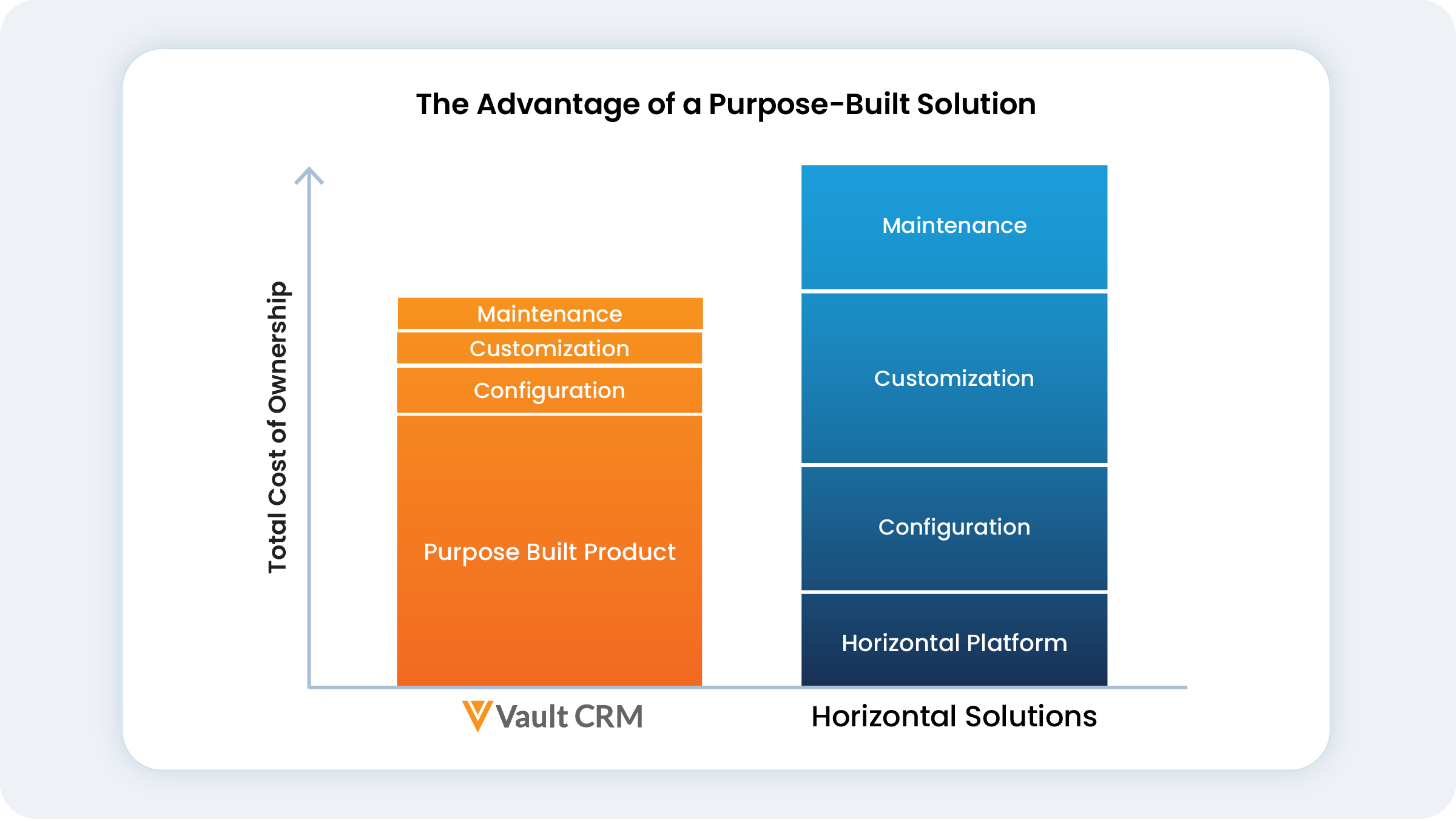
To break this cycle, recent industry benchmark data shows that executive priorities have shifted decisively toward stabilizing their operational foundation:
Choosing a purpose-built platform provides the clean data foundation required for an Agentic Commercial model – ensuring IT investments fund growth and precision engagement rather than perpetual maintenance.
A New Approach: The Purpose-Built Solution
Unlike horizontal platforms, an industry-specific solution like Veeva Vault CRM is designed for the unique regulatory and compliance demands of life sciences. The Vault Platform integrates sales, marketing, and medical teams onto a single, unified architecture – transforming fragmented data into a customer-centric solution where every function works towards the same goals.
True commercial success depends on more than just the software; it requires a long-term partner who understands the unique demands of medtech. A dedicated partner provides a platform that natively enforces business rules and regulatory standards, freeing teams to focus on the agility and innovation needed to stand out in a crowded market.
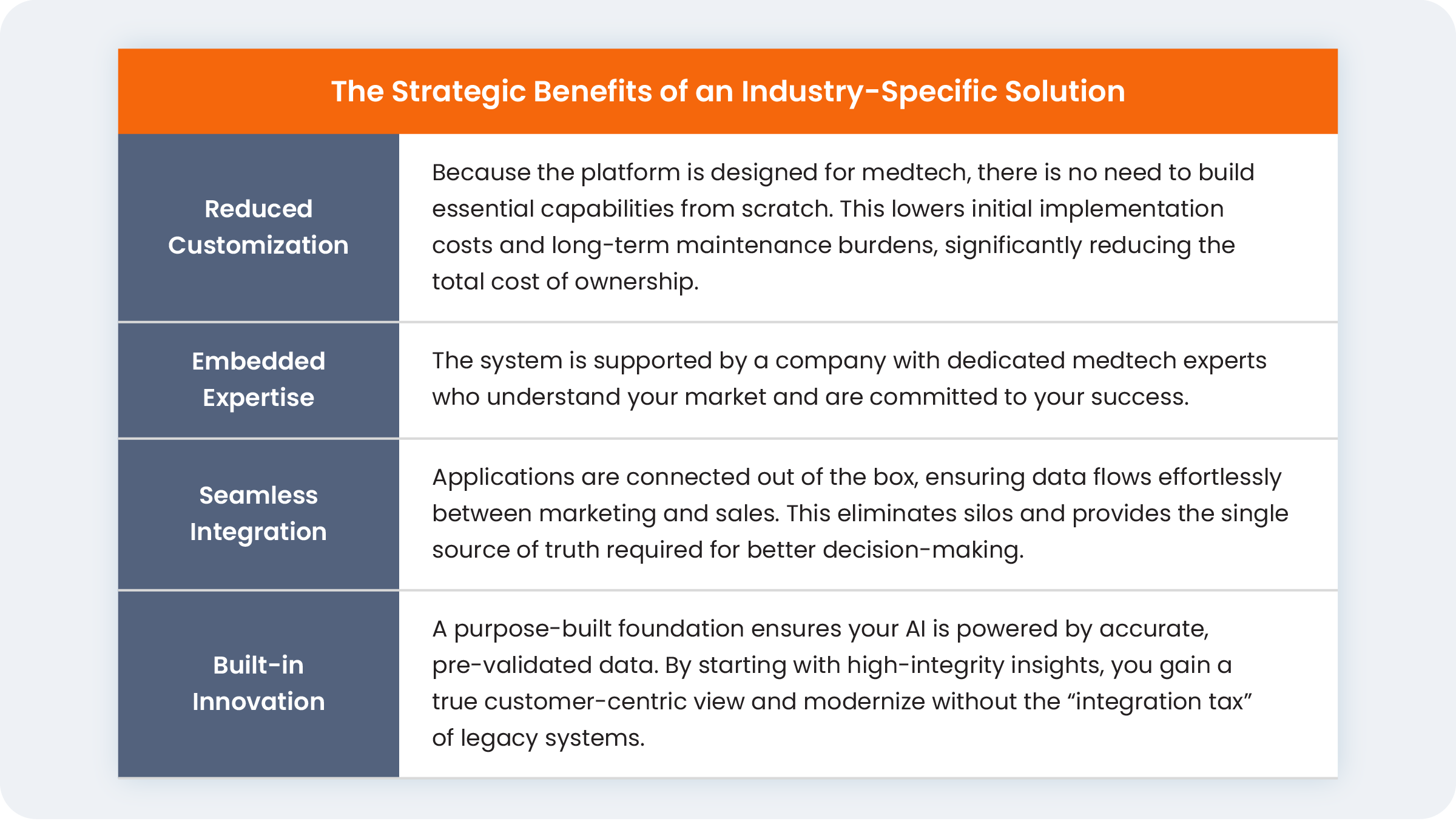
Choosing Growth Over Complexity
Transitioning away from legacy systems isn’t just about upgrading software; it is about reclaiming the agility to compete and the capacity to scale without increasing overhead. Today, leaders have a unique opportunity to move beyond tools that simply record activity to platforms that actively drive business outcomes.
As the pace of innovation accelerates—fueled by practical, embedded AI—the ability to implement quickly and execute efficiently becomes a competitive necessity. Organizations that shift away from fragmented databases toward an Agentic Commercial model will find themselves at the center of the customer journey, while those tied to passive archives risk falling behind.
Ultimately, a modern commercial ecosystem allows your teams to stop spending time managing software and to start focusing on their actual work. By connecting data with day-to-day actions, you can build the kind of customer-centric approach that leads to better patient care and more predictable business results.
To future-proof your commercial operations and unlock your team’s full potential, it is time to prioritize a platform that:
- Is Purpose-Built for Life Sciences: Eliminates the need for costly, perpetual customization by natively understanding your regulatory and clinical environment.
- Unifies Your Entire Organization: Breaks down silos between sales, medical, and marketing to provide a 360-degree view of the customer.
- Generates Commercial Evidence: Leverages practical AI (like Agentic Voice and Agentic Call Reports) to transform daily field notes into actionable intelligence that clears obstacles to care.
Learn how an Agentic Commercial platform can close the insight gap and turn real-world field intelligence into a strategic growth engine.