Johnson & Johnson AI Business Case and Impact
"When we saw Vault AI, it was by far better than any other technology we'd seen. That made us feel much more comfortable moving forward and investing in Vault AI for our business."
As AI adoption accelerates across the medtech industry, organizations are exploring how it can help strengthen compliance, drive speed to market, and increase productivity of promotional review. Success, however, depends on more than technology alone. To drive true ROI, companies must first establish clear KPIs and optimize their underlying data, processes, and governance structures.
A prime example is Johnson & Johnson, which implemented Vault AI in PromoMats – including Quick Check Agent for pre-review document quality checks, and Content Agent for context-aware document insights. These AI capabilities helped harmonize their global processes, improve content quality, and transform their promotional review platform into a strategic engine. At the Veeva MedTech Summit, Stephanie Carter, associate director of promotional integrity at Johnson & Johnson, shared practical strategies for building an AI business case, measuring impact, and preparing organizations for AI adoption.
Measuring the value of AI
Before implementing Vault AI in PromoMats, Johnson & Johnson built a rigorous business case to prove the investment would deliver clear, quantifiable value. Carter explained that because AI ROI can initially seem unclear, securing alignment required moving past theoretical benefits and presenting a compelling case tied to top operational priorities of the business.
To build the business case, Carter partnered with Kelly McQuillan, global director of content, to organize the projected value of AI into a “3E Value Framework”:
- Efficiency: Reducing manual effort and saving reviewer and coordinator labor hours
- Effectiveness: Improving first-pass quality, reducing review time, and accelerating speed to market
- Experience: Improving employee satisfaction and supporting reviewer and coordinator retention
Together, these provide a framework for evaluating financial and operational impact while recognizing that not every benefit can be captured through traditional ROI calculations.
To translate this high-level framework into concrete figures, Carter highlighted three operational areas to model and measure AI value:
- Reduced MLR review time: Carter encourages using conservative assumptions when estimating potential AI impact. For example, modeling a conservative 10% reduction in MLR review time can help quantify substantial reviewer labor savings. Spending less time reviewing assets can free reviewers for high-value strategic work.
- Increased first-pass quality rates: Assuming a 25% increase in assets successfully clearing the initial QC check directly reduces the administrative hours coordinators spend managing rejected materials.
- Accelerated Speed to Market: Faster approvals create measurable financial value by getting campaigns and new product launch materials to customers sooner. Applying that same 10% efficiency gain to a typical 30-day approval cycle cuts three calendar days off the timeline, allowing the business to capture incremental daily revenue faster.
Together, these projected labor savings, operational efficiencies, and revenue gains formed the estimated business benefits used in Johnson & Johnson’s business case. By balancing these projected benefits against total investment costs—including software configuration, user training, and annual usage—the team calculated a clear net return on investment to leadership.
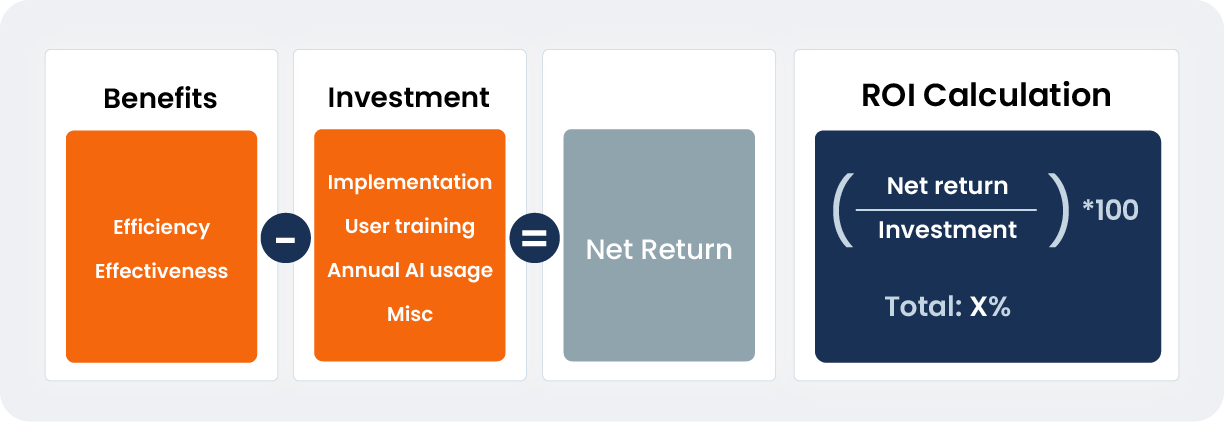
The scale of the discovery caught the team by surprise, “We were shocked because we did go for a global business case and ours is in the millions,” Carter noted. While results will vary by organization, the exercise demonstrated that even conservative assumptions can reveal significant business value at scale.
Ultimately, Carter emphasized that financial metrics are only one part of the equation. Consistent with the 3E Value Framework listed above, the full value of AI includes substantial improvements in employee satisfaction, reviewer experience, and overall productivity.
Preparing for AI Adoption
Building a business case is only one part of the process. Medtech companies should also assess whether their data, processes, and governance structures are in place to support AI initiatives.
Carter emphasized that successful AI adoption starts with a strong operational foundation. Structured claims data and accurate metadata help AI generate more precise, reliable outputs, while clearly defined KPIs enable organizations to measure success over time. She also highlighted the importance of establishing governance early and aligning legal, privacy, regulatory, and IT stakeholders to build trust, ensure appropriate oversight, and support long-term adoption.
Organizations should also consider how they will monitor AI usage, gather user feedback, and maintain appropriate human oversight as AI capabilities continue to evolve.
Future of AI
AI has the potential to transform how commercial and medical teams create, review, and manage content. As Johnson & Johnson’s experience demonstrates, realizing this potential requires more than just deploying new technology. True operational excellence depends on building a data-backed business case, establishing the right structural foundation, and preparing teams to adopt AI with confidence.
Medtech companies that prepare today will be well positioned to drive speed to market, improve efficiency across the content lifecycle, and realize greater value as new AI capabilities continue to emerge.
Learn more about Vault AI in PromoMats and how to improve content quality, streamline review processes, and increase reviewer productivity.