Rethink the Model for Publications Management in Medtech
Publications are the currency of every medtech's scientific credibility, built on a foundation of peer-reviewed, validated literature. They transform data into actionable evidence that defines how clinical innovations are introduced, understood, and trusted.
In life sciences, scientific credibility is your organization’s greatest asset.
Despite the key role publications play in bridging research and clinical application, challenges with their end-to-end management can limit impact. Processes are complex and fragmented while data is scattered across disconnected systems. These breakdowns risk disrupting the flow of scientific evidence — slowing translation to clinical practice and impacting patient care. This creates an opportunity to rethink the publications model:
unify processes, data, and intelligence to ensure that scientific evidence flows efficiently from innovation to intervention.
Publications: From tactical output to strategic driver of scientific exchange
As the function of medical affairs evolves from executional to strategic, so does the role of publications. While a fundamental activity, publishing now plays an integral, deliberate role in overarching medical strategy. No longer isolated or execution focused, publications are a strategic engine for evidence-
based scientific exchange that can make-or-break market access and clinical adoption.
With this elevated role comes an uncompromising standard. Every publication must be:
- Scientifically sound: Peer-reviewed and evaluated for scientific merit, validity, and originality
- Clinically relevant: Data presented in the right context, tailored to the right audience
- Responsibly and ethically published: In alignment with Good Publication Practices (GPP) and the International Committee of Medical Journal Editors (ICMJE) guidelines
The standards of a publication are clear, but the path to delivery is rarely straightforward. End-to-end management of a publication requires navigating intricate processes across multiple stakeholders and shifting timelines. Clinical specialties can introduce variability, influencing the volume, complexity, and delivery of a publication. For instance, companies in areas such as robotic surgery, cardiovascular devices, or oncology face added pressure to meet market demands and respond to clinicians’ growing need for deep scientific information.
Despite these nuances, there are similar processes across publications regardless of clinical domain and company size. The typical end-to-end workflow for managing a publication is as follows:
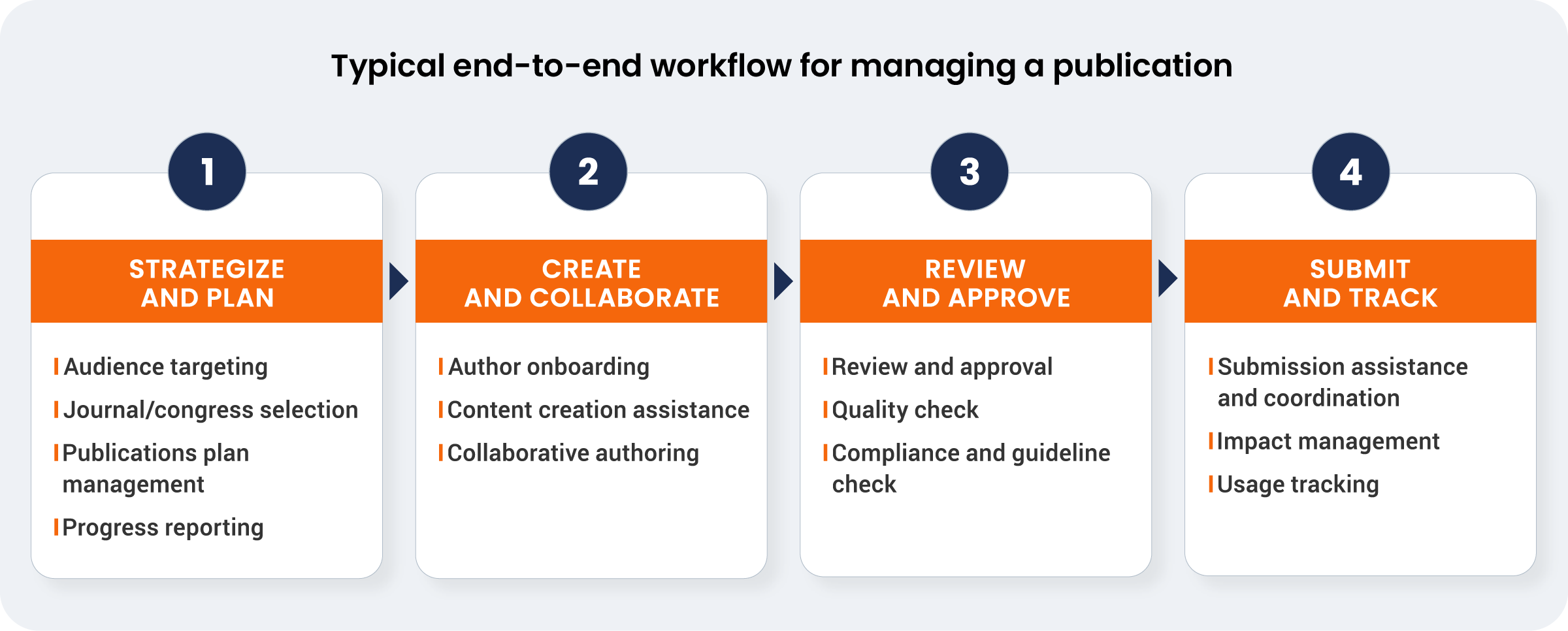
Today’s end-to-end publications journey
How your organization manages the end-to-end publications journey can be the difference between science shaping clinical practice or getting lost in the noise. When planned strategically and executed efficiently, publications accelerate the path from evidence generation to clinical adoption. But publications management is a complex puzzle of people, process, and technology. The role of technology should be to empower those people and processes. Instead, limitations of existing solutions often do the opposite, reinforcing inefficiencies that delay clinical evidence from reaching the providers and patients who need it most.
Common challenges with existing solutions:
- Fragmented workflows: Publications span dozens of contributors across functions, geographies, and external partners. Without a single platform, teams piece together drafts, timelines, and submissions across disconnected tools. Duplication of effort and disorganized version control slow the delivery of clinical evidence that is vital for both market access and regulatory compliance.
- Poor external author experience: Contributing to a publication should be a seamless experience for external authors. Requiring busy surgeons, clinicians, and researchers to navigate complex systems and manage publication-specific logins delays contributions and adds administrative burden. In an effort to support external authors, publication managers often consolidate contributions from multiple authors and disconnected sources, increasing their workload and the potential for errors.
- Inflexible systems: Unintuitive systems are too rigid to adapt to your evolving plans or processes. Instead of streamlining processes, they create frustration and force teams to rely on costly customizations or inefficient workarounds. Users default back to spreadsheets and email — the tools that this technology was intended to replace.
- Out-of-reach analytics: Publications data is out there, just not where your teams need it. Data is dispersed across external vendors and gathering metrics on readership and impact requires visiting individual journal and congress websites. Without intelligence embedded into workflows, analytics are out of view when they matter most.
- Isolation from the broader medical affairs ecosystem: Findings from published evidence rarely flow seamlessly into Clinical Evaluation Reports (CER), briefings, medical information systems, or technical training materials. This integration disconnect breaks the continuity of scientific exchange, limiting how quickly and effectively evidence translates into better patient care.
Capabilities that define modern publications management
Modern publications management requires a single, connected environment that is intuitive and easily accessible for all users. By leveraging technology and automation to handle manual, repetitive tasks, teams can focus on strategy to shape the scientific narrative and drive meaningful impact. When evaluating publication management solutions, consider the following capabilities:
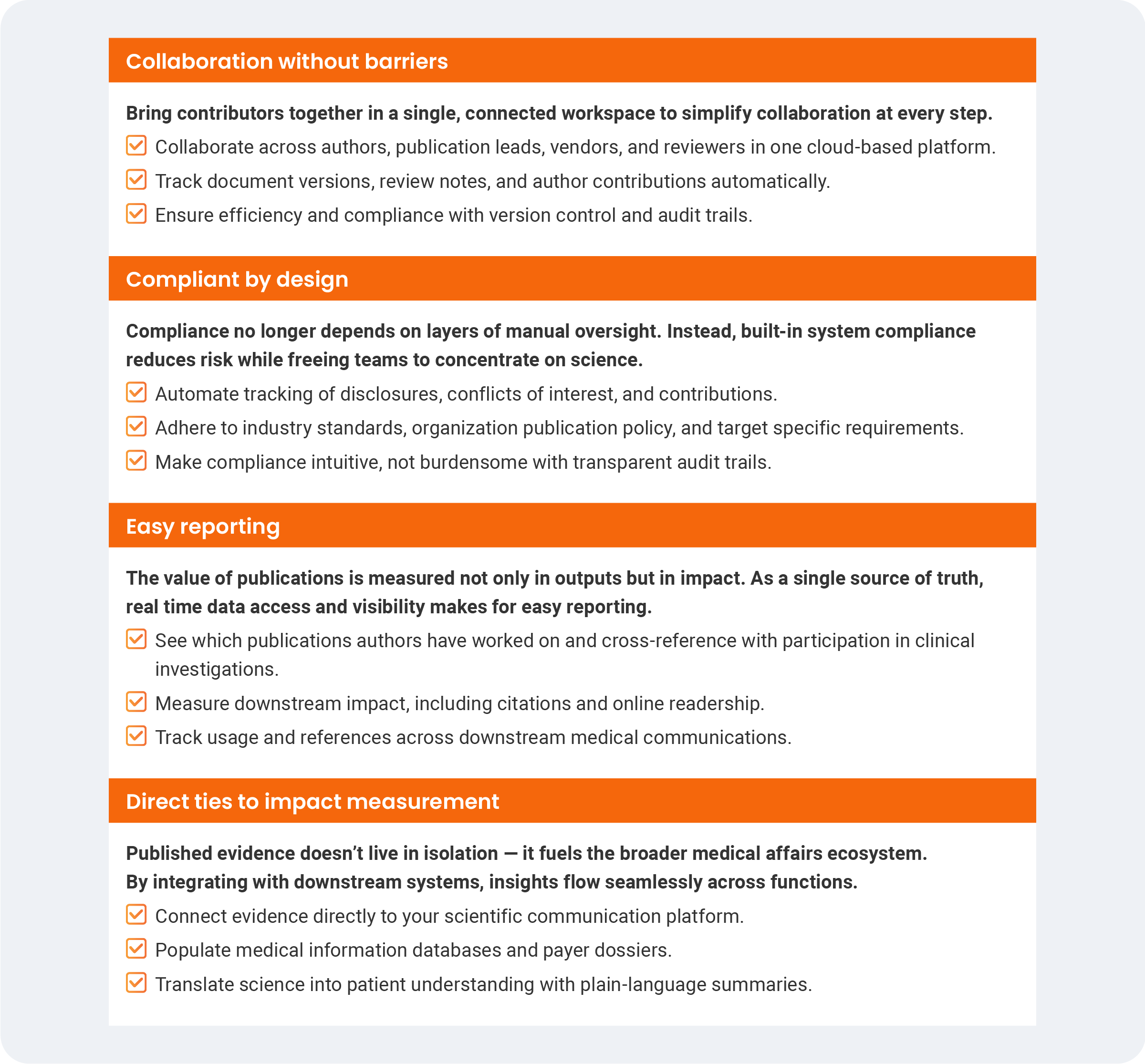
A new path forward with Veeva Publications
Veeva is leaning into the complexity of scientific publishing to simplify and standardize it, transforming how medical affairs teams operate in this space. Veeva Publications — joining Vault Medical alongside Medcomms and MedInquiry — is an application used to plan, author, collaborate, approve and submit scientific literature to medical journals and congresses. It supports the end-to-end publication process from audience selection and manuscript drafting through submission, and helps teams ensure compliance with
submission requirements and industry regulations.
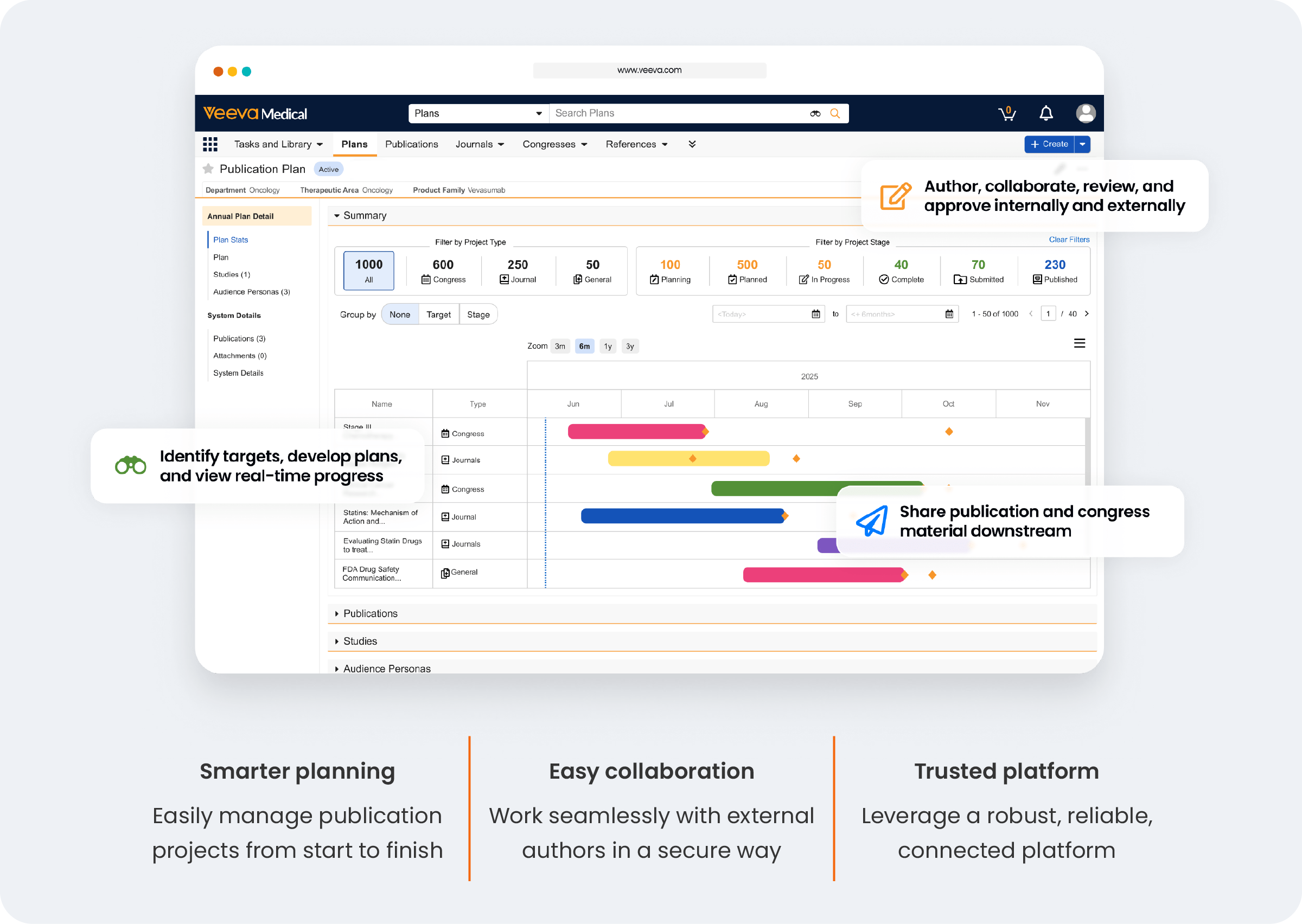
Dedicated innovation for publications teams
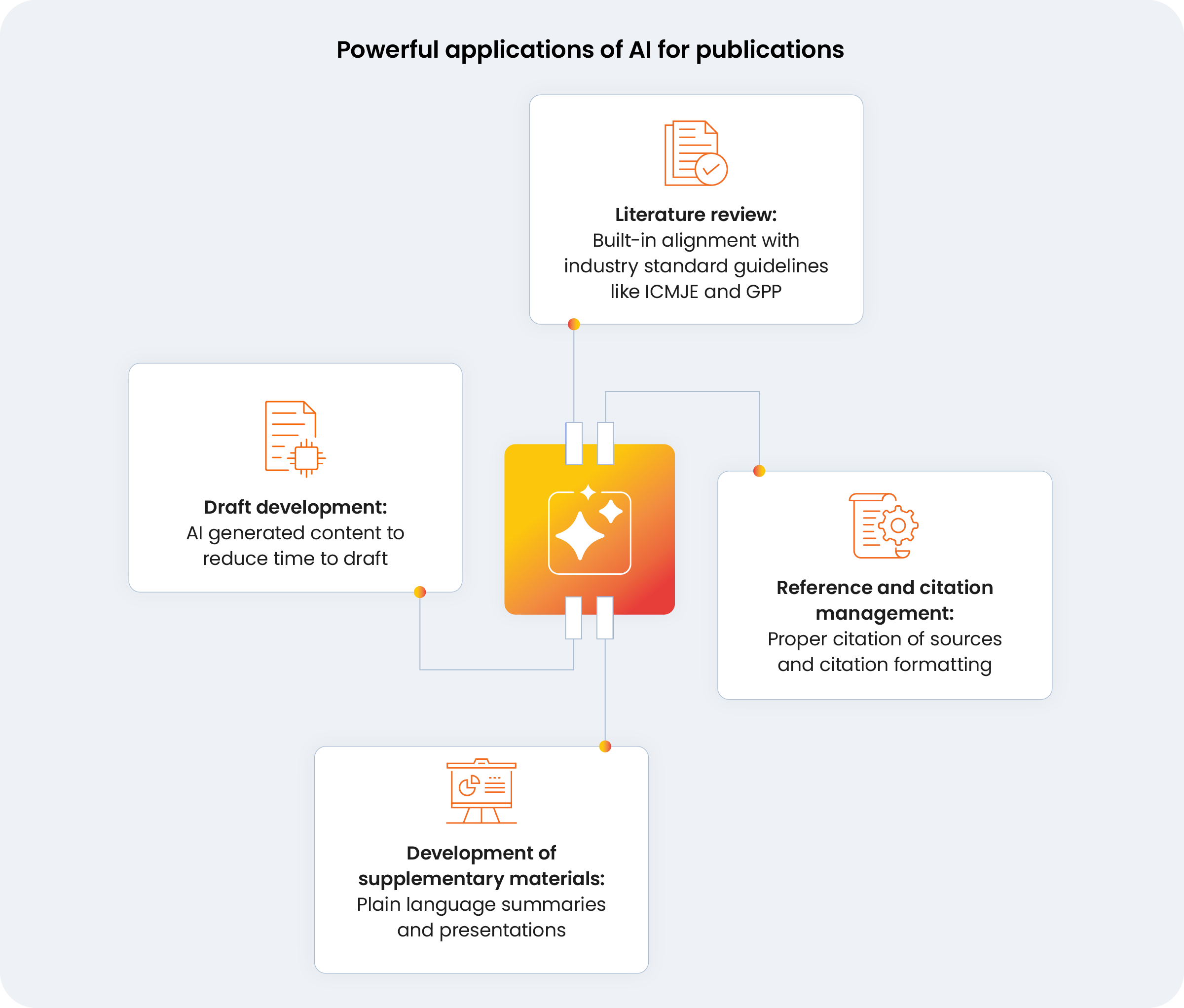
Intelligent: Publications teams can plan, execute, and analyze with new levels of precision. AI-driven recommendations identify publication gaps, flag compliance risks early, and surface opportunities to accelerate review cycles.
Connected: Connectivity isn’t optional — it’s a strategic imperative. Veeva Publications, living together with other Vault Medical applications, ensures that scientific evidence remains accurate and consistent as it moves across the broader medical affairs ecosystem.
- Published evidence flows without friction to material used in activities downstream.
- The same validated data underpins every message and every channel.
- Eliminate redundancy and accelerate the path from innovation to clinical adoption.
Outcome-driven: Embedding publications into the broader medical affairs ecosystem creates a critical feedback loop between evidence generation and scientific exchange. Measure what evidence was published, in which context published evidence was used, and ultimately how it impacted understanding, adoption, and patient outcomes.
In fast-moving clinical specialties, minor delays can alter competitive positioning and delay access to care. Veeva’s unified publications model ensures every insight, every data point, and every publication contributes to measurable scientific and medical impact.
Learn about Veeva’s connected, end-to-end solutions for medical affairs.