The Medtech CRM Decision: Key Advantages of a Purpose-Built Solution
Medtech leaders trust Veeva as a proven partner, delivering a purpose-built application and industry-advancing AI. Learn how key advantages of Vault CRM position your medtech organization for long-term success.
The CRM you select impacts your organization’s ability to deliver transformative therapies to patients in need — and patients can’t wait. When every moment counts, it’s critical to get technology decisions right the first time. That’s why more than 100 companies have implemented Veeva Vault CRM, a purpose-built application for life sciences.
These organizations all chose industry-advancing AI, a unified platform, and a proven life sciences partner. As a result, they’ll keep focus on what matters most: accelerating innovation, connecting complex teams and data, and achieving customer centricity — ultimately improving patient care.
A singular solution like this drives smarter account planning and execution, enables seamless coordination between the field and marketing, and unlocks efficiencies to supercharge revenue growth. A purpose-built CRM solution shores up gaps and ties together activities across sales, medical, and marketing teams, allowing for simple exchange of compliant content and critical data.
To achieve similar outcomes and position your organization for long-term success, consider the following differentiators of Vault CRM.
Proven partner, unmatched industry focus
In life sciences, CRM is used to enforce business rules related to commercial models, regulatory compliance, and general regulations. When implemented well, it enables agility, innovation, and differentiation. It’s a common misconception that any CRM can deliver these outcomes. The reality is that success depends as much on the right long-term partner as on the technology itself.
Veeva is a proven partner to life sciences committed to your success and the success of the medtech industry. Veeva uniquely understands the business and its singular regulatory and compliance needs. By delivering innovation with The Next Generation CRM Suite, Veeva helps move the industry forward with greater efficiency.
Purpose-built applications reflect an unmatched focus on life sciences and address the unique challenges and opportunities facing the industry. The platform understands your world so there is less of a need to start from scratch. This reduces initial implementation costs and long-term maintenance burdens, ultimately lowering the total cost of ownership.
Moreover, the suite of applications is connected out-of-the-box, ensuring that data flows effortlessly between sales, marketing, medical, and other teams. This eliminates data silos and provides a single source of truth, enabling better decision-making.
As medtech modernizes and accelerates revenue growth through strategic technology investments, leaders should consider how their CRM solution supports this trajectory. The system is built to support your market by a company with dedicated experts in the medtech space, ready to drive your success.
Purpose-built for life sciences
The hidden cost of custom projects
Adopting a next-generation CRM solution built for life sciences avoids unnecessary risk, complex customizations, and costly technology rebuilds when business priorities shift. In contrast, adapting a horizontal CRM to the needs of life sciences is largely a custom project. This approach pulls investment away from critical areas such as orchestration, digital engagement, and new field operating models.
Your organization risks spending limited resources recreating essential life sciences capabilities that already exist in a purpose-built platform. An expensive, time-consuming, difficult-to-enable project is almost certain and leaves little room for innovation.
At its core, a horizontal CRM adapted for life sciences relies on legacy architecture and layers of complex integrations. It requires continually rebuilding the system’s core and keeping up with disruptive product changes.
Comparing Vault CRM to a horizontal CRM adapted for life sciences
| Feature | Veeva Vault CRM | Horizontal CRM |
|---|---|---|
| Product architecture | Modern CRM architecture with one unified platform, database, and customer record | Difficult-to-enable legacy CRM architecture with layers of complex integrations |
| Life sciences capabilities | Next-generation capabilities built specifically for the needs of life sciences | Adapted from a horizontal platform, demands significant resources to recreate essential life sciences features |
| Track record | Proven, trusted leader in life sciences, listens to the needs of all customers, 100+ customers live today | Inconsistent support of life sciences industry, no customers live today |
| Future commitment | Focused exclusively on life sciences, ensuring continued support and innovation | Supports many unrelated industries, risk of deprioritizing life sciences |
Evaluating a horizontal CRM adapted for life sciences?
Four questions to ask and how Vault CRM compares:
1. Are leaders in life sciences successfully using this CRM today?
Vault CRM: Has 100+ customers live.
2. Am I spending time and resources recreating essential capabilities already available in a life-sciences CRM?
Vault CRM: Core capabilities are built for the needs of life sciences companies.
3. What happens if the vendor deprioritizes the life sciences sector; will my investment be at risk?
Vault CRM: Veeva has exclusively focused on and invested in life sciences-specific technology for nearly two decades.
4. Does my voice matter regardless of my organization’s size, and to what extent will my feedback be valued and incorporated?
Vault CRM: Veeva listens to customers and values feedback, regardless of company size.
Purpose-built CRM for life sciences
The depth of Vault CRM spans 15 years, includes 1,500+ features across data models, business rules, and compliance.
Account Management
- Account Plans
- Stakeholder Navigator
- Account Hierarchies
- Affiliations
- Account Spending Limits
- Data Change Requests
- Dynamic Attributes
- Product Metrics
HCP Engagement
- Engagement Planning
- Call Reporting
- Call Detailing
- Call Objectives
- Customer Journeys
- Integrated Field Campaigns
- Patient Journeys
- HCP Timeline
- Suggestions
- Outlook Calendar Integration
- Consent
- Free Text Monitoring
- Call Metrics
- Field Coaching
- Surveys
Medical
- KOL Profiling
- Medical Insights
- Scientific Content Sharing
- Medical Inquiries
- CLM
Channels
- Rep Email
- Recommended Email
- Events
- Video
- Chat
- Microsoft Teams
- Zoom
- Remote Sharing
Events Management
- Event Lifecycle
- Page Layout Engine
- Event Materials
- Speaker Contracts
- Attendee Reconciliation
- Digital and QR Sign In
- Budgets and Expenses
- Business Rules
- Approval Workflows
- Event Templates
Sampling
- Sample Inventory
- Sample Audits
- Sample Limits
- State License Validation
- Sample Opt-In
- Sample Signature Capture
- Sample Orders
- Sample BRCs
- Barcode Scanning
- Cold Chain Sampling
- Ohio TDDD
Territory Management
- Roster Management
- Structure & Alignment
- Targeting Rules
- Omnichannel Cycle Plans
- Integrated Territory Feedback
Platforms & Setup
- Windows / Mac / iPad / iPhone / Browser
- Synchronization
- Product Catalog & Alignment
- Content Alignment
Standard Integrations
- Concur, Knipper, ZS, Workday
- PromoMats, MedComms, OpenData
- Link, Nitro, Network, CTMS
Built-in compliance over outsourced integrations
Complex industry regulations continually evolve across markets, requiring your organization to be responsive and agile to avoid risk. When evaluating a CRM, opt for a solution that simplifies your compliance journey. The platform you choose should meet today’s regulatory requirements and prepare your organization for the future.
Navigating compliance requirements can be resource-intensive. Without the right partner or tools in place, your organization spends more time managing compliance than driving strategic initiatives.
A horizontal CRM adapted for life sciences lacks built-in support for industry-specific compliance. You’re forced to bolt on additional integrations and manage another project — introducing further complexity, cost, and risk.
Five compliance must-haves in a life sciences CRM:
1. Provides built-in compliance features that evolve and adapt with the regulatory landscape.
2. Fosters collaboration between IT, operations, and compliance teams.
3. Flexes to support your organization’s unique compliance needs.
4. Supports region-specific business requirements and regulatory needs.
5. Enables organizations to interact and communicate with HCPs compliantly.
Vault CRM Compliance Checklist
Includes hundreds of built-in compliance features: Compliant at its core, Vault CRM stays up-to-date with evolving regulatory and compliance needs.
Built for complex field teams: Field teams stay compliant with features that flag words or phrases violating regulations in text input fields and proactively block prohibited terms from being sent to an HCP via chat.
Delivers critical local capabilities: Supports all critical region-specific capabilities and regulatory needs from Brazil to Japan, Germany, and beyond.
Enables full offline support: Data, configuration, and content are seamlessly synchronized across mobile devices, giving your field force instant access to the information they need online and offline.
Customer centricity realized
Connected commercial teams improve outcomes
Delivering coordinated scientific information and connected experiences deepens stakeholder relationships, mitigates access challenges, and improves treatment adoption. But many life sciences organizations aren’t consistently delivering a connected experience. A single source of truth — all customer data, content, and interactions residing in one place — supports connected engagement by eliminating data silos and providing a 360 view of customer relationships. Unify your commercial teams with Vault CRM: one platform, one database, and one view of the customer to drive collaboration, customer centricity, and a more effective field.
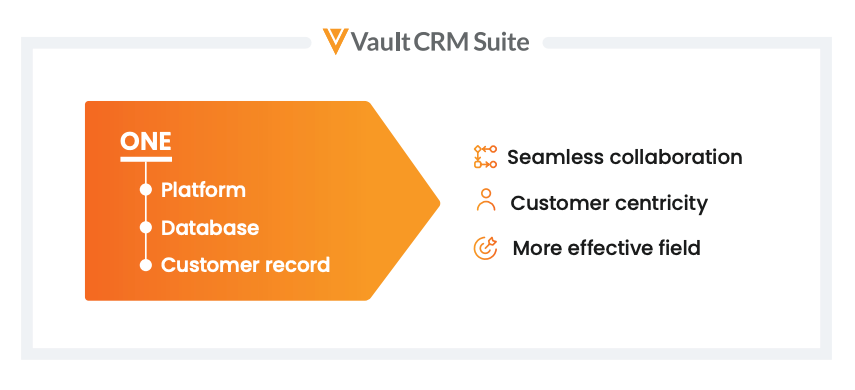
Unified ecosystem enabled by modern CRM architecture
Connected teams powered by unified data and technology help customers progress through their journeys faster and more efficiently. A truly unified ecosystem allows seamless data flow and collaboration across sales, marketing, medical, market access, and clinical teams, while laying the foundation for future innovation. This unified approach challenges the constraints of old engagement models and legacy CRM architecture.
For years, ‘best-of-breed’ technology stacks promised flexibility by combining different vendors and platforms. In reality, this approach often creates complex integrations and limited agility.
Modern CRM architecture and the limitations of legacy CRM architecture
| Vault CRM: Modern CRM Architecture | Legacy CRM Architecture |
|---|---|
| ✔ One unified platform | ✖ Stitches together disparate tools and data |
| ✔ Simplified architecture with minimal integrations | ✖ Heavy reliance on complex integrations |
| ✔ Built for life sciences | ✖ Function-specific, not industry-specialized |
| ✔ One database, data instantly available | ✖ Data moves between multiple databases and systems |
| ✔ Agile, easily enabled | ✖ Limited elasticity, high effort to enable |
| ✔ Lower risk, fewer moving parts | ✖ Higher risk, multiple points of failure |
Industry-advancing AI at the core
Next-generation engagement and decision-making enhanced by AI
Commercial models in life sciences are changing and this will continue to accelerate over the next 10 years. Companies that embrace AI-driven engagement and decision-making will gain a clear competitive advantage. To stay ahead, your AI capabilities must evolve in step with the industry. Through industry-specific enhancements, such as specialized features for life sciences workflows or advanced analytics for medical affairs, purpose-built AI can support your progress.
With Veeva AI, agents are built into the core of the Vault platform, on the same level as the foundational components of data and content. Because of this unique architecture, these agents have direct, secure access to data and content. With innovation focused on life sciences, Veeva can accelerate the development of industry-specific AI features to stay ahead of the industry’s changing needs.
Value delivered from industry-specific AI agents
| Agent | Use Case | Value Delivered |
|---|---|---|
| Pre-call Agent | Individualized customer context, opportunities, and suggested actions for better engagement | More productive field teams and improved customer experience |
| Media Agent | Semantic search to locate, summarize, and launch content in content library for quick access to relevant information | Faster content search and increased content use, which research shows leads to greater impact |
| Free Text Agent | Real-time analysis of free-text capture for compliance based on customer-specific guidelines defined in natural language | Free text unlocked, allowing compliant capture of rich insights from field teams |
| Voice Agent | Natural language voice as the main input of information into CRM business processes | Saves time and effort when transcribing notes; field teams capture and act quickly on valuable insights |
Built-in Agility: The Power to Move as Fast as Your Market
Adopt and innovate without disruption
Rather than constantly attending to your CRM, your organization’s energy is better spent innovating to drive outstanding customer experiences. With Vault CRM, you don’t need a large, disruptive custom solution to prepare you for the future. It is the only solution that enables the following:
- Innovation built in: If the goal is to advance your organization and the industry, Veeva delivers the deepest application, the fastest path to AI, and a true customer-centric view.
- Targeted adoption: You can scale step by step, incrementally integrating new innovation and additional products as needed.
- Life sciences leadership: Veeva’s innovation pipeline is dedicated to life sciences and built with unmatched depth and focus.