
Accelerating Market Release through Connected Quality and Jurisdictional Control
Oct 22, 2026 | angela.maffei@veeva.com
Oct 22, 2026 | Ryan Bliss and Nabeel Umar
Accelerating the release of a batch by even one day means an organization can avoid non-trivial costs. Applied across a whole product portfolio, and it could drive meaningful financial value for the entire enterprise from improved working capital to lower safety stock levels.
As products move through the supply chain, organizations must continuously assess how regulatory changes affect market eligibility. Determining whether a batch can be released to a specific market often requires information from regulatory, quality, manufacturing, and supply chain. Yet that information typically resides in multiple systems, requiring manual coordination and disconnected decision-making. As a result, batches that are already eligible for release might remain on the shelf while teams reconcile information, adding unnecessary inventory carrying costs and delaying revenue recognition.
Leading organizations are moving toward a future where regulatory, quality, and supply chain decisions are connected through a single, end-to-end process. From identifying a material change to assessing regulatory impact and determining market eligibility, each decision is informed by the latest data and seamlessly shared across functions. Jurisdictional Control, a new capability in Veeva Batch Release, represents an important step toward that future.
However, technology alone is not enough. Realizing the full value of Jurisdictional Control requires a connected quality ecosystem built on aligned data and standardized business processes.
Connected quality starts with aligned product data
The starting point for connected quality is shared cross-functional understanding of products and markets. Product hierarchies — which define product families, dosage forms, and strengths — need to be represented consistently across systems.
For many organizations, this is easier said than done. Quality and regulatory often represent the same product differently, requiring users to manually determine which records correspond to one another. While already a major source of friction in disconnected processes, these inconsistencies become a critical barrier when information needs to flow automatically between systems.
For example, when a change control is initiated against a product in Veeva QMS, the corresponding regulatory market assessment could appear against a different representation of that same product in Veeva Registrations. The two systems must refer to the same product hierarchy for the impact of that change to be assessed accurately and ultimately evaluated by Jurisdictional Control.
The Veeva Quality-RIM Connection establishes this foundation. Once product data is synchronized between Registrations and QMS, Registrations can serve as the authoritative source for product information. With product data aligned, organizations can automate the flow of regulatory and quality information, reduce manual interpretation, and create the trusted data foundation required for a connected quality ecosystem.
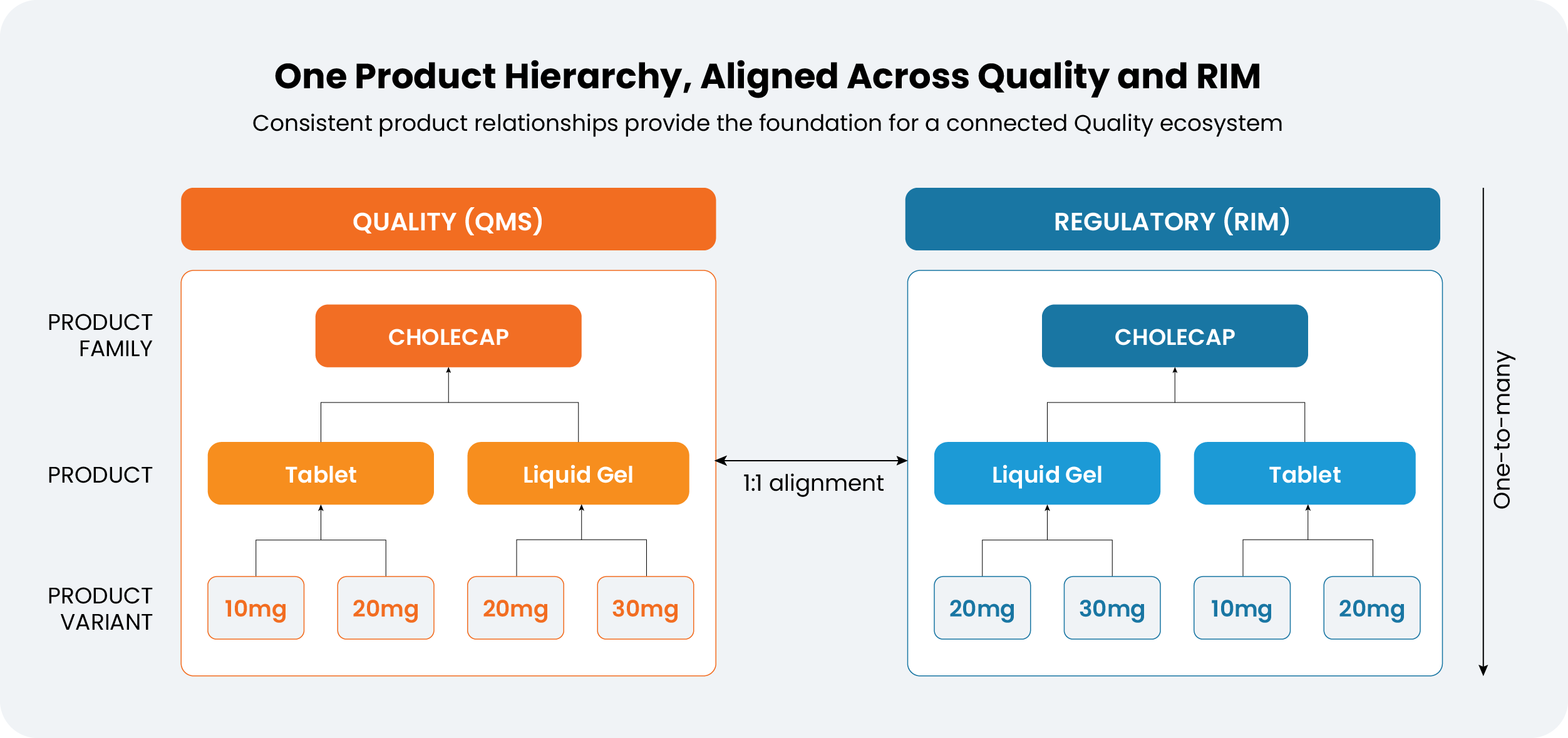
Figure 1: Illustrative example of aligned product data hierarchies in QMS and RIM
Connect business processes first, then systems
Aligning product data is only part of the equation. Quality and regulatory must also share a common business process for evaluating, implementing, and tracking changes that impact marketed products.
Change controls and regulatory market assessments are often disconnected. That’s because quality and regulatory teams have distinct responsibilities: Quality is focused on managing change and releasing product, while regulatory is responsible for securing and maintaining market approvals. These different objectives can make cross-functional coordination challenging, particularly when the underlying processes and systems are not designed to fit together. Once a quality change is initiated, regulatory may first hear about it through notifications requesting assessment of market impacts and whether filings are required. Progress is then tracked outside the system, making it difficult for quality to understand the current regulatory status of a change or determine when implementation activities are complete.
A connected Quality-RIM process creates a common workflow around these distinct responsibilities, replacing manual handoffs with structured cross-functional coordination. When a change control is initiated, impacted products are automatically identified via material selection, regulatory assessments are managed within the connected process, and market approval status is continuously shared with quality. Once implementation is complete, Jurisdictional Control extends this connected process into Veeva Batch Release by automatically evaluating the regulatory status of each market before a batch is released. Rather than relying on manual verification, disposition owners gain real-time visibility into market eligibility, enabling faster, more informed release decisions while maintaining compliance.
Realizing the value of jurisdictional control
For many life sciences organizations, preventing batches from being shipped to restricted markets requires a series of manual controls. Quality, regulatory, and supply chain spend valuable time performing manual checks throughout the process, reconciling market approval status across disconnected systems, creating temporary workarounds, and more. The effort to maintain these activities becomes unsustainable as volume increases.
Jurisdictional Control replaces these non-value-added activities with automated market eligibility checks, giving cross-functional teams confidence that only compliant batches will be released to approved markets. Aligning product data and harmonizing business processes between quality and regulatory are the foundational steps toward realizing the vision of a connected quality ecosystem, and unlocking the full value of Jurisdictional Control.
Turning vision into reality
For organizations with complex product portfolios and global markets, building a connected quality ecosystem can feel like a significant undertaking. But you don’t have to solve every challenge at once.
Veeva Business Consulting partners with organizations to assess readiness, prioritize the highest value opportunities, and develop practical roadmaps for aligning product data, standardizing business processes, and maximizing the value of connected Veeva applications.
To learn more, visit veeva.com/eu/businessconsulting or contact us at veevabusinessconsulting@veeva.com.
Authors
Ryan BlissSenior Business Consultant, Quality
Ryan.Bliss@veeva.com Nabeel Umar
Senior Business Consultant, Quality
Nabeel.Umar@veeva.com