
Veeva RTSM Resupply
Read this features brief to understand Veeva RTSM’s innovative and holistic resupply approach.
Balancing Supply and Demand: Veeva RTSM Resupply Optimization
Drug wastage is a critical challenge in clinical trial management. Particularly in specialized therapeutic areas like oncology, where cell therapies, biologics, and targeted small molecules command exceptionally high manufacturing costs, drug waste can quickly jeopardize a trial's budget. At the same time, clinical supply managers operate within a difficult forecasting dichotomy: they must ship enough inventory to ensure that a site never misses a patient dose, yet strictly limit quantities to prevent expensive, short-expiry IMP from sitting unused on a shelf.
Striking this balance requires moving away from the rigid, site-wide configurations of traditional RTSM systems, which can lead to over-dispensing, unnecessary waste, or premature drug expiration at clinical sites.
Through an innovative and holistic resupply approach, Veeva RTSM optimizes inventory management, removing the need for lengthy custom updates mid study and enabling users to quickly update settings through the user interface. Thereby ensuring the right drug gets to the right patient at the right time, whilst reducing drug wastage.
Centralized & Configurable Resupply Features
Resupply Strategy Management
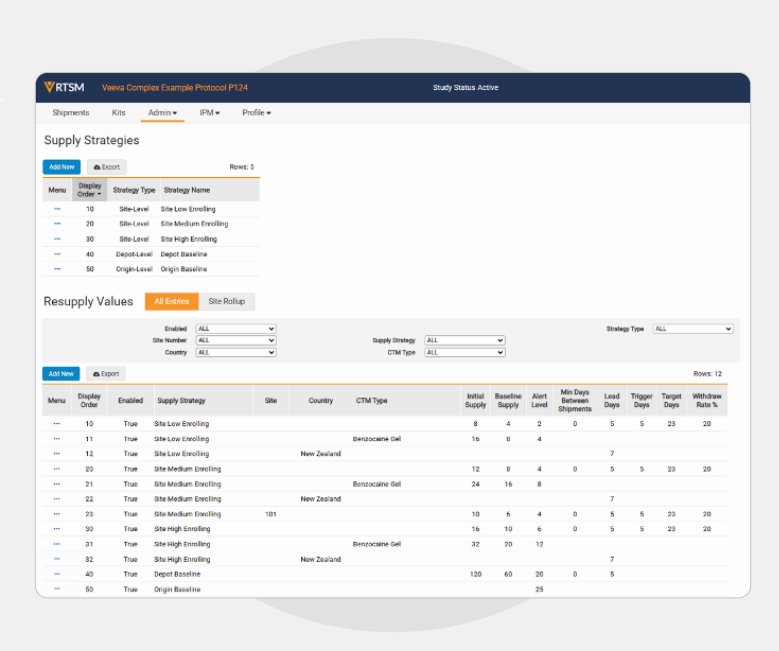
Users can manage site and depot-level strategies from a single dashboard and configure parameters based on location tier:
-
Origin Level: For manufacturing depots where supply originates in the system.
-
Depot Level: For secondary depots whose supply is sourced from a manufacturing depot.
-
Site Level: For clinical sites being sourced by these depots.
Strategies can be added or updated at any stage of the trial through the user interface by authorized endusers, ensuring flexibility after the initial study go-live.
See the resupply strategy management in action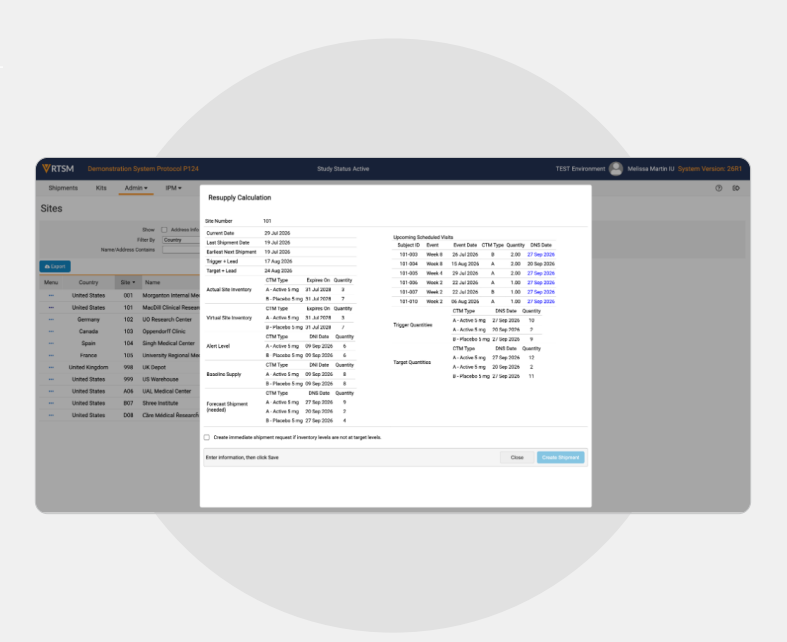
Predictive Resupply Calculations
Veeva RTSM runs resupply calculations nightly, using a combination of Lead Days, Trigger Days, and Target Days to evaluate real-time patient demand against actual site inventory.
-
Automated Order Generation: The system compares predicted demand with current quantities to automatically generate optimal shipment orders.
-
Shelf-Life Maximization: The system calculates requirements against available batches, matching upcoming demand with the earliest expiring batches that satisfy DNx parameters to maximize shelf-life utility.
-
Traceability: All historical calculations are stored in the UI allowing inventory users and supply chain planners to audit historical logic at any time.
Flexible Resupply Buffers
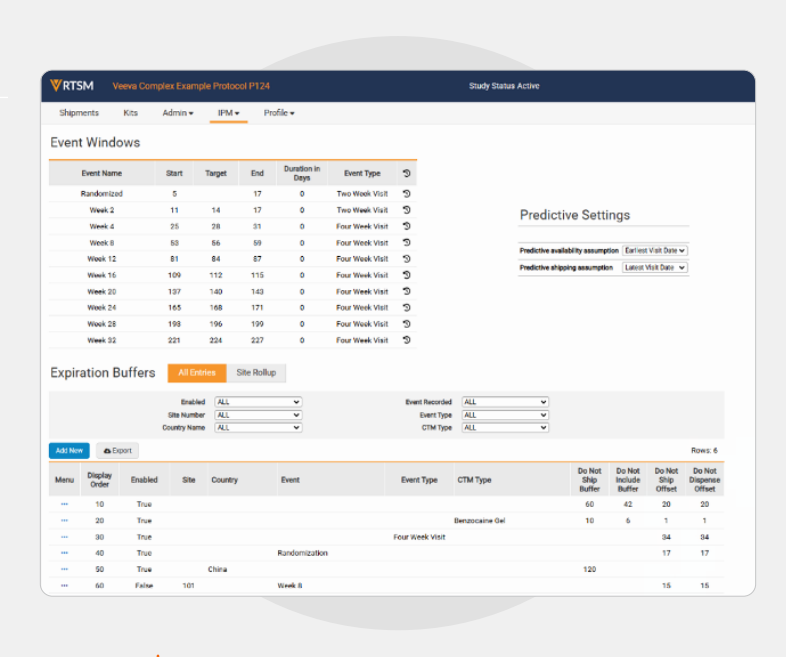
To prevent the premature rejection of usable inventory, the expiration buffers table separates applicable DNx parameters (Do Not Ship (DNS), Do Not Include (DNI), Do Not Dispense (DND)) into Buffers and Offsets:
-
Buffers: Applied to static demand where specific patient timing is unknown (e.g., randomization/enrollment visits, unscheduled visits, or kit replacements).
-
Offsets: Applied to predictive demand where the schedule of events or specific visit windows are known.
The system permits granular overrides by site, country, event type, or material kit type. This allows a single study to accommodate different visit cadences or unique country-level logistics without needing custom coding.
See the resupply buffers in actionOrganizational Benefits from Veeva RTSM’s Resupply Functionality
-
Reduced Product Waste: Offsets prevent the system from blindly rejecting batches with short shelf lives when they are clinically viable for an upcoming short-window visit.
-
Mid-Study Autonomy: Clinical supply managers can configure site overrides or adjust buffer thresholds directly via the user interface without executing costly system change orders.
-
Full Audit Visibility: Comprehensive rolling history logs preserve calculation states for every site, enabling clinical data and supply teams to verify precisely why an order was or was not generated.