
From Service as an Afterthought
to Agentic Service for HCPs
Legacy tools prevent the delivery of service that HCPs expect and receive from other industries. Here is your blueprint for transitioning to Agentic Commercial service.
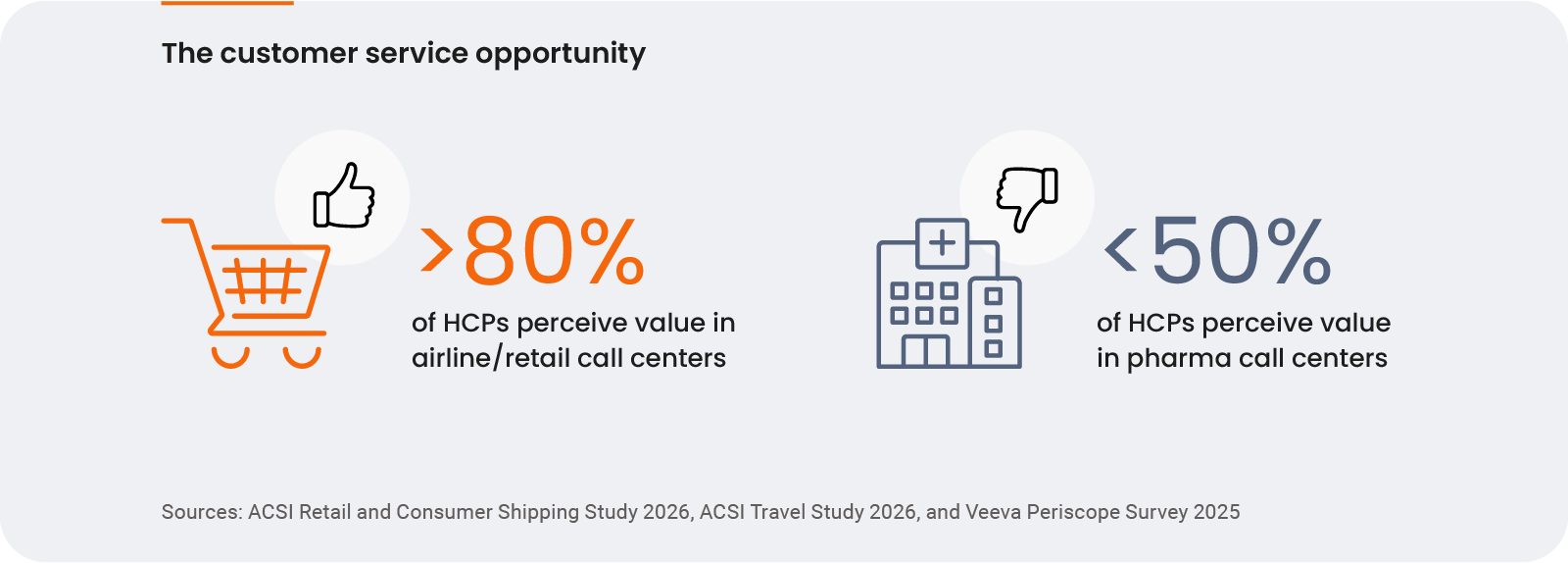
At home, a healthcare professional (HCP) who contacts a consumer call center expects, and receives, great service, finding value in 80% of interactions. Resolving an issue with a retail order is nearly seamless.
But the moment that HCP steps into the clinic, puts on a white coat, and reaches out to a biopharma service center, the experience changes drastically. Perceived value drops below 50%. Instead of swift answers, HCPs face limited operating hours, long hold times during tight clinical windows, and agents who have zero context regarding recent conversations with their local field rep.
This creates a barrier between a doctor, a medicine, and a patient: An HCP’s outreach to your service center often stems from an urgent need for information on behalf of a patient.
Legacy tools perpetuate a service shortfall
Your service professionals are dedicated to helping HCPs in need and delivering a great experience during every interaction. But the legacy tools and infrastructure they work with are falling short, perpetuating this shortfall in service compared with other industries.
Customer service teams often work in a standalone service system independent of the CRM, preventing transparency of past interactions and creating a fragmented experience for the HCP. Moreover, service teams hop in and out of multiple systems to resolve issues for customers, delaying critical responses and frustrating HCPs. This materializes into low perceived value of biopharma call centers, despite the engaged services professionals working there.
It’s time to make customer service core to customer engagement
Safely bringing complex therapies to market faster and educating your customers about them requires an evolved service model positioning service as a core part of the customer journey, not an afterthought. Likewise, pushing your teams beyond capacity by maintaining fragmented, legacy technology outside of the CRM creates significant business risk.
Agentic AI is poised to bridge this gap in service, but requires critical prerequisites: defragmented data systems, connected communication channels, and clear cross-functional visibility. Making these operational improvements and transitioning to an agentic service model will allow biopharma to overcome the bottlenecks that frustrate service teams, inconvenience HCPs, and ultimately delay patient treatment.
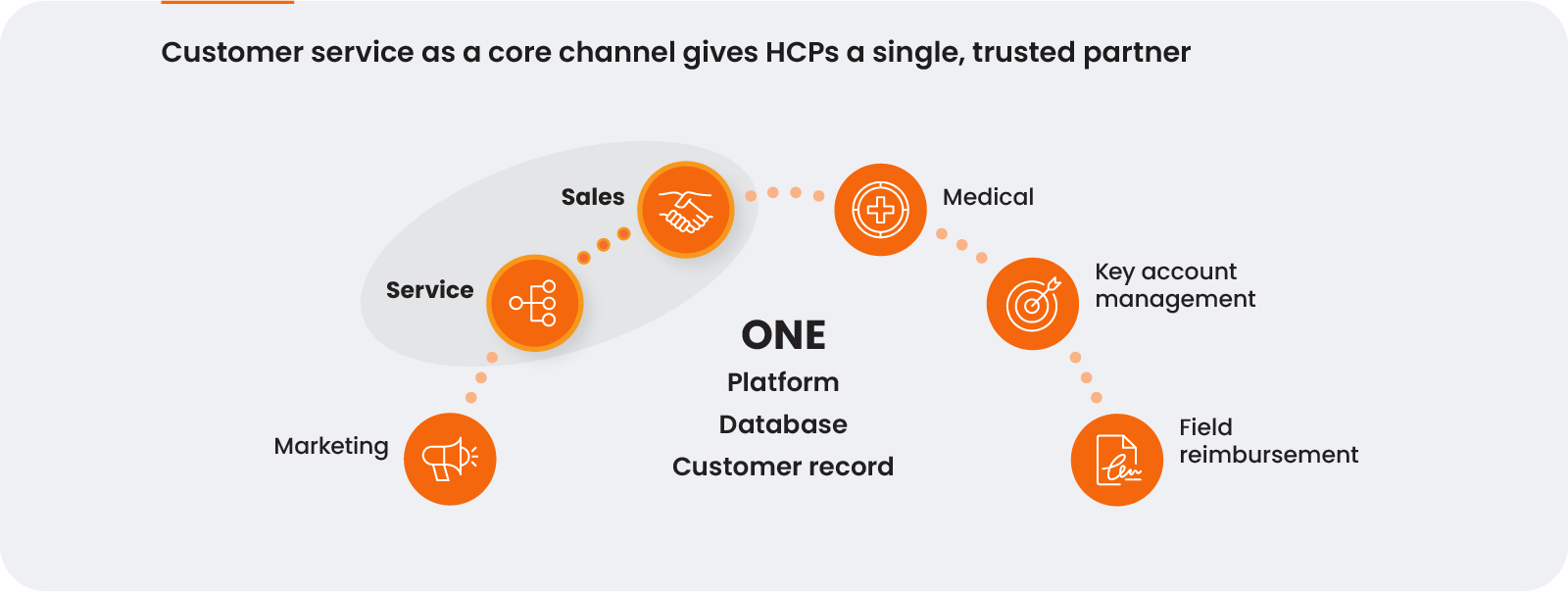
Veeva Vault CRM Service Center, an industry-specific application that enables inbound and outbound cross-channel engagement, is embedded in Vault CRM Suite to serve as a unified platform for customer service and inside sales, delivering seamless omnichannel engagement and data capture. These applications use agents built on the Vault AI Platform and, together, make customer service core to overall customer engagement.
Service agents and field teams share full cross-functional visibility into the HCP's current status and past interactions. The field representative can seamlessly continue the conversation exactly where the service team left off, without missing a beat, providing a superior, uninterrupted experience that builds trust and accelerates patient care.
“By unifying all service engagement data and sales output data within Vault CRM and Service Center, we gain the transformative ability to precisely link interaction choices to sales impact, fundamentally optimizing how we engage every physician.” — CEO of a technology-enabled biopharma services company
The result is improved productivity and commercial agility to deliver medicines to more patients in need.
Compounding pressures are accelerating the agentic shift
Beyond the need to bring services to the core engagement, there is growing urgency to shift to agentic service to address compounding internal and external pressures:
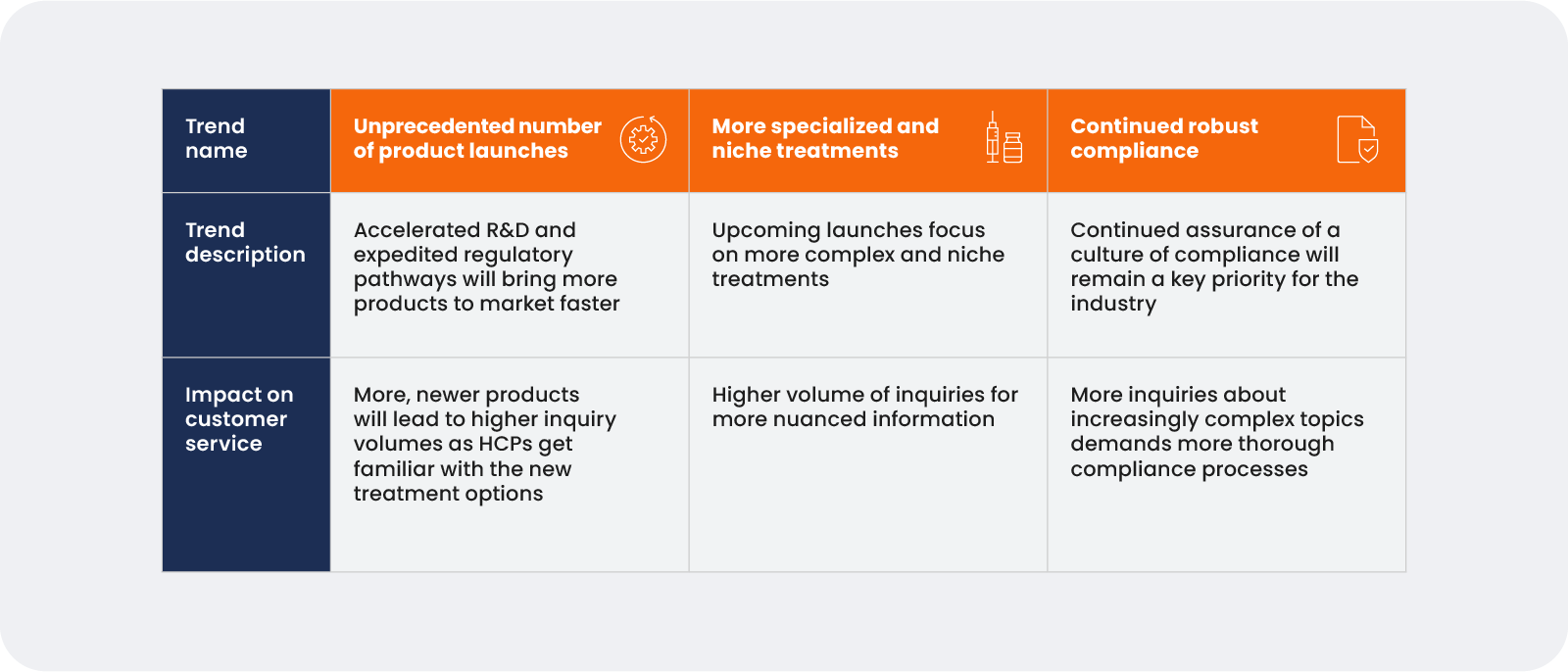
Combined, these three trends will lead to higher volumes of more complex inquiries that will be harder for customer service teams to handle. However, biopharma can't simply scale customer service operations using legacy technology. The customer service function must transform, embracing AI and other technology advances to keep pace with the new demands.
How agentic service relates to the new Agentic Commercial™ model
Agentic service handles high-volume, complex inquiries from both human stakeholders and AI systems. As an integral part of the Agentic Commercial model, it orchestrates the four pillars, digital, agents, the field force, and content, to power continuous service dialogues. Agentic service enables 24/7 AI concierges to resolve inquiries autonomously alongside human ‘system pilots.’ When a nuanced clinical exception arises, the system executes a seamless contextual handoff to the field force, ensuring the company represents itself as a single, trusted partner.
Agentic service is part of the new Agentic Commercial model. Agentic Commercial leverages AI to get the right medicines to more patients using four pillars (sidebar). Commercial Evidence™ is the real-world context these teams generate by compliantly capturing the critical details of field and digital interactions, which in the past typically went unrecorded. The agentic AI in Veeva Commercial Cloud taps into unstructured field free text, voice notes, and conversational digital queries to reveal the exact intent signals, content gaps, and therapeutic barriers HCPs and patients face.
Crucially, customer service acts as a vital channel for capturing Commercial Evidence. As HCPs reach out via phone, secure chat, or email, every interaction generates actionable intelligence. In fact, 65% of agentic call reports capture specific treatment barriers. By incorporating customer service into this unified data layer, biopharma companies uncover deeper insights into localized friction, allowing them to solve patient access hurdles faster.
The four pillars of Agentic Commercial
Four components of the Agentic Commercial model work together, harmonizing engagement for HCPs who experience the brand, and the human and AI agents representing it, as a single, trusted partner:
- Digital: Non-personal digital promotion expands beyond Google searches and static brand websites. The proliferation of consumer digital channels (e.g., ChatGPT, Claude, and Gemini) and healthcare-specific platforms such as OpenEvidence prompts brands to adapt how they measure, optimize, and coordinate digital budgets.
- Agents: Compliant, self-service agents are an entirely new communication channel. Agents conduct two-way interactions with HCPs and patients, answering complex questions, unconstrained by corporate staffing levels or standard business hours. When human touch is required, handoffs to the field force are seamless and include the full conversational history.
- The field force: Field force composition and execution will shift as basic product information becomes easily accessible through digital and agentic channels. The industry will see an increased demand for highly trained clinical specialists, medical science liaisons, and key account managers.
- Content: Because no component of Agentic Commercial can succeed if content is bottlenecked, digital assets will move through the content lifecycle faster while remaining compliant. The addition of agentic AI in medical, legal, and regulatory (MLR) pre-review is demonstrating that a massive bottleneck isn’t inevitable.
Service evolves with Agentic Commercial engagement
Regardless of how AI advancements change service delivery modes, the channel will remain as a core component of customer engagement. Continuous, omnichannel dialogue will still be required to support HCPs and patients whenever and wherever they need it.
The goal for service leaders today is to move teams and technologies past siloed, transactional, and manual ticketing to an expedited and integrated dialogue embedded directly into the broader commercial ecosystem.
While there is no linear path to achieve agentic service, a unified platform and data for commercial teams with embedded, industry-specific AI is required. With this in place, you can begin assessing what is needed to prepare your teams and technology to adapt to agentic service with urgency.
Strategic repositioning prepares service for a digital-first customer
Transitioning service teams to agentic service is not merely a technological upgrade to AI; it is a strategic shift in how your company interacts with a digital-first HCP community. Customers have more entry points to healthcare information and higher expectations than ever before. Obesity medications have brought digital-first engagement to the forefront, with personalized brands including Ro, Hims & Hers, and Amazon and Walmart pharmacies.
Today, stakeholders include not only HCPs and patients, but also ‘AI doctors’ and AI models, the large language models (LLMs) and digital assistants that patients and practitioners increasingly use for decision support.
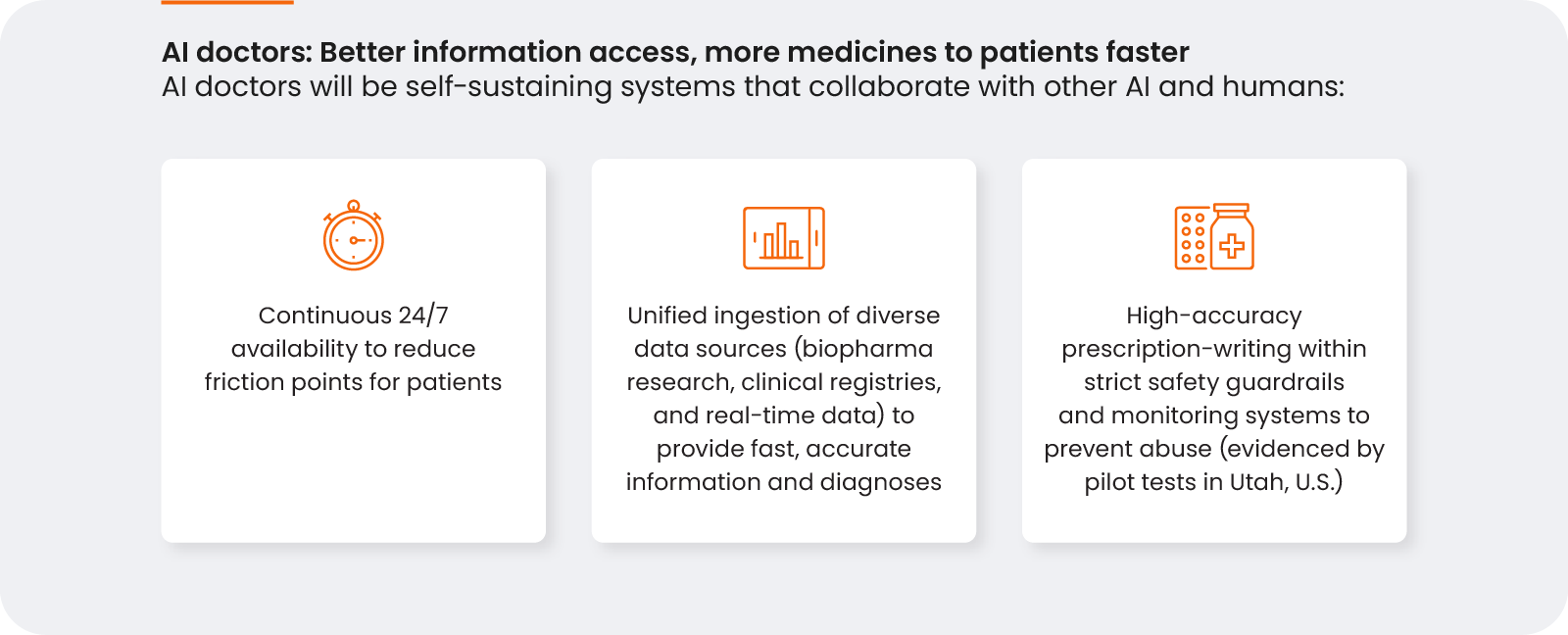
An agentic service approach ensures that no request goes unanswered, whether it came from a human doctor, AI doctor, or an AI model/LLM. AI agents function as a new class of knowledge worker, using reasoning models to execute complex tasks. As a result, human agents shift from ‘case collectors’ to ‘system pilots,’ focusing on quality assurance and managing the exceptions that require deep empathy or nuanced clinical judgment.
This model prepares service centers for hybrid intelligence: a future where your system provides validated data directly to the HCP’s own digital assistant in real-time — an AI-to-AI interaction that ensures clinical accuracy at scale. It also drives the eventual evolution to ‘AI concierges’ that will attend to your customers throughout their journeys.
While the enterprise technology industry often refers to autonomous AI case handling as 'autonomous customer service' or 'virtual customer assistants' (VCAs), biopharma requires an elevated approach. The AI concierge represents the evolution of these underlying AI agents into a continuous, peer-level partner tailored to the complex clinical, regulatory, and access needs of HCPs.
“I envision AI monitoring engagement levels during video calls and triggering an on-the-spot alert to the rep to ask a question to re-engage the customer, and we can use these insights at the corporate level to adjust our messaging or our HCP engagement approach.” — CEO of a technology-enabled biopharma services company
Agentic capabilities to streamline the customer service workflow
Agentic tools are already streamlining workflows in customer service, including AI-powered media search to help service professionals locate, summarize, and launch content for proactive planning and instant support during customer interactions. Many more agentic capabilities will soon be embedded into service workflows to augment human service professionals in delivering high-value service.
Customers gain an AI concierge for their inquiries
In the agentic service model, the future points toward an AI concierge for HCPs requesting service from life sciences companies. The AI concierge provides peer-to-peer level conversations, available at any time through any channel. It retains the complete customer history for an HCP and addresses direct questions through an ongoing dialogue and bespoke generative content.
When a human expert is required, the AI concierge transitions the conversation to a human representative, including all pertinent history and current circumstances, providing the full context for first-class customer service. “I envision AI monitoring engagement levels during video calls and triggering an on-the-spot alert to the rep to ask a question to re-engage the customer, and we can use these insights at the corporate level to adjust our messaging or our HCP engagement approach,” says the CEO of a technology-enabled biopharma services company.
Core principles of agentic service
Agentic Commercial service offers a significant improvement of customer experience when guided by three core principles:
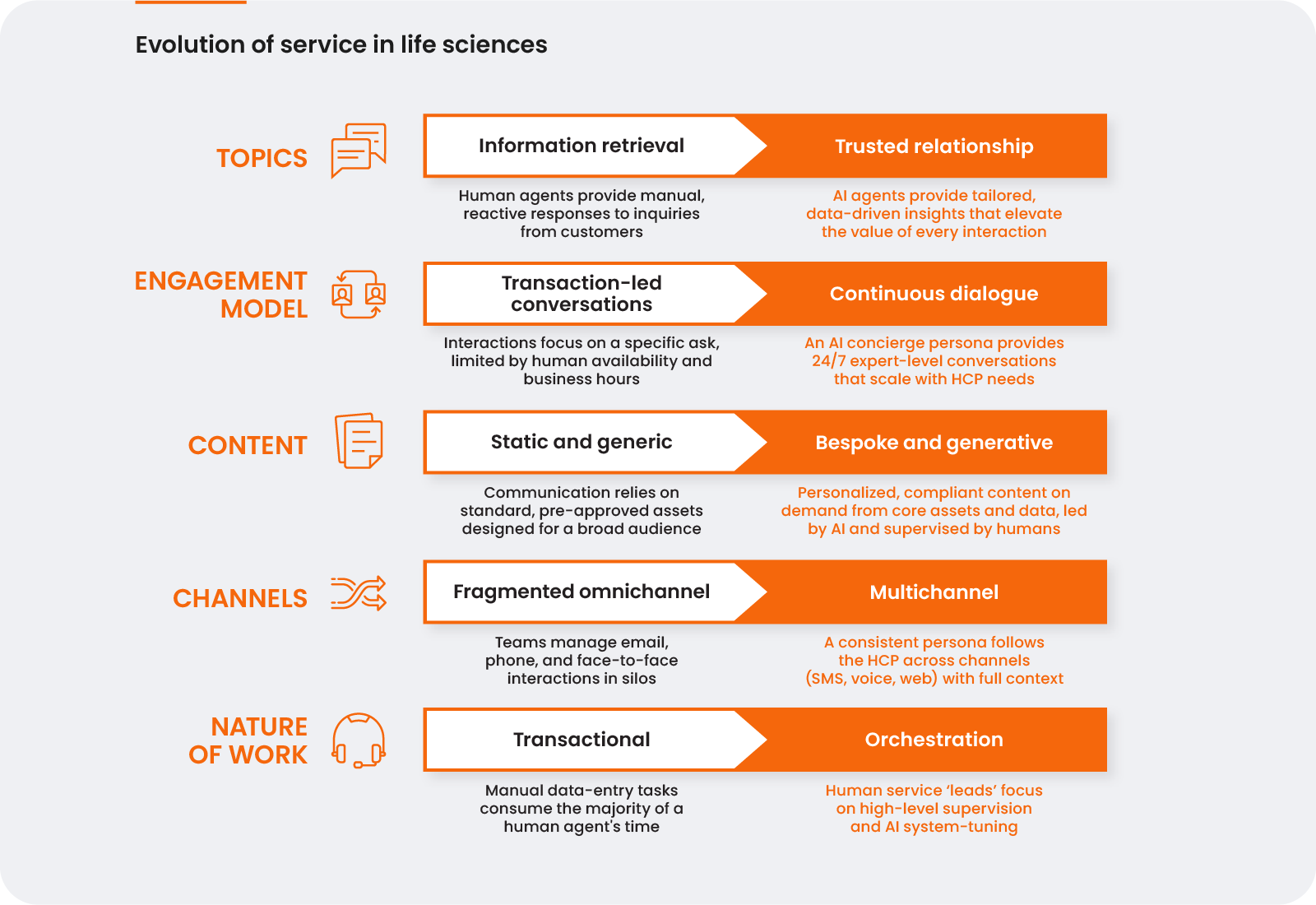
- Continuous dialogue: Shift from fragmented, transactional ‘tickets’ to an ongoing dialogue between customers and service across functions and channels.
- Augmented workforce: AI agents support human teams in serving an increasing volume of inquiries with more specialized requests from different stakeholders/models.
- Streamlined, omnichannel service: Create a consistent experience that feels intuitive to the HCP regardless of whether they engage via text, voice, or web.
Operational evolution: Move from transactional to collaborative
Agentic service will drive fundamental changes across daily operations, moving the focus from manual data entry to high-level system oversight.
Agentic service requirements
Delivering effective Agentic Commercial service and AI concierge capabilities requires three foundational infrastructure pillars. While organizations may have already initiated work on one or more of these individual components, full implementation will require sustained development over the coming months and years:
- Unified, native data: AI models are only effective when they have frictionless access to unified data native to the CRM. This allows both human and AI agents to act on a customer’s full history with complete context.
- Compliant bespoke content: Maintaining a consistent AI concierge requires the ability to generate compliant-by-default content tailored for specific channels. This isn’t possible with static, holistic assets. Rather, structured, granular, and pre-approved component-based inputs are essential for real-time personalization.
- Agentic workflows with humans in the loop: Success depends on balancing efficiency with a human-in-the-loop design. Clear handoff parameters ensure a human specialist takes over during high-empathy (sensitive needs), high-complexity (reasoning limits), or high-risk (clinical verification) interactions.
The path forward
The transition to an agentic service is a calculated decision to unify data, refine AI protocols, and prepare teams for reimagined roles as you shift the line of automation. The starting point is the infrastructure you implement today and the steps you take now to thoroughly prepare service and sales teams for Agentic Commercial and the ability to collect Commercial Evidence.
Veeva Vault CRM Service Center delivers that exact foundation, unifying human and AI agents within Vault CRM to transform customer service and inside sales into a core, personalized engine for high-value HCP engagement.
View a demo of Vault CRM Service Center and learn more about Commercial Evidence and Agentic Commercial.