
4 Trends Driving TMF Strategy
in the Age of AI
Download PDF
TMF leaders connected at the Veeva TMF Innovation Forum to discuss how to implement AI as a validated, auditable step in the TMF workflow. These advancements will redefine every aspect of TMF operations, from team roles to quality control and oversight.
Here are four TMF trends and how they will impact your teams:


-
The TMF is transitioning from active to autonomous
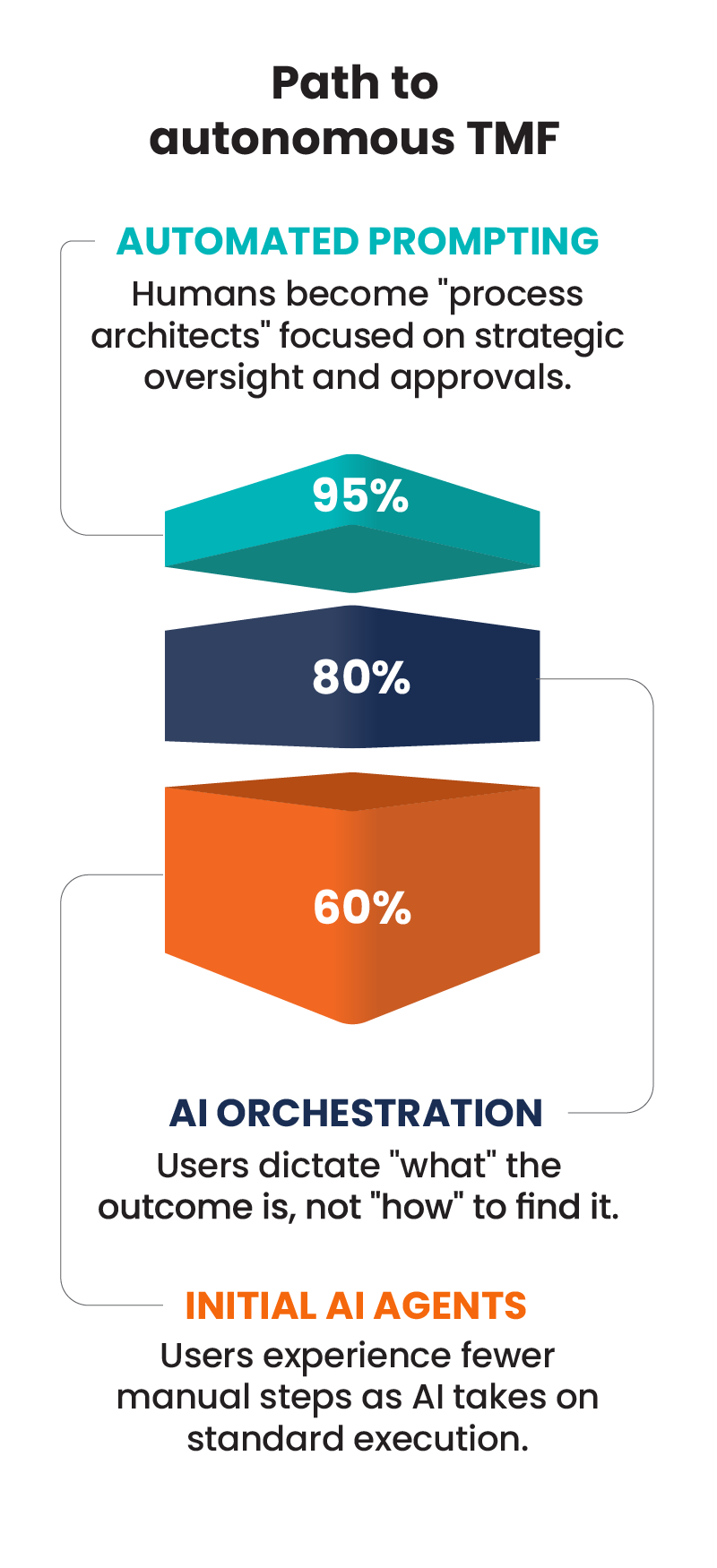
For years, TMF leaders advocated for active TMF, a model where the TMF is a place to do your work rather than a passive, post-hoc archive. Now, with the introduction of agentic AI, TMF management will evolve from “active” to “autonomous.”
However, autonomous TMF is not a replacement for the active TMF model. Autonomous TMF is built upon a foundation of active TMF workflows, document viewers, and reporting structures. In this evolution, these components transition from human-operated tools into the core infrastructure for AI agents.
But an autonomous system is only as good as the data it consumes. A master consumer model prevents “automated chaos” by automatically pulling the truth from across the trial ecosystem and establishing a standard of data integrity.
By creating connections across clinical operations, autonomous TMF detects risks, such as a mismatch between a subject’s age and an assent form, and automatically triggers remediation tasks for the site. Compliance issues resolve at the source before they become audit findings.
TMF leaders expect a majority of TMF activities to be autonomous within the next three years. This will free up TMF teams to become “process architects” focused on strategic oversight and approvals. It will also transform roles across the business, including CRAs.
“I’m well aware of the burdens that a CRA has when they’re on site,” says one head of TMF at a top 10 biopharma. “With regard to the TMF, the activities that require most of a CRA’s time on site are comparing the ISF to the TMF and ensuring all the proper records have been collected. If agents manage those aspects and prompt CRAs ahead of site visits with what they’re missing, we’ll see big time savings and improved relationships.”
-
TMF leads are evolving from processors to process architects
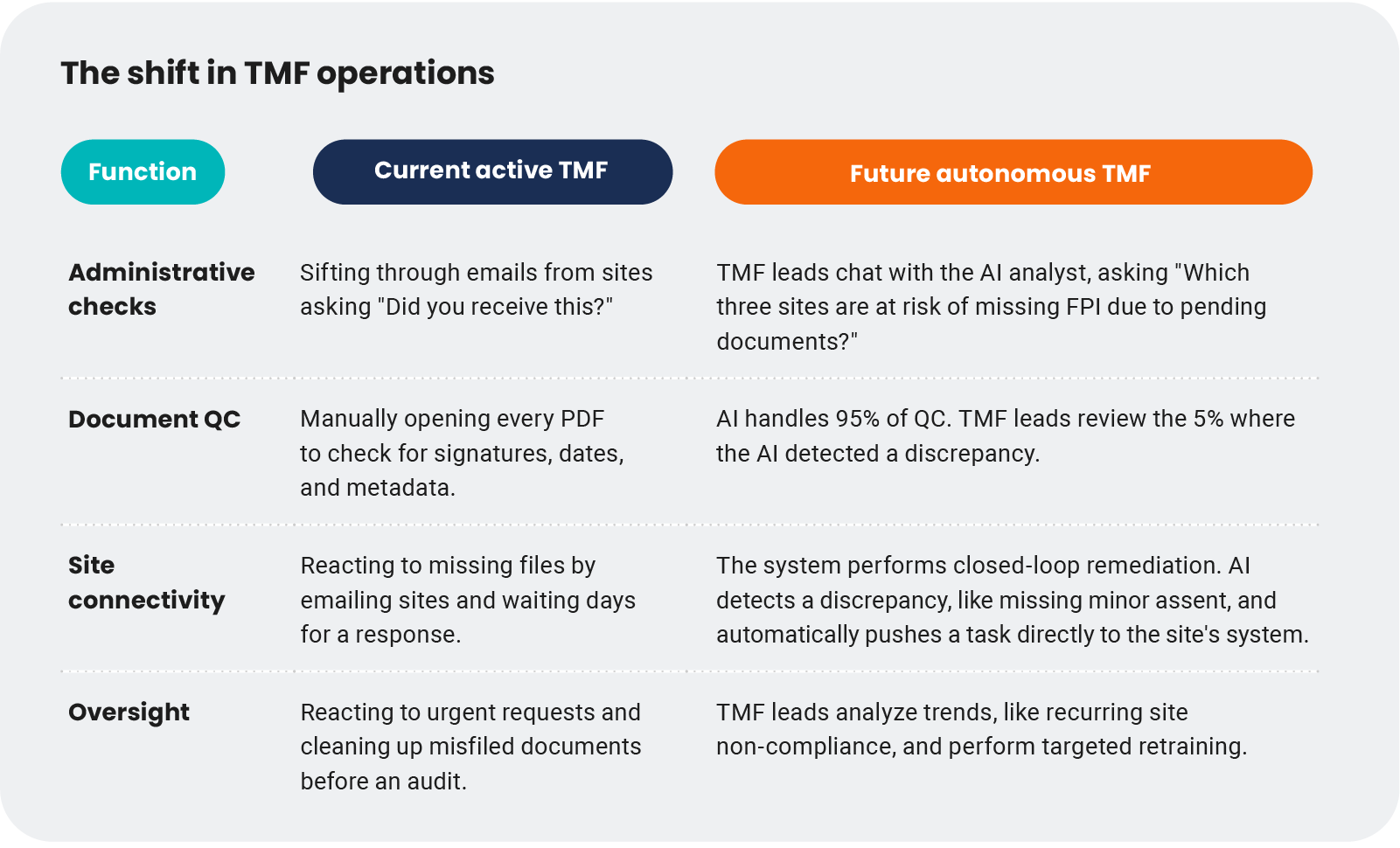
TMF leads have long been bogged down by administrative tasks like inbox triage and manual filing. Now, AI agents are fundamentally changing these roles. Instead of executing tasks, TMF leads will focus on managing AI-driven workflows and enabling strategic oversight.
TMF leads only need to intervene when the application flags an event that requires human judgment. This change allows TMF leads to focus more on strategic outcomes and human-in-the-loop validation.
“Beyond metadata extraction and QC, AI will be able to report on study milestones with country intelligence,” says the head of TMF at one top 20 biopharma. “AI will identify the relationships between events, what records are expected, and what needs to be packaged for other business units.”
-
Biopharmas are embracing risk-based quality control
Last year, CDISC published their TMF Risk Management White Paper to advocate for risk-based quality management (RBQM) to improve data quality and inspection readiness. This guideline coupled with the MHRA’s recently published ICH E6(R3) is a signal for TMF leaders: 2026 is the time to adopt risk-based quality control (QC).
Key principles, as highlighted by CDISC and industry guidance, include:
- Risk proportionality: The need to move beyond a “one size fits all” QC approach, recognizing that risk is multifactorial and contingent on trial design, technology, and operating models
- Criticality focus: Baseline TMF controls should be modified based on the potential threats to patient rights, data integrity, and document “essentiality.” This means focusing on elements critical to trial quality
- ALCOA+ principles: Risk-based QC must ensure that essential records consistently meet the data integrity standards of Attributable, Legible, Contemporaneous, Original, Accurate, and Complete (ALCOA+).
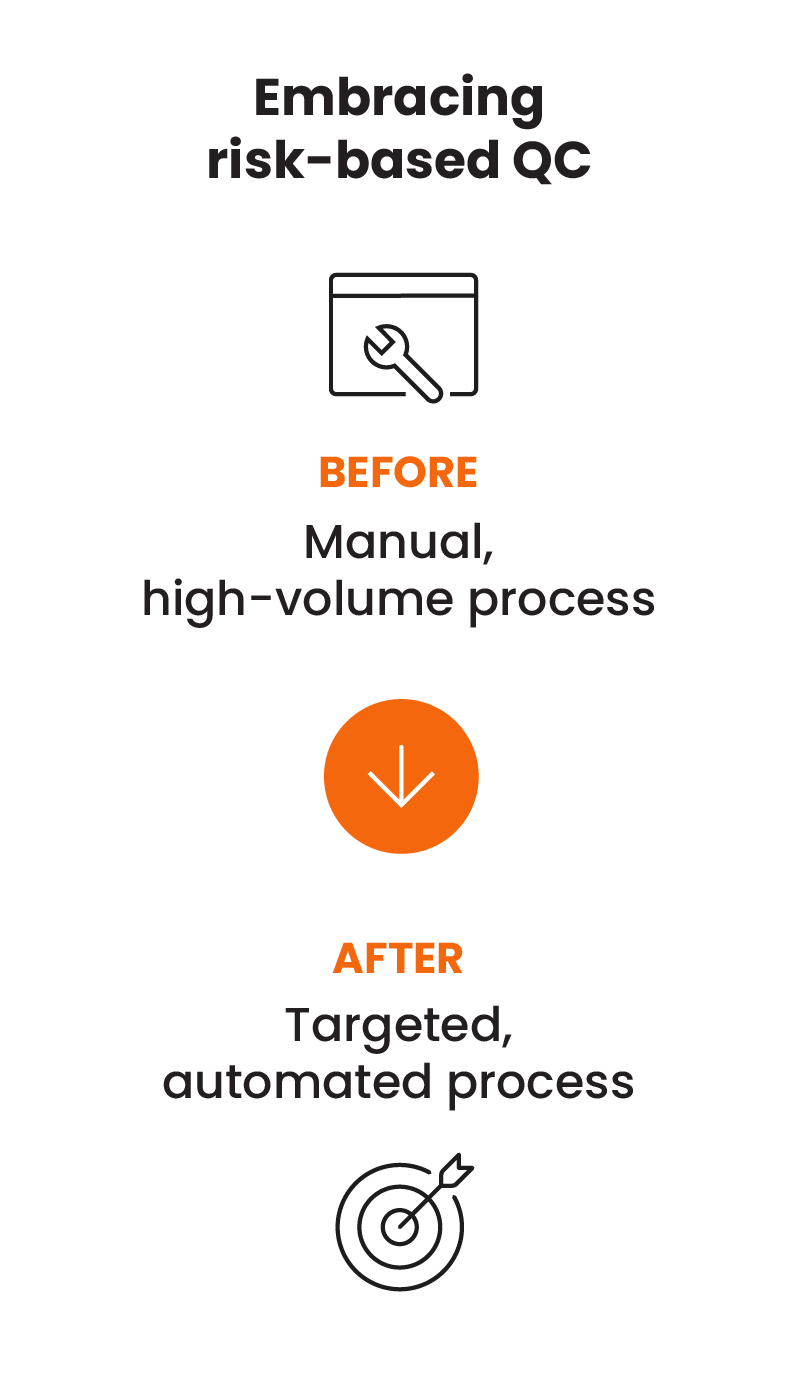
Embracing risk-based QC shifts the burden from a manual, high-volume process to a targeted, automated process – ultimately removing the reliance on manual spreadsheets. In practice, this can look like:
- Document type risk mapping: Organizations can associate specific document types to a pre-defined QC risk level (e.g., high, medium, low).
- QC risk rules: TMF teams can create rules to define a sampling percentage for each risk level.
- Automated risk assessment: TMF leads can create an eTMF workflow that automatically executes a risk assessment when a document enters QC.
-
Companies are pivoting toward continuous AI-driven compliance
AI is changing both inspection preparation and execution. For example, one biopharma shared they have an upcoming MHRA inspection, and the dossier includes how the company qualifies and uses AI tools.
Because the FDA will have the tools to look at everything simultaneously, biopharmas are shifting their strategies from passing visual checks to maintaining continuous, machine-readable data integrity.
Some TMF leaders are looking toward AI to help them maintain inspection readiness. One biopharma shared the example of a safety management plan that notes monthly meetings. AI could review this record and then flag that monthly meeting minutes are missing from the TMF.
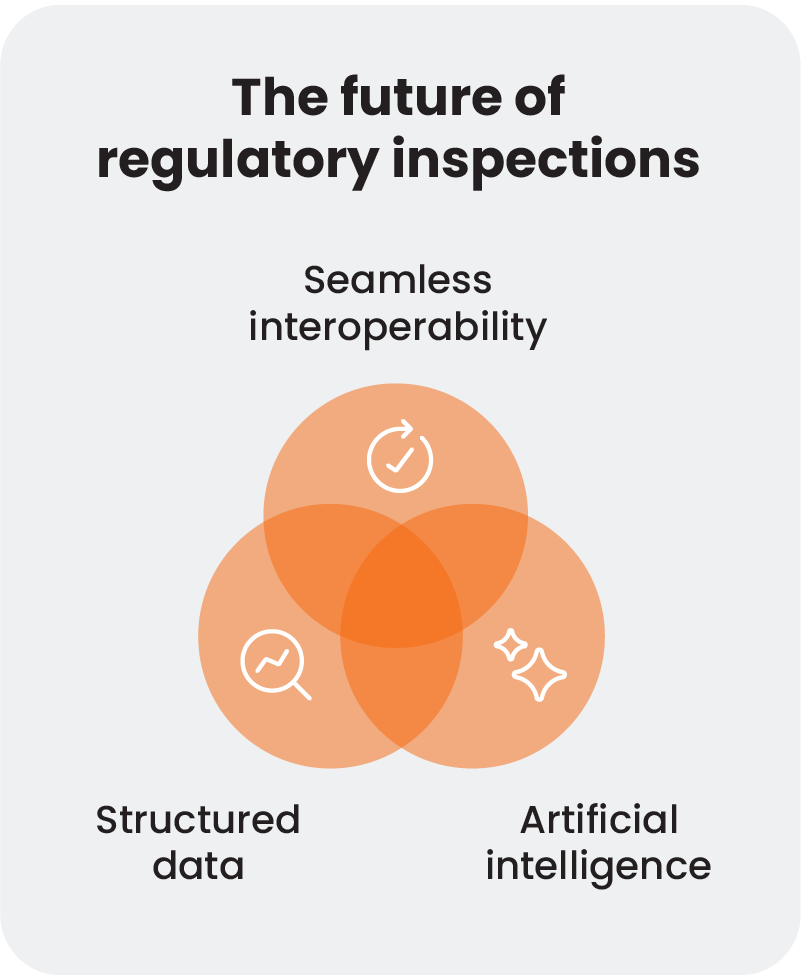
Ultimately, the future of regulatory inspections will not be about inspectors sitting in conference rooms requesting individual PDFs. It will be defined by seamless interoperability, structured data, and artificial intelligence.
Continue the Discussion at Veeva Summit
To continue the discussion with TMF leaders on improving trial efficiency and inspection readiness,
register for Veeva R&D and Quality Summit in Copenhagen on October 28-29 May.