Agentic Biopharma: How Future Ways of Working will Transform Drug Development
The shift to Agentic Biopharma is here. Humans and agents will collaborate to automate R&D processes, and organizations will need to transform their ways of working to capture the potential value.
The industry shift toward Agentic Biopharma
Biopharma is changing. Agentic AI is disrupting everyday business processes as organizations embed it in and around core applications. These agentic ways of working will significantly improve the efficiency and speed of drug discovery, clinical development, and market access. This is the beginning of Agentic Biopharma, a new operating model for life sciences that enables AI agents and people to work together through connected, compliant workflows to increase productivity and help bring therapies to patients faster.
Agentic Biopharma relies on the MAAP Architecture™, where models, agents, and applications work together on day-to-day execution. Core applications remain essential as the central systems of record where work is done, but will evolve into a dual-mode model where both humans and agents act as end users. Agents will sit outside of core applications and use large language models for reasoning. They will also be present in core applications to assist human users in real-time. Platforms like Veeva Vault will evolve to be dual-mode, laying the compliant foundation for agents and people to collaborate across the enterprise.
Agentic Biopharma becomes a reality when an enterprise adopts the MAAP Architecture and incorporates AI within and across all functions. AI then can act in two ways: as agentic labor to perform routine work, and as user-assistive agents to work alongside humans and aid with the execution of more nuanced processes. This gives teams the capacity to focus on strategy, relationship management, and governance. Evaluating where agents can drive immediate value across the drug development pipeline is the first step in preparing for this shift.
What does Agentic Biopharma mean for drug development
Clinical operations, clinical data, regulatory affairs, pharmacovigilance, and quality organizations have many high-volume, manual processes that agents can partially — or completely — automate while humans focus on strategy, relationships, and agentic oversight.
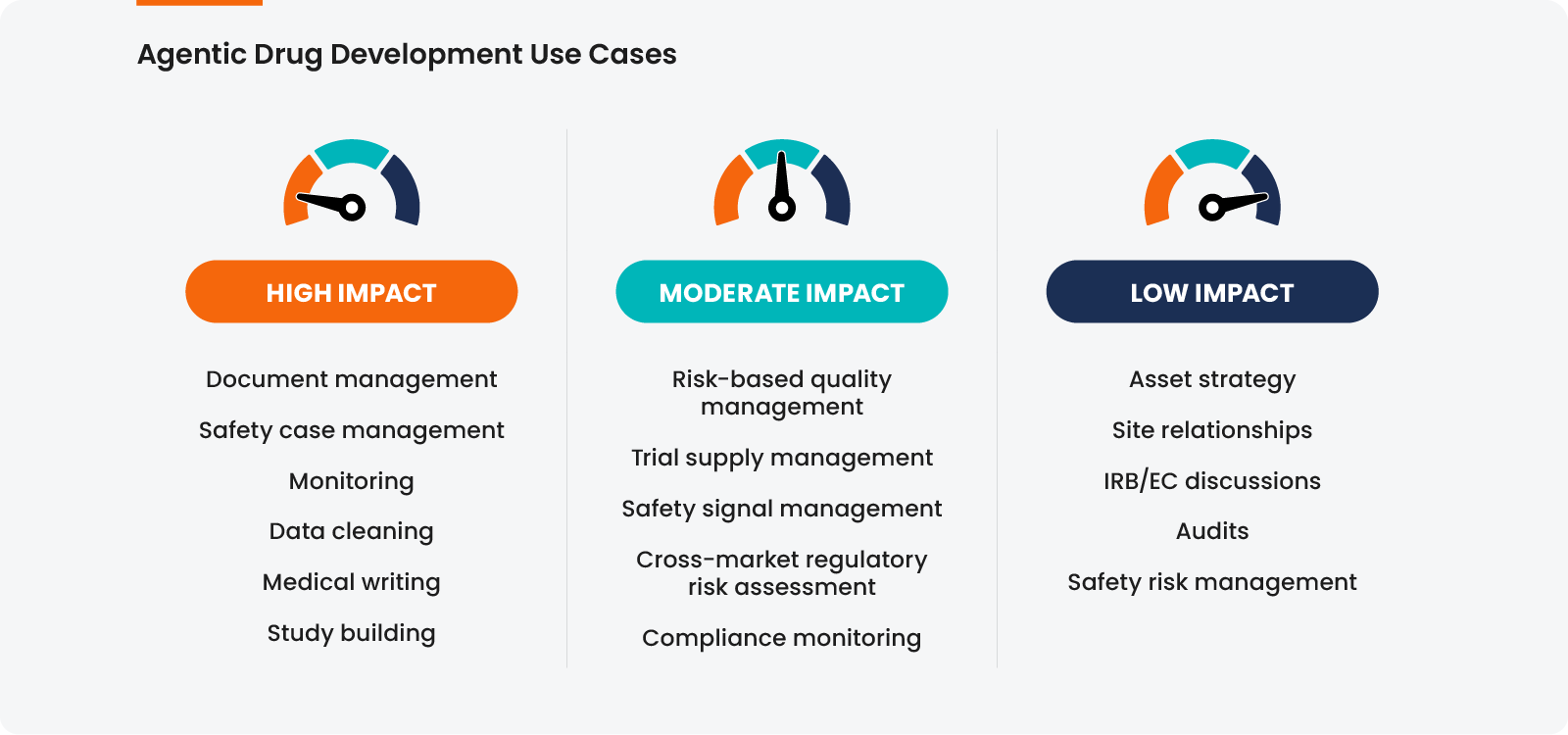
By a bottoms-up assessment of the potential impact, Agentic Biopharma has the opportunity to reduce the manual effort in Drug Development across R&D by 65%. It will also meaningfully shrink the critical path and accelerate time-to-market. Each function will experience this to a different extent and on a different timeline. Subsequent pieces by Veeva will detail the hypothesis for each function.
How Agentic Biopharma creates value in drug development
Agentic Biopharma will require changes to ways of working to create value. It will also precipitate changes to asset economics that will have downstream impacts to portfolio strategy.

Operating model design
Agentic Biopharma presents an opportunity for the evolution of organizational design, outsourcing models, and offshoring models.
Agentic Biopharma will impact the operating model through its business processes. Organizations will give significant thought to re-imagining how teams conduct work in an Agentic environment. There will be major considerations, such as human-in-the-loop or on-the-loop quality checks, or rollout strategies.
As the shape of work changes, so will the shape of the organization. Different functions will realize efficiencies from Agentic Biopharma at different rates - challenging leaders to translate that AI roadmap into a people strategy. Organizations will predict and measure efficiencies, evaluate organizational impact from the bottom-up, and update resourcing algorithms.
Consider, for example, the number of clinical research associates (CRAs) involved in study conduct. In the past, one CRA may own several business processes such as source data verification, query management, and site-staff training across multiple study sites. With the shift to Agentic Biopharma, a company can reevaluate the degree to which agents can integrate into each of these processes and calculate the resulting CRA demand. In Agentic Biopharma, that CRA will be able to support those processes over a greater number of study sites. Adjusting the resourcing algorithm will carry this impact through at an organizational level.
Building this bottom-up view of resourcing will help biopharmas dynamically restructure their organization to fit their pipelines. Headcount will not scale at the same rate as pipelines, and some roles may see a headcount reduction. However, Agentic Biopharma will also open opportunities to upskill into new roles, particularly around AI governance.
There will also be a change in how sponsors work with contract research organizations (CROs). Automation may shift the industry toward fixed-fee or value-based contracting to decouple vendor outputs from time and materials to better align incentives for quality and speed. This evolution will help sponsors, CROs, and ultimately patients.
Asset economics
As agents reduce operational effort and time-to-market, the financial profile of an asset will improve. Development costs will decrease and total revenue potential will increase as an earlier launch results in more time at peak sales volume.
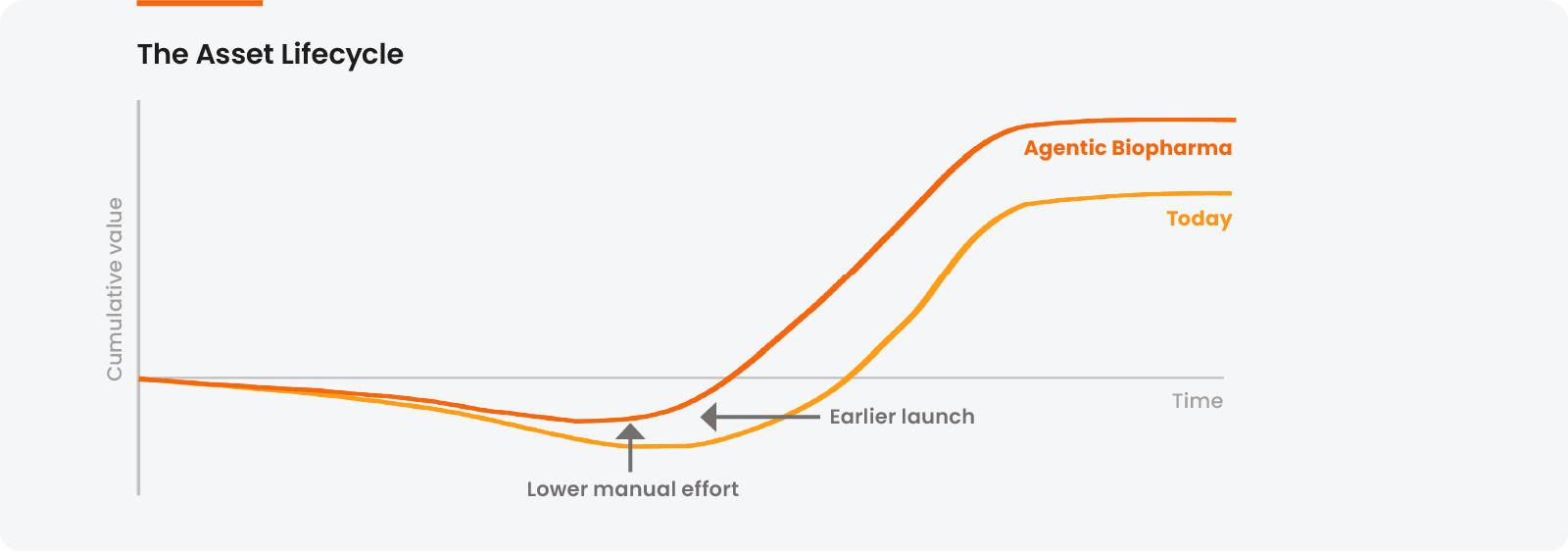
With these changes, assets that biopharmas would shelve today become economically viable. For large biopharmas with extensive investment options, this means that pipelines will expand, more medicines will make it to market, and patients will have more treatment options.
The economics also apply to in-licensing and M&A. Better asset profiles mean more attractive targets for consideration of acquisition. Biopharmas who embrace Agentic Biopharma will seize the competitive advantage in deal-making.
How to prepare for the Agentic Biopharma transformation
Agentic Biopharma will reshape biopharma operations, improving productivity and accelerating the delivery of innovative therapies without compromising quality or compliance.
Identify and prioritize Agentic Biopharma use cases in drug development
Begin identifying processes, both high and low-risk, that agents can improve. When building use cases around these processes, consider the change management and training lift needed to integrate agents, the outsourcing model impact, and your AI governance strategy.
As Veeva innovates new capabilities to support Agentic Biopharma, we look forward to helping customers manage pre-requisites to prepare their Vaults and prioritize use cases based on projected value. Near-term transformations will center around automated Trial Master File (TMF), health authority correspondence, and safety case management.
Establish a centralized AI governance model
Because AI systems are non-deterministic, like human employees, they require continuous training, calibration, and oversight. Establishing central AI governance is the first step to realizing the benefits of Agentic Biopharma.
The following components are vital to a centralized AI governance model:
- Value measurement: Defining and tracking performance metrics, along with operating model transformation and change management, to drive adoption of agents and applications.
- Agent maintenance: Establishing clear accountability for routine agent calibration to upskill agents and prevent hallucinations, alongside managing the semantic routing metadata and agent integrations to maintain accuracy.
- Usage constraints: Managing usage to control costs and improve agent efficiency and performance.
- Security guardrails: Implementing strict role-based access controls to prevent agents querying data across Vaults from surfacing information to the wrong users.
- Roadmap management: Developing a systematic business case framework to intake, evaluate, and prioritize the demand for new internal custom agents, including mapping custom requests against Veeva’s standard agent roadmap.
- Audit readiness: Defining the validation approach, collaborating with auditors on evidence standards, and ensuring that the use of agents to execute business processes is documented, traceable, and inspectable.
Subsequent papers in this series will analyze early use cases and the specific impacts and estimated manual effort reductions across the product development lifecycle, starting with clinical.
Join us at R&D and Quality Summit on October 20–21 to learn more about the Agentic Biopharma model, how it leverages Veeva, and how it will evolve.