How to Adopt a Clinical Platform
Find the right path for your organization to flexibly implement a clinical platform.
The rise of clinical platforms
Clinical trial protocols, processes, and regulatory environments are increasingly complex yet dynamic.
What was once linear and singular is now multi-faceted and varied. We have more data from more sources, paired with more experimental AI projects in search of better efficiency. Industry’s reaction to that complexity resulted in a patchwork of systems, which created its own set of downstream challenges.
Sponsors and sites prefer consolidated systems with streamlined processes. A clinical platform that unifies cross-functional systems offers the ability to simplify and standardize the trial experience for all stakeholders and generate greater efficiency.
A platform approach also embeds flexibility and makes it easier to adapt to changes in protocols, processes, and regulations.
For example, end-to-end study startup time can be reduced by 50% by simplifying site feasibility and initiation – leveraging libraries and automation to auto-populate fields across multiple systems. Instead of manually setting up the same site in CTMS, eTMF, RTSM, EDC, and eCOA, enter the site information once in CTMS and automatically configure it in those connected systems.
Standardizing the process for data collection from sites and patients also increases data quality and reduces the effort to clean data. Standardizing the build process has driven down the time from protocol approval to FPI, taking clinical development systems off the critical path.
This ebook will offer guidance and best practices to adopt a clinical platform.
The advice is based on 10+ recent clinical implementations, ranging from emerging biopharma to top 20 biopharma. In most cases, we assume that the sponsor or CRO already uses Veeva CTMS and/or eTMF (although sometimes the clinical platform
approach begins with Veeva EDC).
An important factor is realizing value quickly with flexibility for a variety of situations. For most companies, we recommend an agile implementation process that requires less upfront investment in time and resource planning, while scaling according to company size.
Key considerations
There are four questions that shape the situational guidance:
- What is the scope of technology to consolidate or implement?
- What is your ideal or current operating model?
- Who manages your standards strategy, and how effective is the program?
- How committed is your team and leadership to a clinical platform approach?
Key Consideration 01
Scope of technology
Dozens of systems are used in clinical development, from protocol finalization to submission.
First, define which capabilities will be part of the clinical platform, and which systems will become ‘legacy’. For reference, one large biopharma was able to sunset over 100 systems as part of a Veeva Clinical Platform implementation.
EDCs are used in most studies and, together with a clinical data workbench, are foundational for clinical data collection and management. Veeva's modern EDC introduces significant efficiency savings, while Veeva DQS provides a single hub to aggregate, manage, and clean all data. Identify must-have value drivers, such as effort reduction, that the technology will support.
Considering other non-EDC data sources, where are there opportunities to consolidate? For example, is there an opportunity to reduce the number of eCOA providers and instead standardize one or two for all studies? Consolidation of preferred vendors simplifies the overall technology landscape and creates operational efficiencies.
We recommend building a library (complete with integrations) over time that can be leveraged by study teams. Note which clinical systems can benefit from out-of-the-box Veeva Connections (e.g. Veeva CTMS, Payments, or RTSM) and which require integration with third party vendors.
Key Consideration 02
Operating model
Most sponsors considering a clinical platform already own – or plan to own – their critical clinical technology. To realize the full value and operational efficiencies of technology, it’s a good time to think about the right future state of your operating model.
In general, we find that a hybrid operating model – combining in-house resources with FSPs or other service partners for certain tasks – is often the best approach. Understand the ‘as is’ process with current technology, and identify who completes each task during study build and study conduct. Discern the processes that are working today from those that aren’t working. Later, when defining SOPs for the new platform, determine which processes need to change. Changing operating models is a large undertaking and it will take time to build in-house capabilities.
A general idea of your future operating model is important to understand, but it does not limit the implementation of the platform. An agile implementation allows an organization to move quickly without requiring all the answers in advance.
For example, some Veeva customers have adopted a platform strategy with only two or three in-house resources that build and deploy studies, flexing with additional support for testing on more complex studies. This “lean team” approach has been used in a wide range of company sizes – from the largest top 20 biopharmas to emerging biopharmas.
Key Consideration 03
Standards strategy
Creating and maintaining a standards library of forms, rules, assessments, and data listings is critical for platform efficiencies. Developing as many reusable assets as possible, directly on the platform, reduces the need for study-by-study development, eliminates repetitive testing, and simplifies the build process. By standardizing, smaller teams can do more without specialized technical skills.
Platform implementation is an opportunity to create or update a standards strategy, and if a dedicated team doesn’t exist already, bring this standards capability in-house.
We believe that platform agnostic standards do not truly exist. Any standard that is built to be used by all platforms does not take advantage of all of the capabilities offered by any one platform. An 'agnostic' standard must use the lowest common denominator of capabilities. We recommend using deployment as a chance to step back, evaluate your data flow, and refine standards to leverage the new capabilities offered by a modern platform.
Key Consideration 04
Commitment to change
Transforming the clinical development process can be a multi-year effort. Some organizations are eager to transform and have strong executive support to change, while others are more reluctant.
In either case, we recommend finding the right initial studies, communicating clear goals, creating early wins, and setting the governance for continuous improvement.
If there is strong commitment to change, then the number one goal is to reach ‘all new study starts’ on the new platform. It is important to continually refine processes, of course, but this is an important milestone to begin to sunset legacy systems and increase long-term value.
Iterative agile implementation
A traditional waterfall deployment model (analyze, design, implement, and test) is a proven way to mitigate risk. However, it is rarely the most efficient and cost effective.
For most organizations, we propose an agile and iterative deployment for a clinical platform. Our goal with this methodology is to start fast and show continuous value. Each study deployed adds to standards libraries, refines processes, and builds towards the future state operating model. Each phase of the plan builds on the last and avoids throwing away work.
This methodology could apply to all organizations, but it’s especially applicable to organizations that do not have the ability to make large upfront investments or that do have some resistance to change.
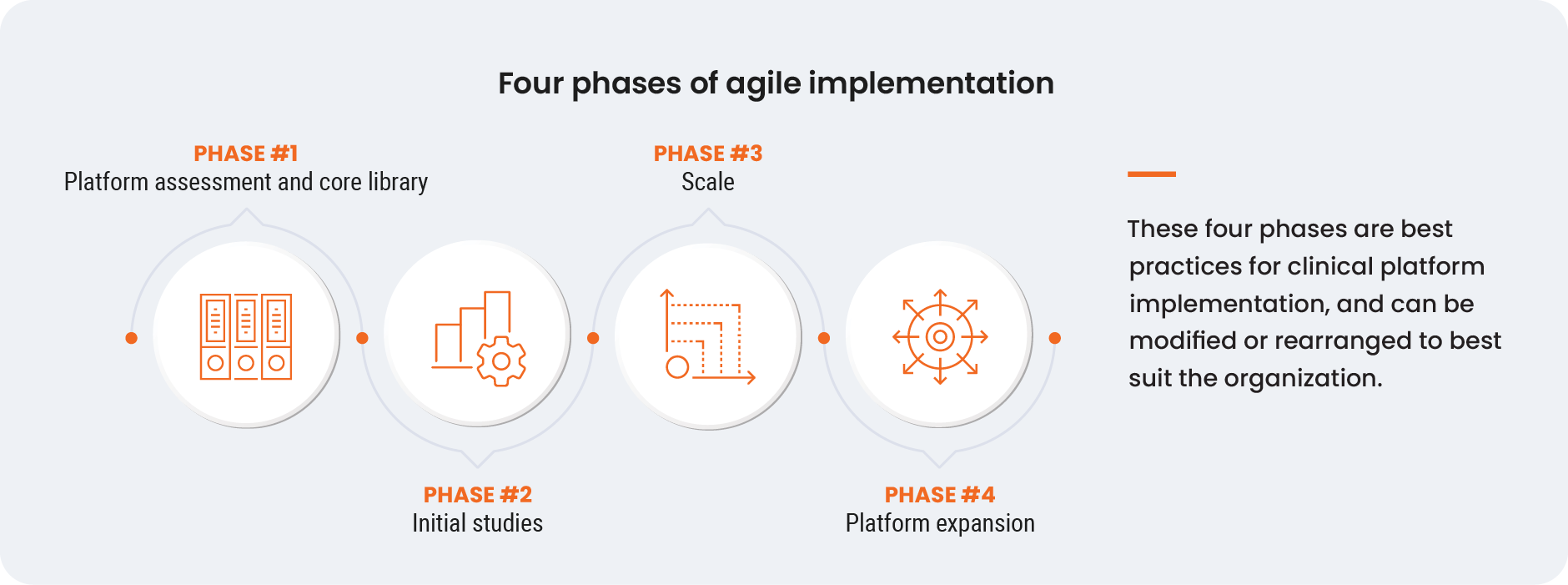
Phase #1
Platform assessment and core library
The first phase is intended to quickly get users in the system for hands-on learning so that the platform capabilities can be efficiently assessed. This is an investment of the sponsor's time and it is important to create value during the assessment phase. After brief formal training for a small set of users on the product, we quickly move to a tailored plan for the sponsor.
Instead of the typical approach of building a mock study, the recommended approach is to begin with a standards library. Building standards gives teams the hands on experience needed to define processes without having the full effort of a mock study. The value of the platform is maximized by having a strong standards library and focusing on adding to the library as part of the assessment process immediately adds value to the platform.
We recommend that the sponsor start with building a library of commonly used or ‘Core’ library forms, prioritizing forms that are required for integrations with other systems like AE or Con Med forms. Additionally, assess the Veeva eCOA library to determine if any additional assessments are required. Begin to strategize listing and autochecks in Veeva DQS.
In parallel with the library build initiation, or before, the platform will need to be validated in alignment with the sponsor's standard process. This effort is always a prerequisite to a first study in production, but more importantly it will ensure any assets built for the library are done with the correct process and documentation so that they can be leveraged in the future.
Phase #2
Initial studies
The first studies on the platform should be used to not only prove the technology capabilities, but also the value case for the proposed future state operating model. It is important to clearly define the value metrics so progress can be accurately measured. Often the value metrics are aligned to key study milestones like FPI.
For the first study, strike a balance between what is necessary for successful conduct and the investment required. For example, integrations with external systems make the platform more efficient and are required at scale, but can be the most costly and time consuming to develop. If integrations are deemed necessary, they should be built in a reusable way.
Process design should begin to evolve for the first study. Veeva will build the first study on the platform while mentoring and training the sponsor team. The Veeva build process provides best practices that the sponsor can leverage as a foundation for future improvement. Study conduct should align as close as possible to the existing process for initial studies.
Phase #3
Scale
After successfully implementing the initial studies, the lessons learned will guide the next phase to scale to all studies.
The most important milestone during this phase is reaching 'all new study starts' on the clinical platform, or prioritizing the clinical platform for new studies. Reaching this milestone will allow us to move into planning for the migration of legacy studies, if desired, and sunsetting legacy systems.
Similar to an agile study build process, we recommend using the same principles to add additional studies. Every study should leverage reusable assets from the library (forms, assessments, listings, and integrations). If the library does not contain assets required, those will be built and then added to the library for reuse. The librarian role is important for evolving the library over time.
In this phase, the sponsor should also start moving towards the future state operating model. Define long term team structure, organize build teams for maximum efficiency, and identify sourcing strategy. For example, the sponsor may decide to bring study build resources in-house but leverage FSP or service partners to augment the team with additional testers or CRAs. Some sponsors with fully outsourced studies on Veeva technology have brought them into their Veeva Domain, shifting conduct from FSO providers to their internal, or FSP, resources.
Phase #4
Platform expansion
The platform strategy will continuously improve and evolve to meet the needs of future trials. Veeva releases three times annually and publishes processes for adopting new capabilities and improvements that will maximize the value of the platform.
After the foundation is deployed, the next set of platform capabilities is assessed, tested, and then deployed at scale for future studies. Mature technology categories like eCOA or RTSM should be the priority for expanding the platform.
Example implementation approaches
A growing number of organizations are realizing the benefits of implementing a clinical platform, either by adding applications over time or implementing several in one go. Here we demonstrate three examples of sponsor approaches:
- Approach B: ‘Big bang’ approach with business process design in parallel to core technology implementation and sequential study builds
- Approach C: Cross platform Proof of Concept and change management: Single out of the box live study across the Clinical Platform
Approach A
A medical devices company that conducts a wide variety of clinical trials, with different ways of capturing, reviewing, and reporting on data, decided to adopt a platform approach over time.
The team, consisting of data managers, database developers, standards associates, and programmers, began using Veeva EDC in 2019, expanding with eight more applications over the following five years across the Veeva Clinical Platform [Figure 1]
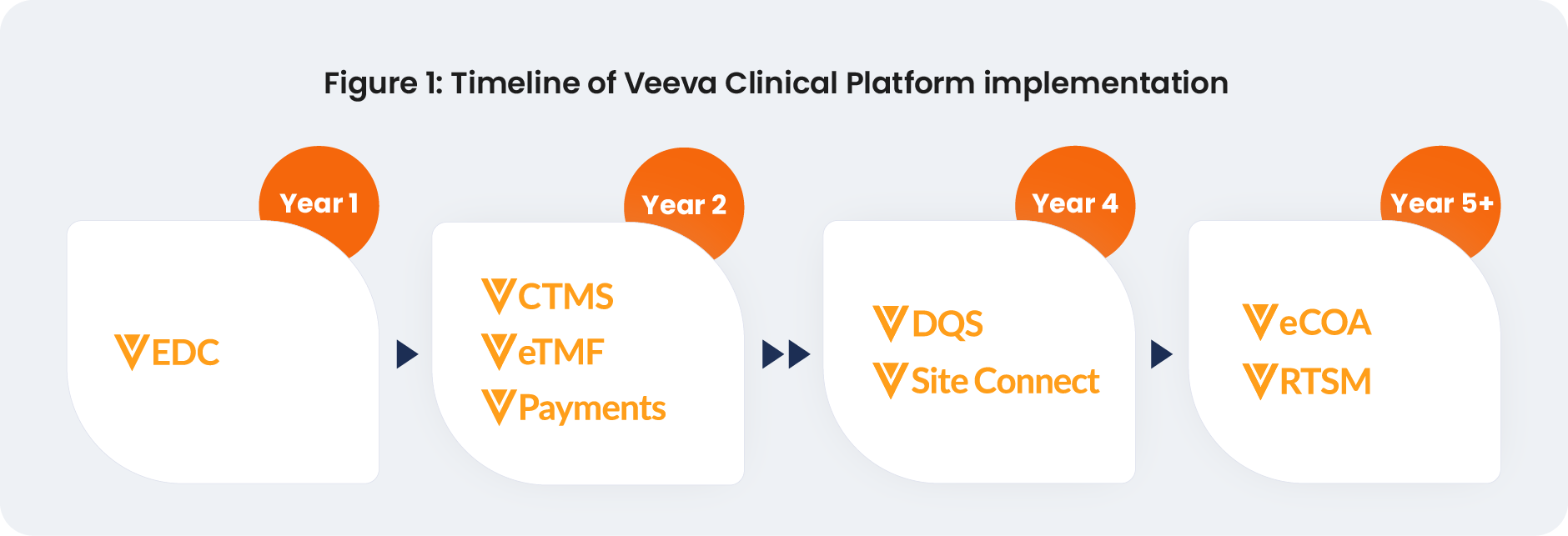
Rather than year-on-year implementation of new systems, the team took a strategic pause in year 3 to refine the use of current technology, develop standards, and stabilize processes. The company also internalized their data management function during this time.
The company created a dedicated team to oversee all implementations, which helped them cross-train application builds and implement learnings for each sequential application. They reduced the time to adopt each new system, from three months for Veeva DQS in year 4, to 22 days for Veeva eCOA in year 5.
It took less than 30 days to build the initial study EDC database with Veeva. Then, the team began EDC builds themselves, with three studies built in less than 90 days.
Before the company fully implemented the Veeva Clinical Platform, they chose to build a foundation of processes and operational metrics. The team invested 12-15 months in building a standards library within Veeva EDC. This focus on standards allowed the team to:
- Increase adherence to CRF standards from 50% with just 20 CRFs, to 90% as they expanded to therapeutic area standards
- Maintain template CRFs as a baseline for new studies, reducing time in development, testing, and deployment
- Reduce data cleaning and lock time where clinical data management is on the project critical path
- Prioritize data transfer technical solutions of large instrument datasets, enabling real-time data review
- Develop a clear vision for adopting new data management tools like a clinical workbench (Veeva DQS)
Developers were responsible for builds across all Clinical Platform applications, helping them embed deep knowledge of the study and feel more ownership for overall delivery. This was advantageous for data managers, who had one point of contact for all clinical data needs across a particular study.
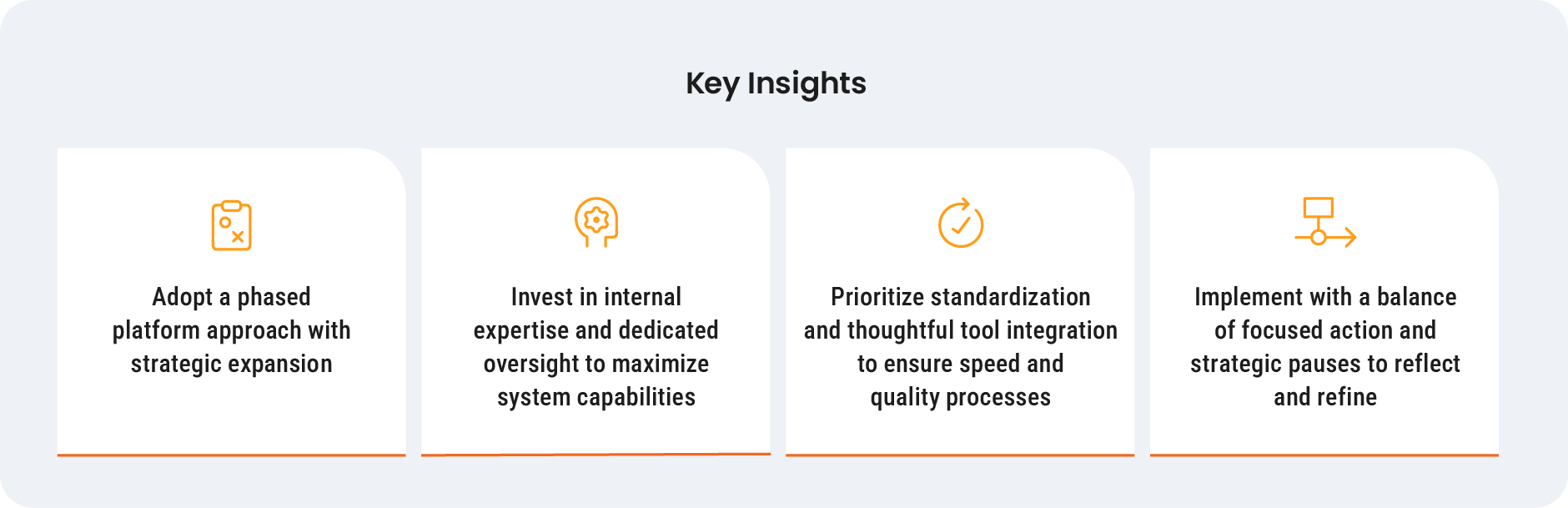
Approach B
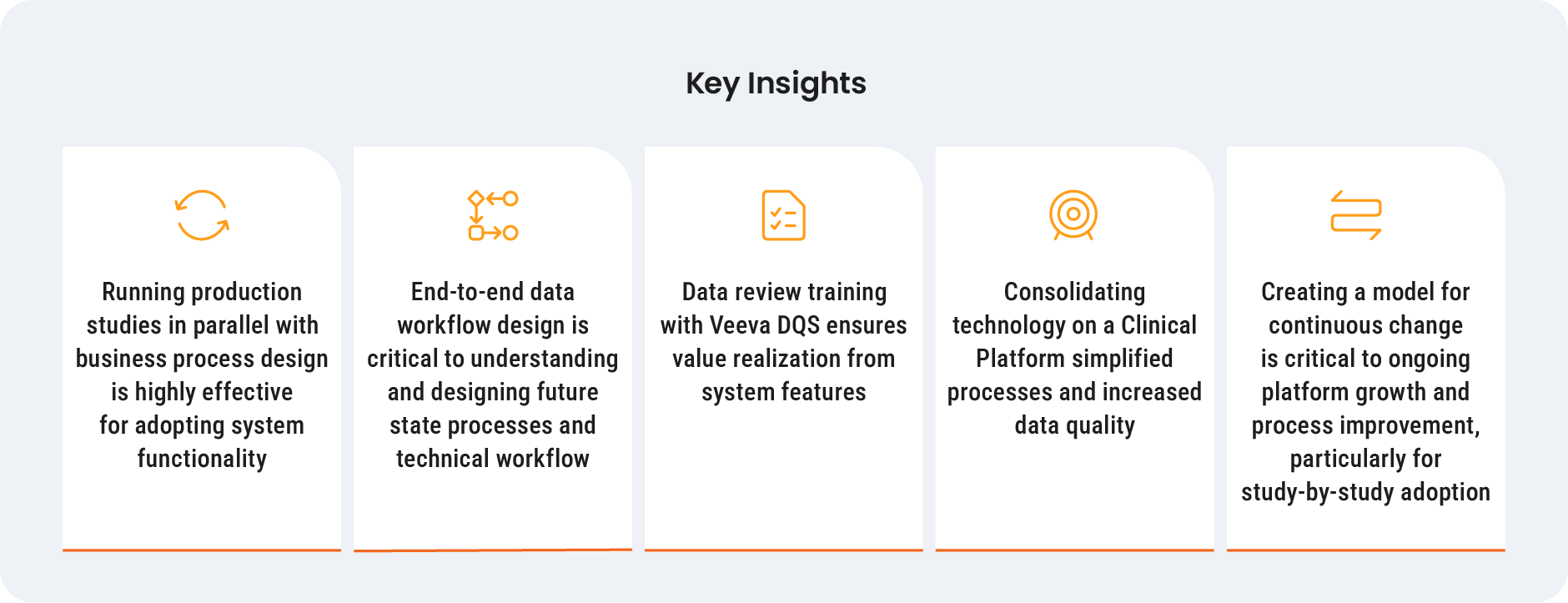
A global biotech company adopted five clinical platform applications at once: Veeva EDC, DQS, CTMS, Site Connect, and Study Training. After the discovery phase, the primary implementation took one year to complete, with the first study going live within six months [Figure 2]. As part of the global library effort, representatives from impacted functions met in person to understand Veeva build and design best practices and create new standards based on Veeva methodology.
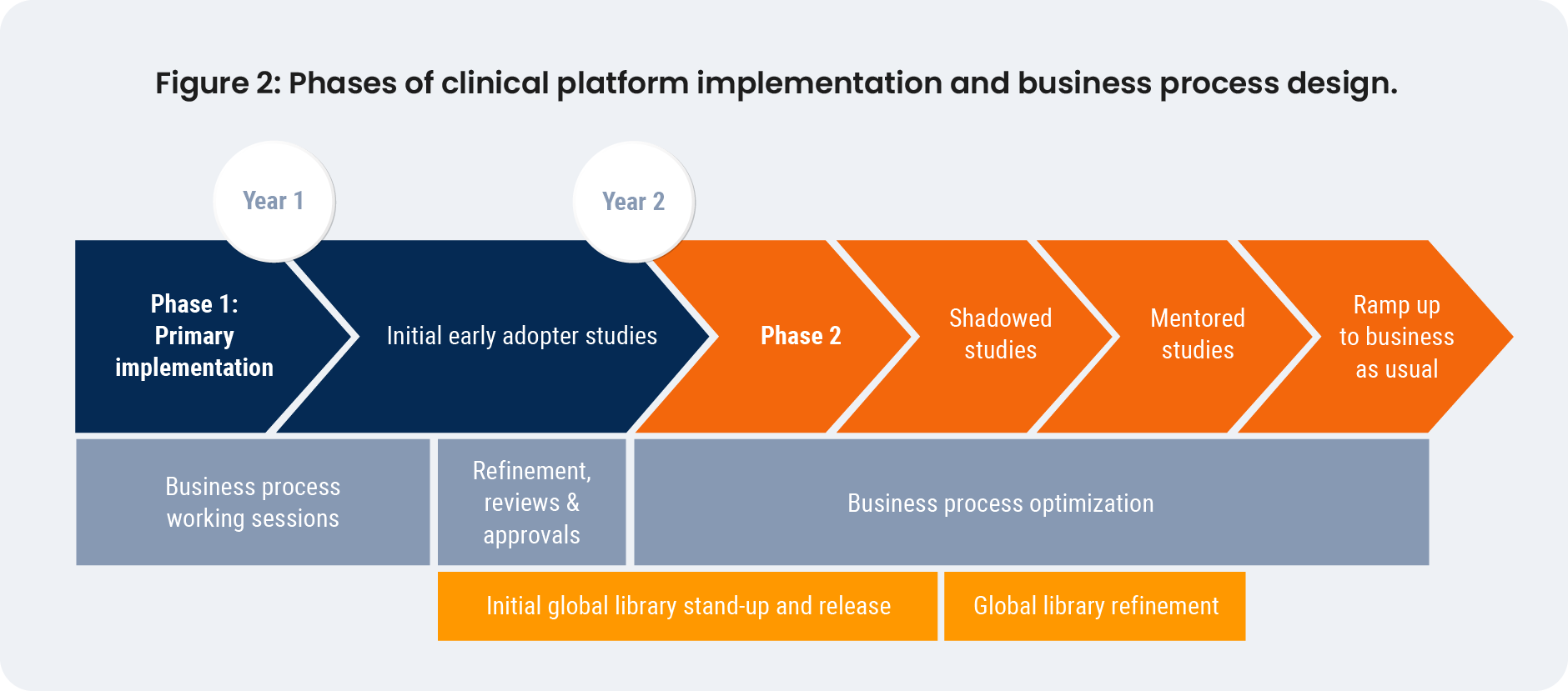
Data management, study builders, data acquisition, biostatistics, coding, safety, EDC operations, and key clinical operations teams were involved in implementing the Veeva Clinical Platform. To ensure cohesive adoption and streamlined process change, the company identified key stakeholders across the implementation: process owners armed with decision making power to define future state processes, SMEs to support global library definition and standards refinement, and super users to ensure knowledge transfer as part of the change management strategy.
Approach C
A global healthcare company adopted ten clinical applications in one project, completing the full Veeva Clinical Platform. The company recently implemented Veeva CTMS, Study Startup, and Study Training on top of the existing eTMF, to support all new and existing active clinical studies. However, under a new digital transformation initiative, the company has embarked on a pilot of the full Veeva Clinical Platform; Veeva eTMF, CTMS, SSU, EDC, DQS, eCOA, RTSM, Site Connect, Study Training, and Payments for a seamless connection between clinical data and clinical operations.
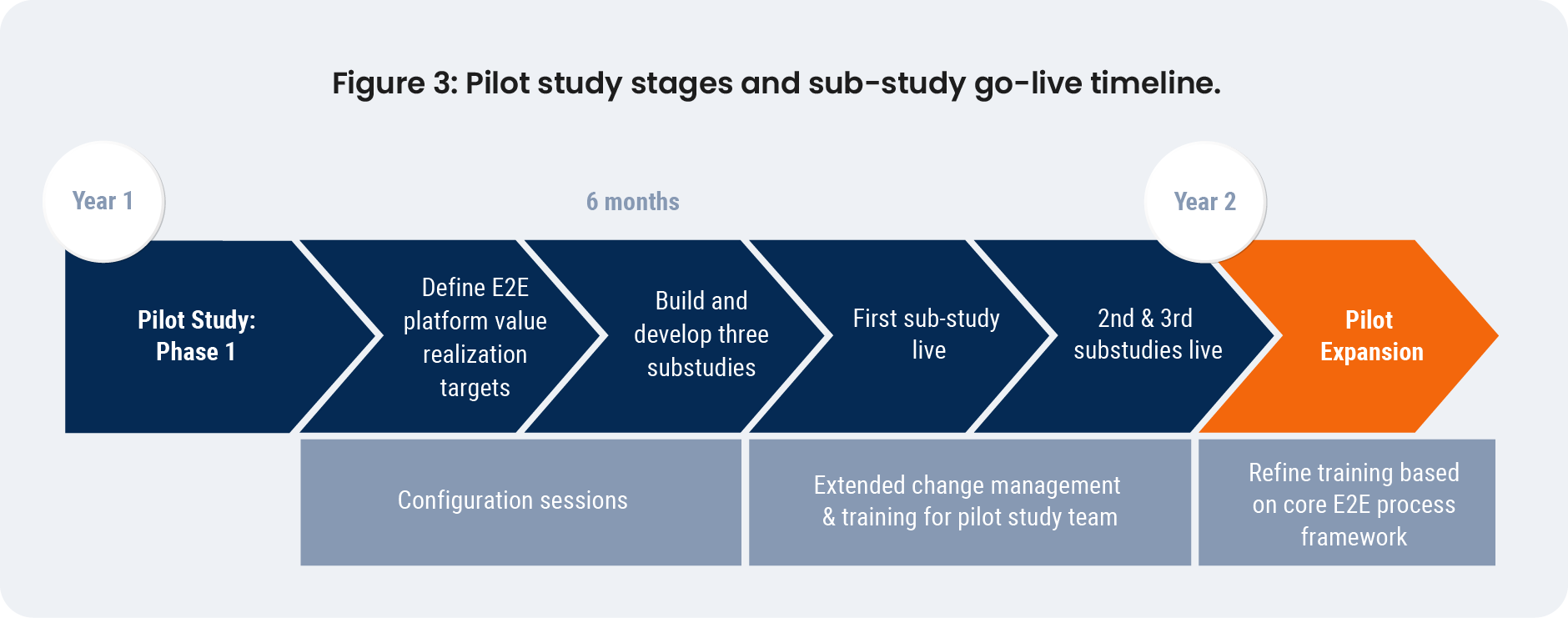
The company plans to sunset its existing development organization and piloted a new organization, which implemented the new applications out of the box with minimal configurations. Rather than conduct business process workshops, configuration sessions were used to determine essential requirements. The Phase I pilot study consisted of a single and two multiple ascending dose substudies, which were built leveraging Veeva’s Master Protocol functionality, and developed simultaneously right from the start across the clinical platform [Figure 3].
The pilot expansion may include increasing the volume of studies on the clinical platform, and/or expanding technical capabilities by implementing Veeva AI, utilizing new features such as RBQM via Veeva DQS and CTMS, and adding applications such as Disclosures or OpenData Clinical.
The project involved an SME from each function, representing clinical operations, data management, biostatistics, trial supply management, study management, TMF managers, Site Monitoring, Medical, Quality, Regulatory and Safety, in addition to process and system training leads. The pilot expansion will launch with larger, more complex trials on the platform, expanding the technical capabilities by implementing applications like Disclosures and Falcon.
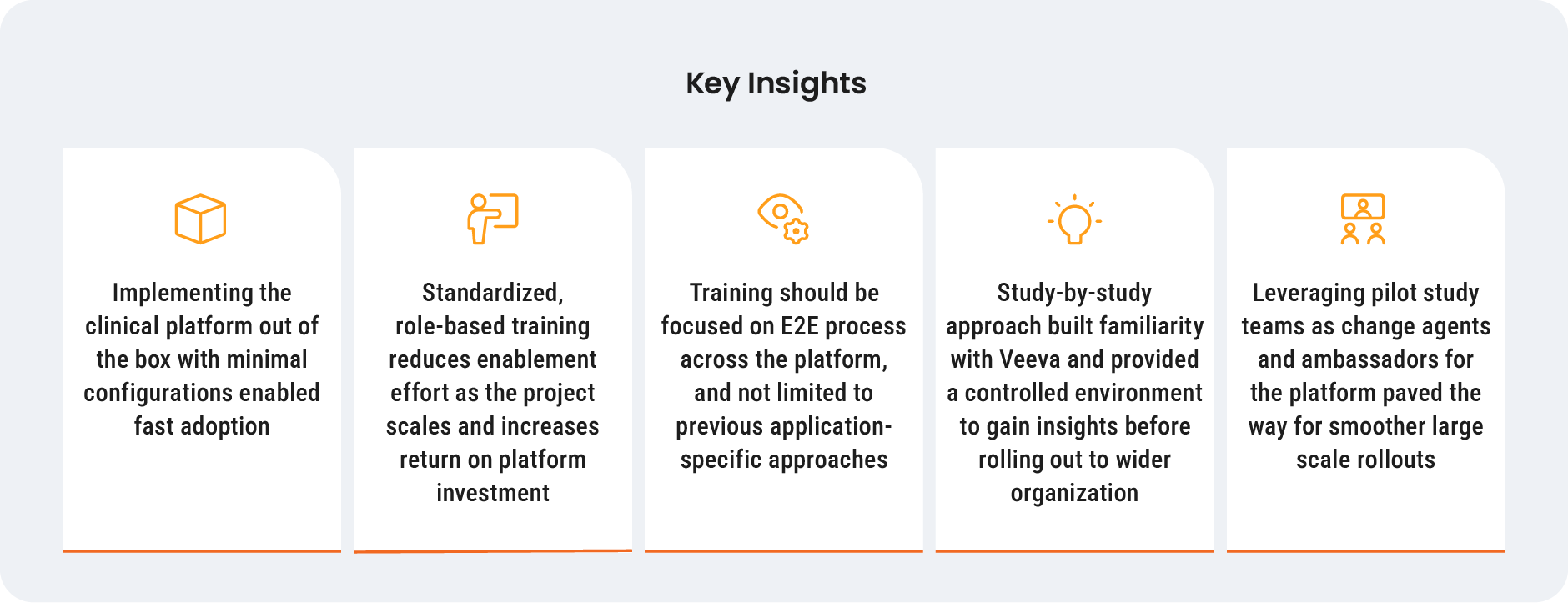
To enable change, the company focused on a scalable, role-based learning model that supports future studies without proportionally increasing enablement effort. Rather than focusing on application specific approaches, training is delivered according to end-to-end processes across the platform. For example, data managers are taught how to manage automatic and manual protocol deviations across the platform to ensure correct data and actions flow into CTMS, to support Study Managers and CRAs with their follow up activities.
Conclusion and next steps
Don’t let the fear of change restrict your company’s ability to gain platform efficiency today and lay a foundation for growth. Contact your Veeva Account Partner to discuss what agile implementation of a clinical platform would look like for your organization.
Get in touch to discuss your organization’s adoption plan.