Mergers, Acquisitions and Divestitures: From Strategic Intent to Executional Excellence
Mergers, acquisitions, and divestitures in life sciences are a strategic pivot point that requires effective integration of technology, data, and processes.
After several years of restraint, dealmaking in the life sciences industry has returned with vigor. Mergers and acquisitions (M&A) reached approximately $200 billion in the first half of 2026 — a jump of roughly 140% over the same period a year earlier. The first quarter alone surpassed $65 billion, the sector’s strongest quarter since 2020, with no signs of slowing
down.1
With more than 200 drug patents expiring in the coming years, companies are rushing to replenish their pipelines. Meanwhile, a favorable macroeconomic and antitrust environment enables bold strategic moves. In response, mergers, acquisitions, and divestitures are picking up momentum as tools for growth and portfolio reshaping.
Yet a strong strategic rationale is only part of the equation. Execution determines whether that value is ultimately realized or not. In life sciences, regulatory compliance is essential and there is no tolerance for operational disruption, regardless of sponsor size. Companies may underestimate the planning required to make the right decisions when combining two organizations or separating one.
This also holds true for the technological aspects of such transactions. With Veeva’s Vault Platform as the operational backbone for a majority of pharmaceutical companies, technology and business process changes as a result of M&A represent a major component to evaluate. Without a structured approach, strategic objectives may be put at risk. If done well, costly technical and process debt can be mitigated.
Uncoordinated execution is an undermanaged risk in M&A
Definitions
Signing: Legally binding commitment to the deal.
Closing: Final milestone where regulatory conditions are met, funds are transferred, and ownership of the asset or pipeline officially changes hands
Day 1: First operational day post-closing where new ownership or separation takes effect.
Effective integration of technology, data and processes — or their effective separation — is a labor-intensive undertaking and success requires the right focus, especially during the window between signing and closing of an M&A deal or divestiture. More often than not, organizations that succeed approach the process proactively as a structured program spanning from pre-close planning to post-close stabilization.
By contrast, the cost of inaction compounds across the deal lifecycle, leading to persisting inefficiencies, rework, and unrealized deal value. Fewer than half of acquirers follow a structured M&A playbook — leaving execution, where synergies are actually realized, as the most consistently undermanaged risk in the deal.2
Across integrations and separations, common technology-related issues can be clustered into five areas:
- Suboptimal technology choices: No informed decisions on go-forward technology stack and data integration, leading to value erosion.
- Slow path to steady state operations: Legacy and new technology setups running in parallel far longer than planned.
- Siloed integration efforts: Uncoordinated workstreams that drive continuous rework.
- Operational inefficiencies: Lack of clarity on go-forward processes and ways of working, slow adoption.
- Regulatory risk: Key studies and submissions put at risk during extended technical transition periods.
This holds true even when a deal appears to be a straightforward acquisition of intellectual property or a single pharmaceutical asset. The assumption that such a transaction is simply a matter of moving data from one system to another rarely holds up in practice. Transfer of data and documentation always needs to be planned and managed carefully to avoid compromising compliance and audit trails, especially in the case of ongoing submissions.
Proactive and intentional planning forms the basis for success
A key part of any merger, acquisition, or divestiture is integrating or separating the underlying technology and data architecture. As Veeva is often a common denominator for the life sciences industry, there is a high likelihood that the Veeva Vault Platform and other Veeva products are components of any integration or separation.
When Veeva Vault ecosystems are integrated as part of a merger or acquisition, or separated as part of a divestiture, it is important that organizations conduct a structured assessment and thorough post-close planning. Technology and data are often where the conversation starts, but they are only part of the picture. Integrations and separations also reshape business processes and change the way people work. Programs scoped narrowly around systems and migration alone tend to underestimate the process, change management, and program governance needed to ensure successful execution and sustained adoption.
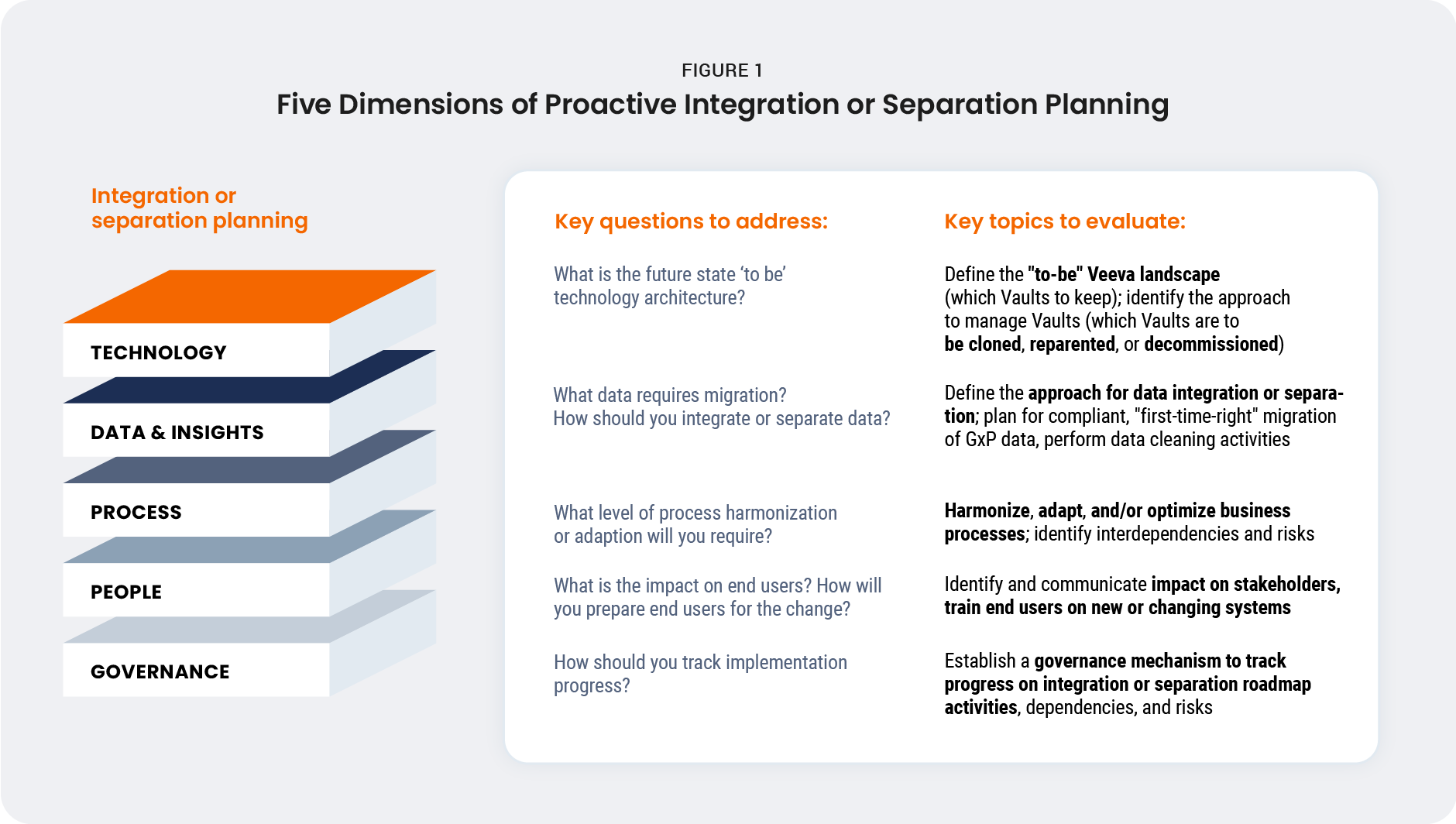
Taking a broader view from the outset helps avoid this. In practice, that means that organizations need to drive clarity across five dimensions — Technology, Data, Process, People, and Governance — and ideally establish a clear path to execution pre-close, or as soon as possible thereafter (Figure 1).
Technology
Defining the future-state Veeva landscape is the key decision: Which Vault applications are retained, cloned, or decommissioned, and which integrations (third-party vendors, health authorities) must be re-established? Which Vault AI agents should be kept? In a merger, organizations must agree on which Vault becomes the go-forward standard, including the consolidation and migration strategy. In an acquisition, they must determine if there are any systems that need to permanently stay due to the uniqueness of their portfolio. In a divestiture, they must decide whether the divested entity retains all Vaults or not, and how to carve the divested entity out of shared Vault environments.
Data
In Veeva Vault, regulated content and its records carry immutable audit history, so any migration or separation needs to carefully consider data integrity to minimize compliance risk. A merger or acquisition requires a data integration framework that supports the subsequent migration of the acquired entity’s records without corrupting the clinical and regulatory history those records represent. A divestiture requires a separation framework that delineates what data and records move with the divested entity, what is replicated, and what stays for ongoing regulatory obligations.
Process
Reviewing processes in parallel with technology decisions creates an opportunity to optimize best practices and critical paths. Failing to review processes risks embedding inefficiencies that become costly to resolve later. A merger or acquisition requires harmonizing divergent legacy processes into a single standard and, if done well, provides an opportunity to build a better process than either side had before. Acquired companies often adopt the acquirer’s established business processes, but this shouldn’t be automatic; where the acquired company operates in a distinct therapeutic area or remains independent, its existing processes may be the better starting point. A divestiture requires ensuring continuous process ownership and accountability but also offers an opportunity to adjust business processes to reflect post-divestiture operations.
People
Structured change management moves end users onto the go-forward platform, shortens the productivity dip that follows any transition, and keeps users informed of changes impacting their user experience, such as freeze periods during migrations.
Governance
Governance keeps Veeva-related activities on time and decision-ready, with clear accountability and rapid risk mitigation. Most organizations assign a dedicated Veeva workstream lead with authority over scope and timeline to orchestrate execution and track progress through to stabilization, often reporting into an overall Project Management Office (PMO).
The weight each dimension carries depends on the type of deal. For example, when a large organization acquires a small or mid-sized business, the to-be technology stack is often not in question; the acquirer’s landscape likely prevails, and the focus shifts to migrating the acquired data and processes into it, as well as training end users on new systems. In a merger of equals, the harder question is whose technology becomes the new standard. Lastly, if an acquired asset sits in a therapeutic area that is new to the acquirer, they must examine existing processes and configurations to support it.
| Day 1 readiness looks different for integrations and separations |
|---|
| Day 1, i.e., the point in time when the transaction becomes operationally effective, does not require finished migrations, but it does require operational clarity and continuous compliance within all Vault operations, which differs by deal type. |
| Merger or acquisition | Divestiture |
|---|---|
| The priority is rapid harmonization following Day 1, including a clear execution roadmap so Veeva applications do not run in parallel longer than necessary and clarified ways of working to minimize inefficiencies. | An operational separation must often be in place by Day 1, including updated access rights, a clearly defined data separation approach, clarified process ownership, and signed agreements to govern jointly owned Vaults and shared processes in the interim. |
Minimize disruption, mitigate risks, and reach steady-state operations faster
Veeva leverages a tried and tested methodology to support life sciences companies as they plan and execute complex integrations and separations of Vault ecosystems. The goal is to minimize disruption to business-critical operations and ensure they reach steady-state operations rapidly.
Definitions
Cloning Setting up a new Vault as configuration copy from an existing one.
Migration: Moving and consolidating data into an environment.
Reparenting: Moving a Vault to another domain.
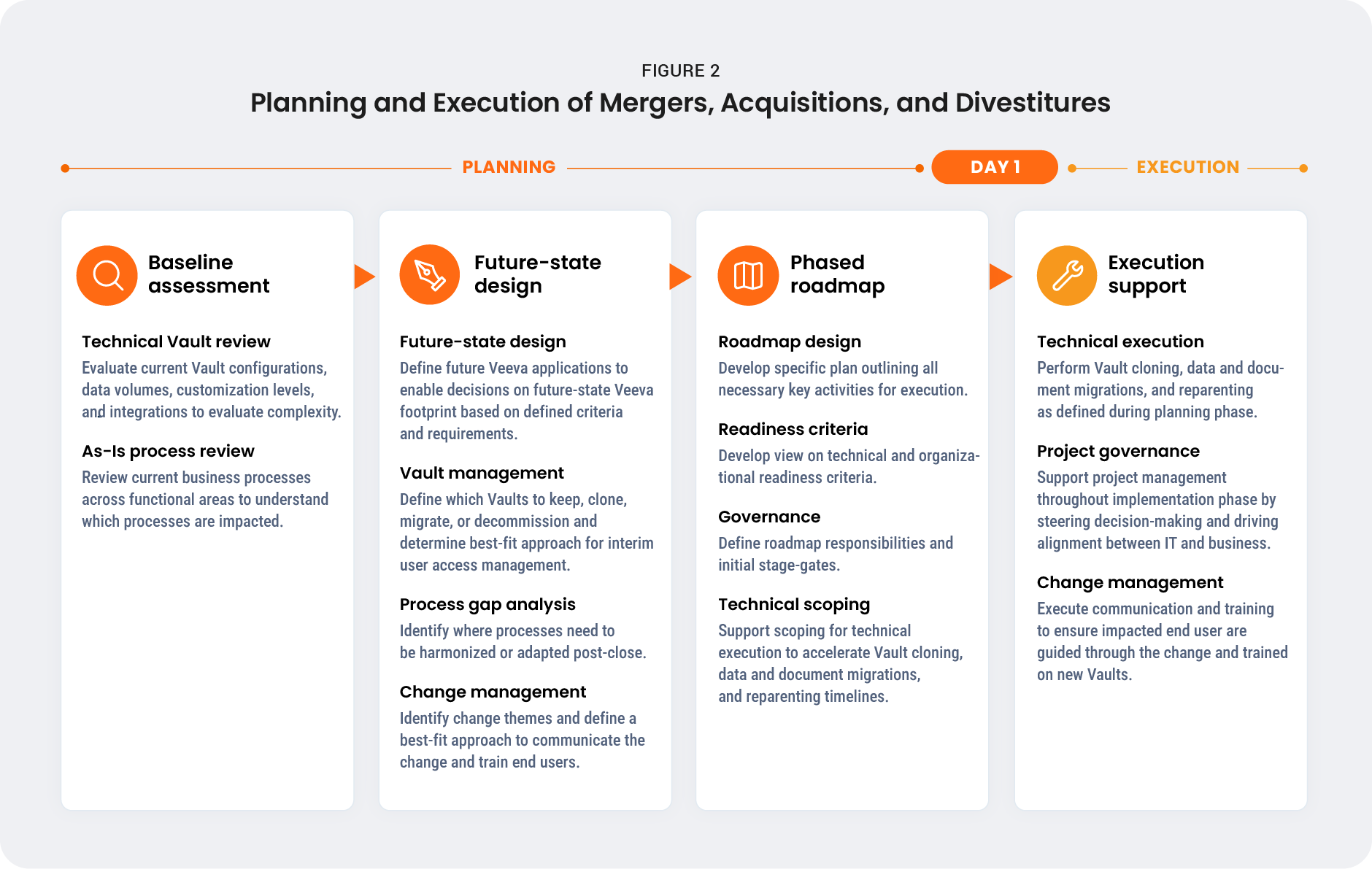
Veeva’s approach is structured into planning and execution phases, with planning ideally (but not necessarily) concluded ahead of Day 1. The approach begins with a baseline assessment, which evaluates the current Vault ecosystem alongside a review of end-to-end business processes to understand the areas impacted by an integration or separation. From there, Veeva supports customers in defining the future-state Vault ecosystem including decisions on the future Veeva footprint, and where required, an approach for cloning, migration, reparenting, and decommissioning for each Vault. As part of this, we identify process gaps and dependencies, and jointly define a fit-for-purpose change management strategy.
Ultimately, Veeva supports customers by translating all findings into a phased roadmap that sequences activities before and after Day 1 in consideration of business-critical operations. This can include defining readiness criteria and governance, as well as scoping the technical execution and mapping out key activities to follow any Vault cloning, migration, or reparenting work, such as validation. Customers will also need to consider whether they need hands-on execution support, including the technical execution of cloning, migration, reparenting, and Vault-to-Vault transfer activities, as well as project governance and organizational change management.
Executional excellence helps minimize redundancies and risks
Ultimately, a successful merger, acquisition, or divestiture is not merely a transaction to be managed — it is a strategic pivot point. Life sciences companies can transform a period of profound organizational change into a catalyst for operational excellence by combining a disciplined execution methodology with the native flexibility of the Veeva Vault Platform.
Executional excellence in mergers, acquisitions and divestitures helps minimize redundancies and compliance risks, while unlocking efficiencies and ensuring adoption. Most importantly, though, it allows organizations to keep their primary focus where it belongs: driving innovation and delivering life-changing therapies to patients.
Reach out to the Veeva Business Consulting team to learn more and create a strategic advantage now.
1 EY-Parthenon, H1 2026 Life Sciences M&A Analysis; PwC, Pharmaceutical and life sciences: U.S. Deals 2026 midyear outlook.
2 Global PMI Partners, 2025 M&A Success Survey Report.