The Essential Ingredient for GxP Training Innovation
Learn how to launch a training innovation project with maximum impact while avoiding the 'innovation trap'.
Setting the foundations for technology investment
Life sciences organizations are rapidly adopting advanced learning technologies to improve workforce readiness, including adaptive learning, xAPI, AI-driven content creation, and recommendation engines.
However, the success of these tools depends on the health of the underlying training matrix.
This article examines a top 10 global contract development and manufacturing organization (CDMO) preparing to migrate to the Veeva Training learning management system (LMS). The organization had fragmented training strategies across a global footprint, and engaged Veeva Learning Strategy Services to conduct a comprehensive gap analysis and training matrix optimization.
When properly calibrated, a role-based training architecture is a strategic imperative for life sciences companies. For instance, the CDMO remediated over 80,000 line items in its training matrix, recovering hundreds of hours of wasted learner seat time.
Without a robust training foundation, organizations risk automating inefficient processes, wasting learning and development (L&D) budgets, and missing out on the substantial return on investment that modern learning systems can provide.
The innovation trap
While blended learning and interactive eLearnings are valuable tools for modern training professionals, focusing on content authoring before securing a robust training matrix creates an "innovation trap".
Deploying a learning management system on top of chaotic, misaligned data accelerates the delivery of the wrong training to the wrong people. At the same time, investing in automation features yields limited value if a company's foundational data cannot support the proper application of those features.
When directed thoughtfully, training technology spend should mean reduced compliance risk, lower administrative overhead, and recovery of lost operational hours But before turning on any new system, an organization must accurately understand the roles, tasks, and required competencies to achieve its goals.

Customer spotlight: managing complexity at scale
The significance of a robust training matrix foundation is highlighted by a 2025 Veeva Training implementation at a top 10 global CDMO.
The CDMO recognized that unrefined data migration would blunt the impact of its Veeva Training and Veeva LearnGxP implementations, and initiated a pre-migration "cleanup" to lay the groundwork for the switch.
THE CUSTOMER: KEY STATS
Disconnected processes and structural challenges
Before the project, the CDMO's training landscape was highly fragmented. Its six GMP manufacturing facilities operated in silos, resulting in unharmonized assignment plans for 10,000 learners.
Key Structural Issues Included:
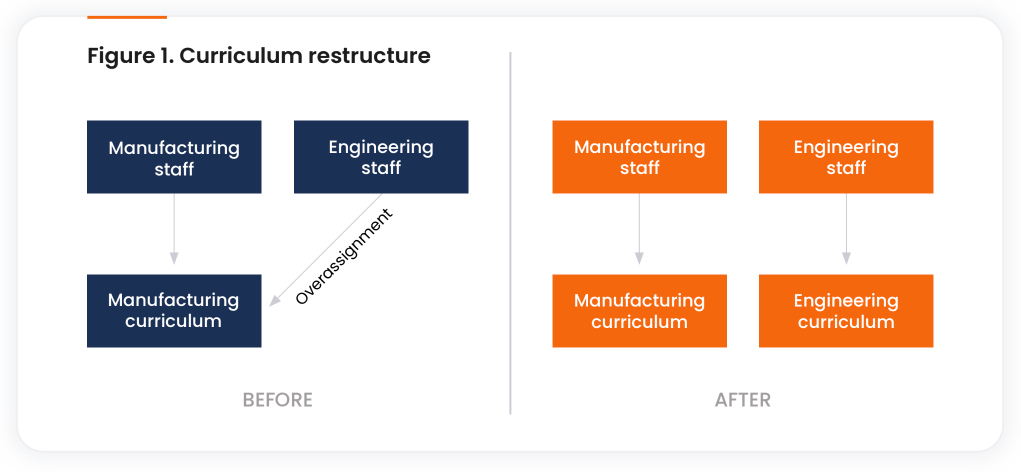
- Rigid assignments: Learner assignment groups and curricula were built in a strict one-to-one fashion, resulting in widespread overassignment.
- Bloated curricula: "Bucket" curricula averaged over 75 distinct training items per person, creating unstructured learning paths.
- Lack of traceability: Because content was grouped in these large buckets, tracking qualification for individual, role-specific tasks was highly challenging.
The methodology: data-driven optimization
To rectify these structural issues, the CDMO provided reporting and data from its legacy LMS. The Veeva Learning Strategy Services team then performed a comprehensive data analysis, risk assessment, and curriculum redesign project.
Finding the weaknesses
Veeva Learning Strategy Services conducted a holistic review of the legacy data, identifying inefficiencies such as:
- Full and partial duplications at all levels of the matrix
- Orphaned training items and empty assignment structures
- Misalignments between system data ownership and the learners receiving assignments
- Discrepancies in departmental and organizational mapping
Identified weaknesses were prioritized and assessed based on compliance risk and potential impact on the usability of Veeva Training.
This risk assessment was built around regulatory expectations, namely ICH Q10 and its two pharmaceutical quality system (PQS) "enablers" of knowledge and risk management. By aligning with these enablers, the assessment sought to preserve operational knowledge regarding LMS system usage while mitigating GxP compliance risk.
Rebuilding with best practice
To rebuild the CDMO's legacy curricula, the Learning Strategy Services team first identified system duplications, orphaned or empty structures, and organizational mapping discrepancies.
Once they had identified those high-risk areas of the curricula, the team applied multiple deconstruction methods to ensure curricula were modular, targeted, and highly relevant for the learner:
- Ownership vs. assignment alignment: The first method evaluated the relationship between the department that owned the curriculum and the learners assigned to it. The Veeva team separated content into modular curricula that targeted specific job functions accurately, eliminating overassignment.
- Task-based anchoring: The second method applied high-effort, task-based events, such as on-the-job training (OJT) and formal quizzes, as the foundational anchors for new curricula. Related contextual training (such as SOPs) was then mapped directly to it, ensuring learners received appropriate context precisely when they needed it to qualify for a task.
Simplified processes, clear efficiency gains
During its analysis, Veeva Learning Strategy Services identified a quality control (QC) microbiology curriculum assigned to manufacturing (MFG) staff. While MFG personnel need a basic understanding of microbial impacts on product quality and patient safety, assigning an entire 75-item QC curriculum resulted in significant wasted time. The results of restructuring the curriculum were significant:
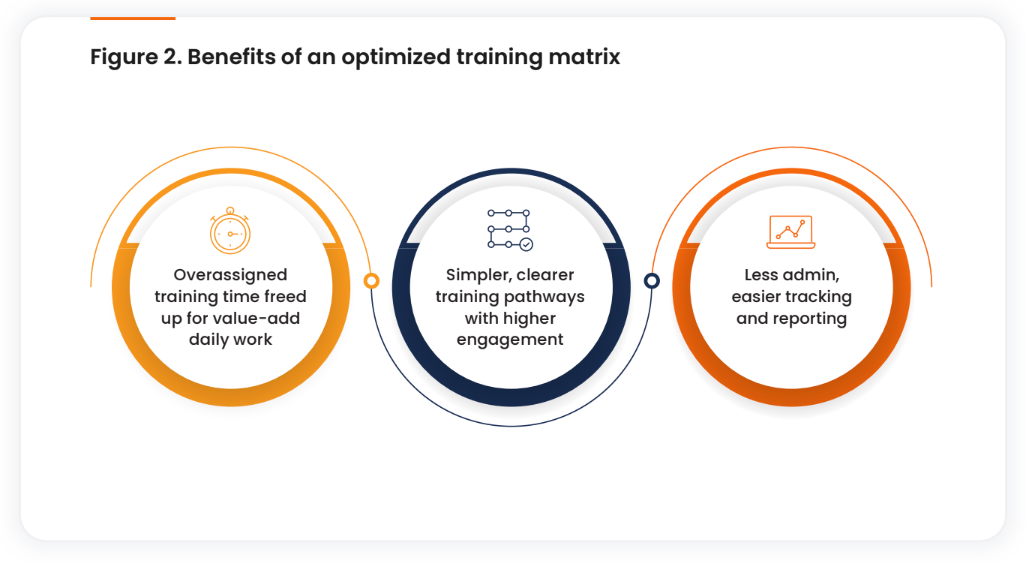
- Recovered operational hours: 58 SOPs and five quizzes identified as irrelevant to MFG roles were removed, resulting in a 31% reduction in assignments for those roles. This single restructuring led to an annual saving of over 300 hours of MFG learner seat time, amounting to significant efficiency gains across a global matrix of 10,000 learners.
- Reduced administrative burden: The team also identified 16 redundant SOPs within the QC curriculum that had been assigned in a separate curriculum. Removing redundancies clarified training expectations for managers, eliminated the confusion and administrative burden of overlapping assignment rules, and simplified reporting.
Laying the groundwork for a modern LMS
By the project's conclusion, the risk-based gap analysis performed by Veeva Learning Strategy Services had impacted over 80,000 unique line items across the CDMO's training matrix.
This analysis helped the CDMO to maximize its use of key functionality in Veeva Training and LearnGxP:
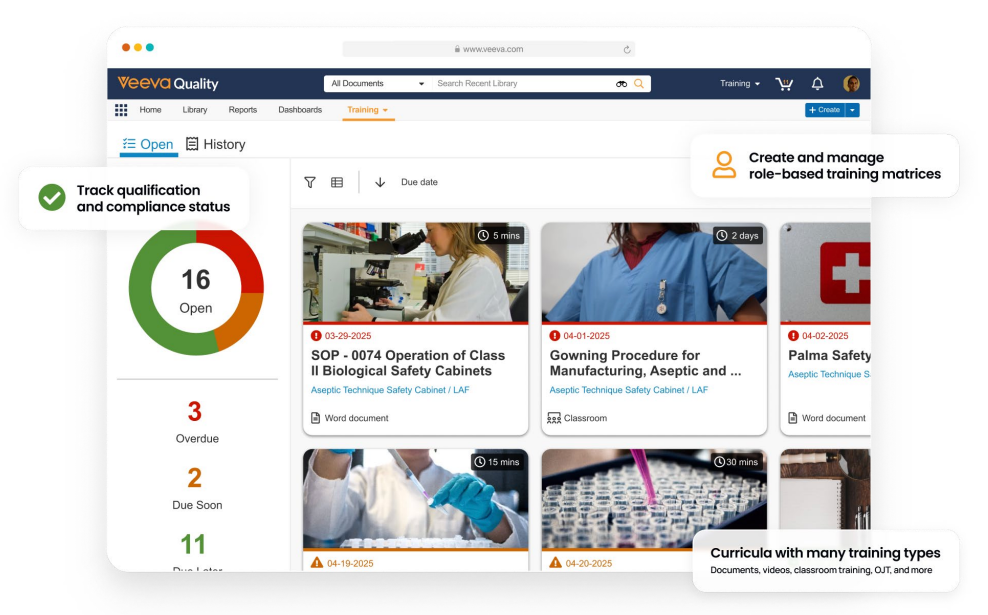
- Automated assignments: By breaking down curricula into targeted, modular components, the CDMO could confidently adopt Veeva's dynamic enrollment and curriculum matching features. Structured data allowed the LMS to automate assignments based on learner attributes without the risk of overassignment.
- Targeted eLearning: The newly optimized, role-based matrix provided a clear roadmap for adopting the LearnGxP catalog across the enterprise.
The strategic importance of training architecture
A properly calibrated training matrix is the foundation for any successful training strategy. Before organizations invest in advanced learning technologies or automated LMS features, they should ensure their underlying data accurately reflects the roles, tasks, and competencies of their workforce. Attempting to innovate on top of a bloated or misaligned training matrix will only bring budget wastage, administrative friction, and lost productivity.
Evaluate your training setup with Veeva Learning Strategy Services
The Veeva Learning Strategy Services team offers a personalized diagnostic audit of your current training matrix, identifying the symptoms of a suboptimal setup and providing a clear understanding of the potential return on investment of optimization.
Contact the Veeva Training Solutions team today to schedule your diagnostic audit