Veeva PromoMats 2025: A Year in Review
Explore the latest Veeva PromoMats innovations from 2025, featuring new agentic AI capabilities, eCTD and claims enhancements, and more — all designed to improve the reviewer experience, strengthen compliance, and support the fastest path to approved content.
Medical, legal, and regulatory (MLR) review is at the core of commercial content. When optimized, it helps teams move faster, stay compliant,and maintain the quality of materials across brands and markets.
Veeva PromoMats helps life sciences organizations keep pace with growing complexity as content volume rises and regulations evolve. With streamlined workflows and embedded AI in PromoMats, teams manage review and approval more efficiently with less manual effort.Keep reading to explore what’s new in 2025 and how the latest innovations in PromoMats help your teams transform MLR processes by accelerating review to deliver faster, more personalized quality content for your customers.
Building a Scalable Content Foundation
Vault AI in PromoMats
Leverage agentic AI for the fastest path to approved content
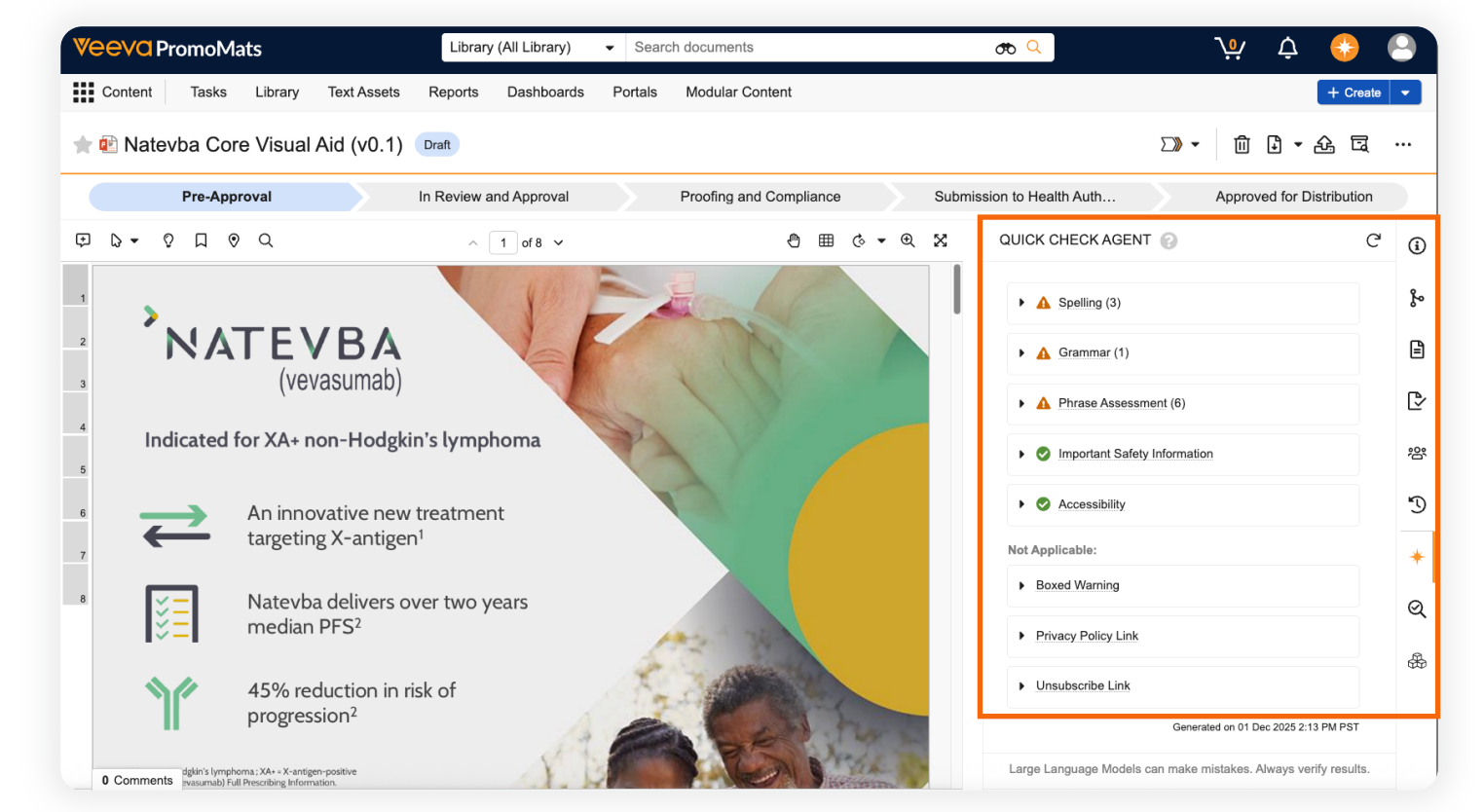
Vault AI in PromoMats (25R3) introduces the first agentic AI capabilities in PromoMats, designed to support the overall MLR review process so teams can work more efficiently. Quick Check Agent evaluates promotional content against editorial, brand, market, and channel guidelines before MLR review to catch issues like spelling, grammar, prohibited phrases, and missing safety information to reduce review cycles and speed approvals. Content Agent provides real-time answers, contextual guidance, and insights during review, giving reviewers clarity to make faster, more confident decisions. We will be introducing additional AI agents in upcoming releases, including a claims management agent and persona-based AI agents that eliminate manual tasks for MLR reviewers.
See how Moderna is pioneering MLR transformation with Veeva AI.
Focused Reviews, Faster Approval
Content Management
Create structure to support scalability
Commercial Content Kernel Enhancements (25R2) introduce new document types and refine labeling categories to standardize how content is organized. This structure establishes stronger organization, improves consistency, and prepares teams for scalable content governance.
Make image-based content searchable and linkable
Embedded text in images can be difficult to locate or validate during review. With OCR for Images in PowerPoint & Word (25R2), text within embedded images is now searchable and supports auto-linking. This helps teams easily substantiate content by allowing claims and references to be connected automatically, improving review efficiency and traceability.
Reviewer Experience
Focusing reviewers on relevant material is essential to achieving efficiencies and optimizing the reviewer experience, especially as teams manage growing volumes of content and greater regulatory scrutiny.
New capabilities help reviewers focus their effort where it counts, streamlining collaboration and accelerating review cycles to keep content delivery on schedule.
Focus on what’s changed to simplify review
Reviewers often spend significant time re-evaluating derivative materials that closely resemble previously approved content. The Similarity Score (25R1) feature calculates a similarity score between two documents, helping teams quickly determine how much new review effort is needed. This capability supports tier-based reviews, allowing reviewers to focus on content that truly requires attention and move derivative materials through approval more efficiently.
Bring forward annotations automatically
Auto-Bring Forward Annotations (25R1) automates the process of carrying annotations, text assets, and resolved notes to new document versions, eliminating the need for users to manually bring forward feedback. The feature preserves accepted and auto-linked claims from previous versions, streamlining content preparation and helping teams maintain context, reduce repetitive work, and ensure consistency across reviews.
Reviewer Readiness
Ensure document readiness before routing
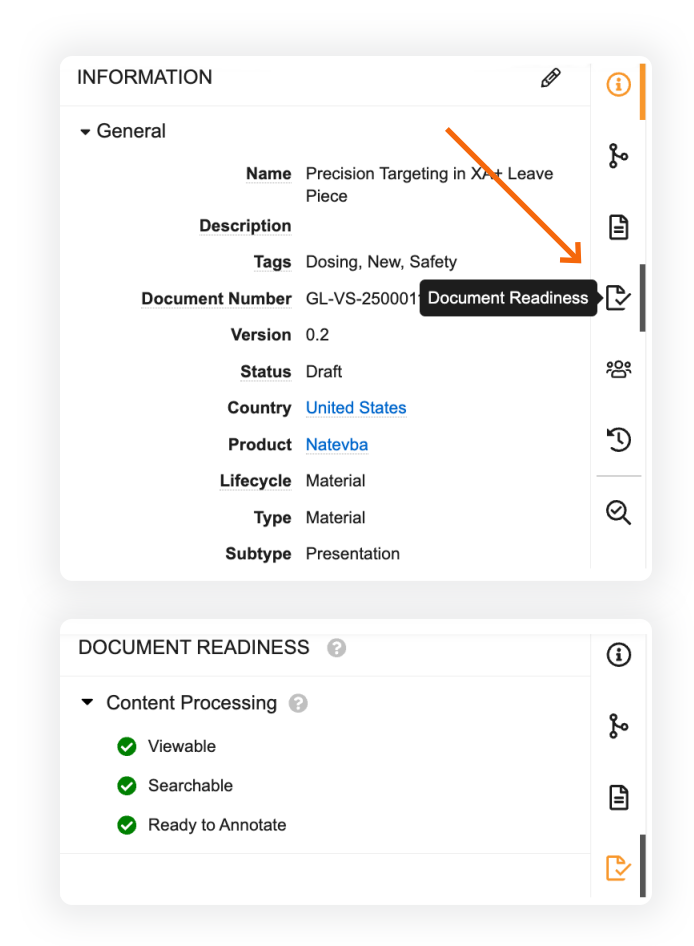
Processing delays can cause document text to not be recognized, a scenario that can cause incomplete substantiation of content. Enhancements to document readiness now reduce this possibility by ensuring content is fully processed before review.
The Document Readiness Panel (25R2) introduces visual readiness indicators and checklists to confirm document completion before routing. Disable Manual Bring Forward Annotations and Suggest Links Until Document Processing is Complete (25R2) prevent users from taking action before OCR processing is finished, ensuring that annotations and links are applied only after content is fully processed. Together, these updates ensure completeness and reduce the risk of errors and rework.
Strengthen Claims Management
Claims
Enhance claims processes
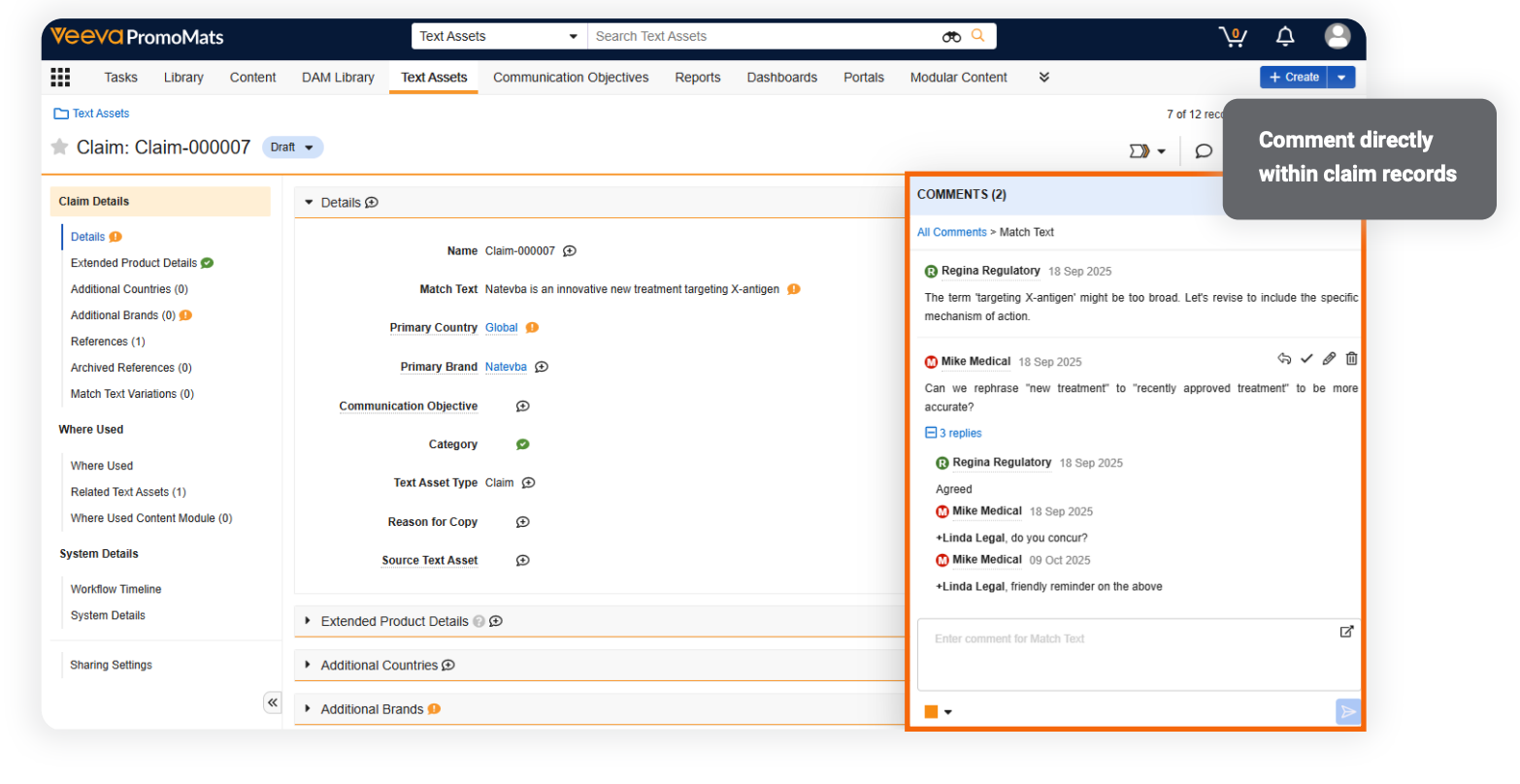
Efficient claims management requires seamless collaboration and connected review processes. PromoMats helps deliver both. Auto-Link PreLaunch Claims (25R3) allows users to link prelaunch claims to prelaunch materials, improving traceability during prelaunch activity and ensuring that relationships between claims and materials are preserved throughout the lifecycle. This makes it easier to incorporate updates once the final label is received. At the same time, Claims Commenting for Review & Approval (25R3) introduces a dedicated space for claim discussions, allowing reviewers to exchange feedback directly within claim records before final approval. Teams can see prior discussions, maintain context, and keep claims-related feedback organized during review. Together, these capabilities simplify claims management, improve visibility, and make the Claims Library more centralized, relevant, and searchable.
Eliminate duplicate links to streamline substantiation
As content volume grows, managing duplicate claim links can create unnecessary work for users substantiating materials. Claims: Auto-Linking Deduplication (25R2) prevents the re-suggestion of previously rejected links, reducing manual effort and minimizing repetitive work. By removing redundant suggestions early, agencies and content owners can streamline the substantiation process and improve efficiency, ensuring reviewers see only new, relevant claims during MLR.
Deliver more accurate claim matching across materials
Agencies and brand teams need precision when linking claims to materials, ensuring only claims that match the correct brand, form, and variant are applied. With the Product Data Model for Auto-Linking (25R2) now incorporated into text assets, auto-linking gains increased specificity when identifying and connecting related substantiation. This enhancement improves linking accuracy, reduces manual correction, and helps teams maintain consistent, compliant substantiation across all materials.
QUICK TIP
While the deduplication feature skips previously rejected claims links, a new user action can be configured to specifically run auto-linking with previously rejected links included.
Increased Compliance
eCTD
Improve submission accuracy and prevent incomplete packages
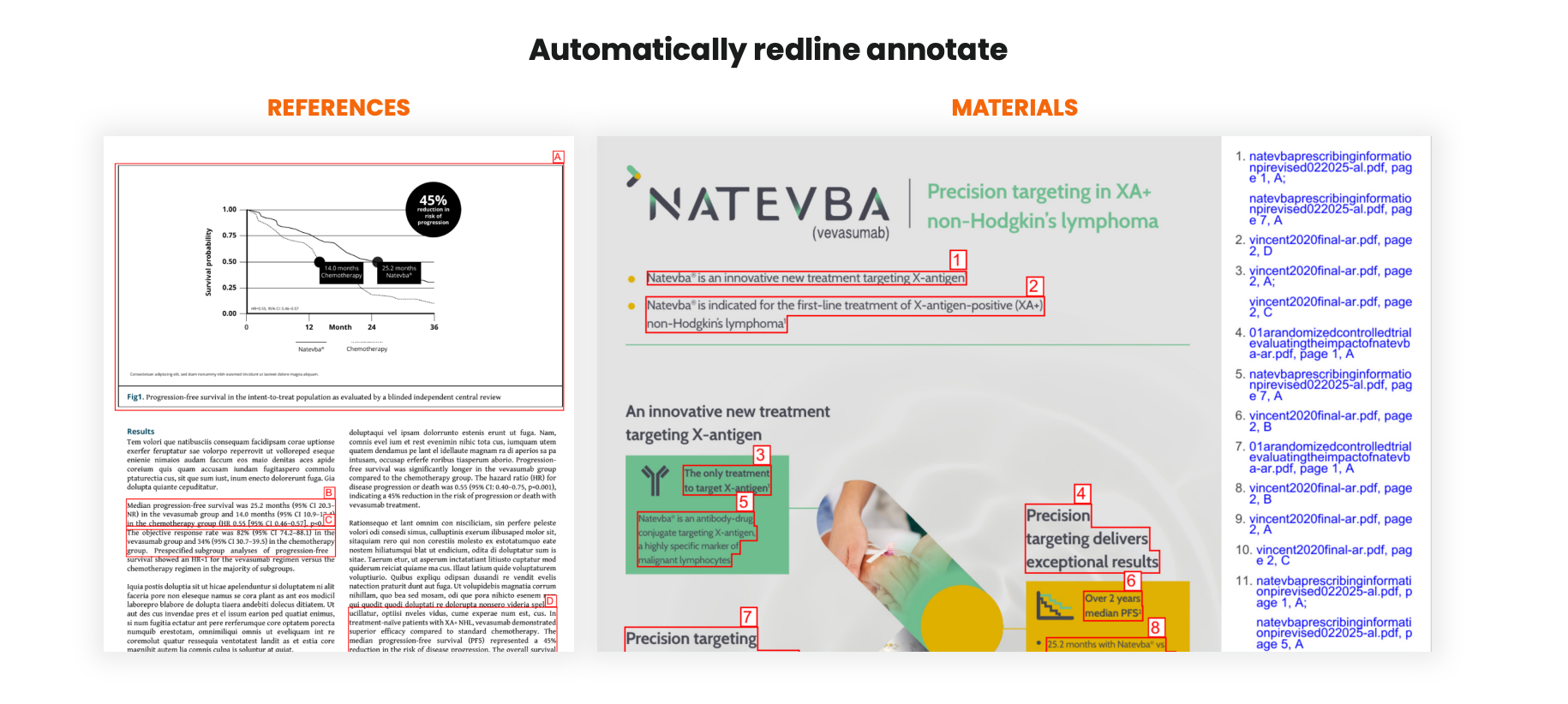
Delivering accurate and complete compliance packages quickly is essential for maintaining regulatory confidence, as incomplete documentation can delay submissions and create audit risk. Redline Annotations (25R1) automate the creation of redline annotations required for FDA pre-clearance submissions, where reference substantiation must be annotated on promotional materials. This feature replaces the manual process by generating redlines directly in Vault using existing link annotations. It saves time for reviewers and ensures that submission packages are accurate and ready for FDA review. Empty Required Fields Warning Messages (25R1) alerts users when key document metadata is missing from compliance packages, preventing incomplete submissions. These eCTD innovations help teams strengthen submission accuracy, prevent missing data, and deliver complete packages.
Streamlined Collaboration and Access
Portals
Teams need reliable access to the latest approved materials to ensure content consistency across brands and regions. Recent updates to Portals make that possible by automatically keeping shared content up to date and giving teams better visibility into what’s approved for use.
Keep shared content up to date
Curating Portal content often required ongoing manual updates, which made it challenging to keep materials current. While curation remains an important part of Portal management, certain scenarios benefit from a more automated and flexible approach. Dynamic Portal Widgets (25R2) can now populate content based on predefined filters, automatically updating the Homepage directly from document metadata. This reduces manual effort and helps Portal Managers to keep materials up to date without making frequent adjustments.
Improve visibility and access to content
Managing access across teams can create visibility gaps and inconsistencies in what users see, making it difficult to direct them to specific content. PromoMats bridges this gap with Shareable Portal Links (25R3) that enable permissions-based access to specific Portals or Portal widgets via URLs. This allows teams to easily share curated views and provide access to key content faster.
Simplify Access Management
Automate access control
Brand Team Security Management (25R3) introduces the concept of Brand Teams in PromoMats, simplifying and automating access control administration. Using the new Team, Team Assignment, and Team Member objects, administrators can group users into teams and automatically create or remove associated user role setup and user role records. This automation reduces the manual effort needed to manage access, ensuring that users are assigned the correct security settings based on their team membership while maintaining alignment with existing Vault security structures.
A More Connected Content Ecosystem
Vault Connections
Strengthen data continuity across Vaults
Bringing together data from different systems helps teams maintain alignment across the full content lifecycle. With PromoMats–CRM Product Data Transfer and Metadata Sync (25R3), product, indication, and CRM metadata are automatically synchronized across Vaults, ensuring every team works with accurate and consistent data. This creates a single source of truth for product information and improves crossfunctional visibility.
Regulatory alignment also becomes easier with RIM–PromoMats Product Registration Check (25R1), which automatically verifies that promotional content references only approved products. This integration reduces the risk of misaligned submissions and helps teams maintain compliance across regions and brands.
Improve collaboration between Medical and Commercial teams
As scientific and promotional content evolve in parallel, keeping related materials synchronized can be time-consuming and challenging. The Auto Update Anchor Support (25R2) enhancement for the PromoMats–Medical Connection automatically refreshes anchors when referenced medical documents are versioned, ensuring claims and scientific references stay aligned across systems. This enhancement streamlines claim administration by reducing manual updates and simplifies Reference Library management by allowing references to be shared between MedComms and PromoMats, providing a more seamless experience for users managing shared content.