Making CRM Stick: Applying Behavioral Science to Drive Adoption at Scale
Designing for human behavior
Part 1 and Part 2 of this series established the strategic vision and the operational blueprint for CRM value: success is a business capability, engineered through a rigorous link between outcomes and behaviors. However, identifying the ‘what’ and ‘how’ of target behaviors is only half the challenge; the final, and often most difficult, hurdle is ensuring those behaviors actually stick.
Many programs clearly articulate their desired changes — such as planning in CRM or acting on AI-driven insights — yet still struggle with declining usage and a return to old habits once the initial launch excitement fades. This is not a failure of intent, but a failure to account for how humans actually behave.
In Part 3, we move from behavioral definition to behavioral design. Drawing on proven principles from behavioral science, we outline a practical playbook to move beyond the limitations of traditional training. We explore how to design an environment where the right behaviors become easy, obvious, and socially reinforced, turning intentional actions into permanent habits that drive long-term commercial impact.
The essential role of behavioral science
Many CRM programs clearly articulate what they want people to do differently — plan in CRM, log interactions, coordinate across teams, act on insights — yet still struggle with inconsistent adoption, declining usage over time, and a return to old habits.
This is not a failure of intent or effort. It is a failure to account for how humans actually behave. People do not change behavior because they are told to. They change when the environment makes the new behavior:
- Easier than the old one
- More visible and socially reinforced
- Safer and more confidence-building
- Immediately rewarding
This is where behavioral science provides a powerful, practical lens for CRM transformation. To drive lasting results, organizations pivot from simply identifying required behaviors to mastering the science of how to embed and sustain those behaviors.
Why?
- Because CRM adoption is not a communications problem.
- It is not a training problem.
- And it is certainly not a technology problem.
It is a behavioral design challenge — and one that can be systematically solved by creating an environment where the right actions become the path of least resistance.
The building blocks of behavioral change
Below are 10 principles that translate behavioral theory into practical CRM adoption tactics.
Figure 1: Veeva’s behavioral change framework
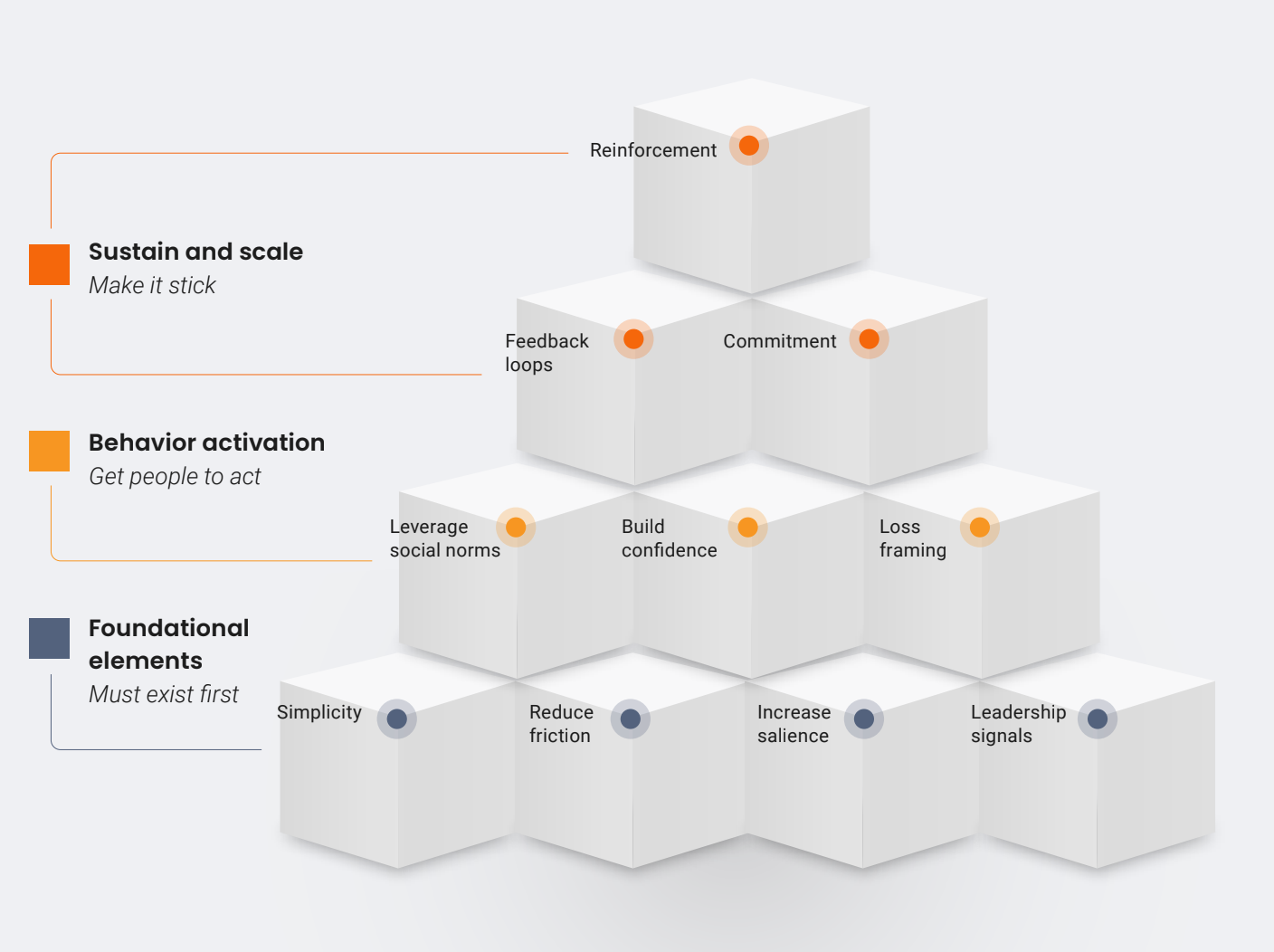
Foundational elements
| Principal | What it solves | How to solve it | What’s the message | Behavioral outcome |
|---|---|---|---|---|
| Simplicity | Overload: Too much choice leads to inaction. |
Adopt:
|
“One step at a time.” | Make the right behavior easy to understand and execute. |
| Reduce friction | Low adoption: People choose the path of least resistance. |
CRM must:
|
“Less admin. More time with customers.” | Make it easy. Remove effort, steps, and unnecessary decisions. |
| Increase salience | Confusion: What stands out gets done. |
Focus attention on:
|
“Here’s what matters right now.” | Make priorities, signals, and next actions obvious. |
| Leadership signals | Mixed messages: People follow what leaders inspect. |
Leaders must:
|
“If it’s not in CRM, it doesn’t exist.” | Clarify priorities, signals, and next actions. |
Behavior activation
| Principal | What it solves | How to solve it | What’s the message | Behavioral outcome |
|---|---|---|---|---|
| Leverage social norms | Resistance: People follow peers — not policies. |
Use:
|
“This is how top teams work.” | Make it normal. “People like me do this” becomes visible. |
| Build confidence | Avoidance: People avoid tools that make them feel incompetent. |
Provide:
|
“CRM guides you — you don’t need to be an expert.” | People feel capable, safe, and supported. |
| Loss framing | Inertia: People fear loss more than they value gain. |
Highlight:
|
“Don’t lose value you already have.” | Make the cost of not changing tangible. |
"The HCP Cockpit, a collaboration with Veeva Business Consulting, saw a 75% adoption rate among sales reps in its first year." Eric Besse Global Customer Engagement Lead, Dermatology, Sanofi
Sustain and scale
| Principal | What it solves | How to solve it | What’s the message | Behavioral outcome |
|---|---|---|---|---|
| Feedback loops | Apathy: Behavior sticks when impact is visible. |
Show:
|
“Here’s the difference you’re making.” | Show impact quickly and clearly. |
| Commitment | Inconsistency: People act in line with commitments. |
Enable:
|
“This is how we’ve agreed to work.” | Create ownership and follow-through. |
| Reinforcement | Drop-off: Habits form through repetition — not launches. |
Sustain:
|
“CRM is how we work — not something we launched.” | Reward, recognize, and repeat what works. |
"Combining Veeva’s cutting-edge solutions with deep industry knowledge creates the ideal platform for our innovation and long-term sustainable growth." Francesco Masi Chief Commercial Officer, Aboca
What this means for leaders
CRM success is not about more features, more training, or more reporting. It is about designing an environment where the right behaviors are easy, obvious, normal, and rewarded. CRM value is not implemented — it is earned, behavior by behavior.
Technology enables transformation. People deliver it.
Ultimately, unlocking the true potential of CRM is not a technical milestone but a human one. Organizations that achieve sustained commercial impact move beyond the ‘launch and leave’ mentality by treating CRM as a core business capability, engineered through value and anchored in the science of human behavior. By systematically designing an environment where high-impact behaviors are the path of least resistance — made easy, obvious, socially reinforced, and leadership-backed — transformation ceases to be a hope and becomes a repeatable reality.
The consistency of the habits, rather than the complexity of the features, drives CRM success. Organizations do not implement value — they earn it, one behavior at a time.
Making CRM stick
- Treat CRM as a business capability, not a system
- Engineer value from outcomes to behaviors
- Design change using behavioral science, not hope
Rethinking CRM in life sciences: from system implementation to value creation.
Engineering CRM value: linking business outcomes to behavior change.
For more information, visit Veeva Business Consulting Services.