White Paper
Engineering CRM Value: Linking Business Outcomes to Behavior Change
The gap between strategy and execution
Part 1 of this series established an uncomfortable truth: organizations don’t realize CRM value at go-live, but through the specific behaviors that follow it. While most organizations agree that CRM should be business-led, few possess the rigorous discipline to bridge the gap between a high-level strategic vision and the daily reality of field execution.
If Part 1 was about the why, Part 2 is about the how.
To break the cycle of underutilized technology investments, organizations must treat value as something to engineer, rather than merely expect. This requires a fundamental shift from tracking what a system can do to what a person must do to drive growth.
In this paper, we dive into the Veeva Vault CRM Value Framework — a systematic approach to mapping your most critical business outcomes to the specific behavioral levers that turn strategy into measurable business impact.
Why CRM value remains elusive
Despite decades of investment, CRM remains one of the most underutilized enterprise platforms. Organizations continue to deploy increasingly sophisticated technology but struggle to translate those investments into sustained commercial impact.
The issue is not technology maturity. It is how organizations conceive, own, and operationalize their CRM. And this is becoming even more of a challenge with the arrival of agentic AI.
Too many programs remain delivery-led, measured by milestones, features, and training completion. Adoption is expected to follow naturally. Organizations often treat behavior change as a downstream activity rather than the core objective.
However, people, processes, and behaviors realize CRM value — technology is the enabler, not the outcome.
“Technology is the enabler, but aligning organizational leadership and commercial teams around a single vision is what delivers the real business benefit. The ultimate goal is that all functions act as one team.”
Moving beyond the 'build it and they will use it' myth
CRM failure rarely looks dramatic. Systems go live. Users log in. Data exists. Dashboards populate.
Yet underneath, the same symptoms persist:
- Inconsistent usage and shadow systems
- Poor data quality and fragmented insight
- Limited cross-functional coordination
- Minimal impact on decisions or customer outcomes
At the root is a flawed assumption: that adoption is a rational response to system availability.
In reality, people do not adopt tools. They adopt behaviors. And behaviors do not change simply because a system exists.
Why agentic AI raises the stakes
The emergence of agentic AI — AI that doesn’t just provide information but proactively executes tasks — makes a behavior-led framework more critical than ever. The ‘70/20/10’ rule of digital transformation remains a stark reality: 70% of AI value is driven by people and process change, 20% by data, and only 10% by the technology itself.
Without a rigorous value engineering framework, agentic AI risks becoming an expensive ‘fancy search bar’ rather than a commercial accelerator. To move the needle, organizations must solve for the human element.
In the era of AI in life sciences, your competitive advantage is no longer the intelligence of your tool, but the speed and consistency with which your people adapt their behaviors to leverage it.
- From suggestion to action: AI can identify a ‘next best action,’ but value is only created if the representative has the confidence and habit to execute it in the field.
- Trust and autonomy: Delegating tasks to an AI agent requires trust in the system’s logic — a shift that requires intentional behavioral design and social proof.
- Rewiring the workflow: Agentic AI can automate administrative friction such as call notes or follow-up emails, but unless that saved time is intentionally redirected toward high-value engagement behaviors, productivity gains will simply evaporate into ‘busy work.’
“Vault CRM and Veeva AI Agents like Pre-call Agent and Voice Agent will drive efficiencies and allow the field to focus on the value parts of their jobs. It’s good for the business, good for HCPs, and great for patients.”
A new definition of CRM success
To move beyond technical milestones, organizations redefine success by focusing on the human element of transformation. This shift requires moving from monitoring system activity to engineering the specific habits that drive commercial impact. The following framework outlines the transition from traditional, delivery-led metrics to a behavior-led, value-engineered model.
Figure 1: Behavior-led, value-engineered CRM transformation
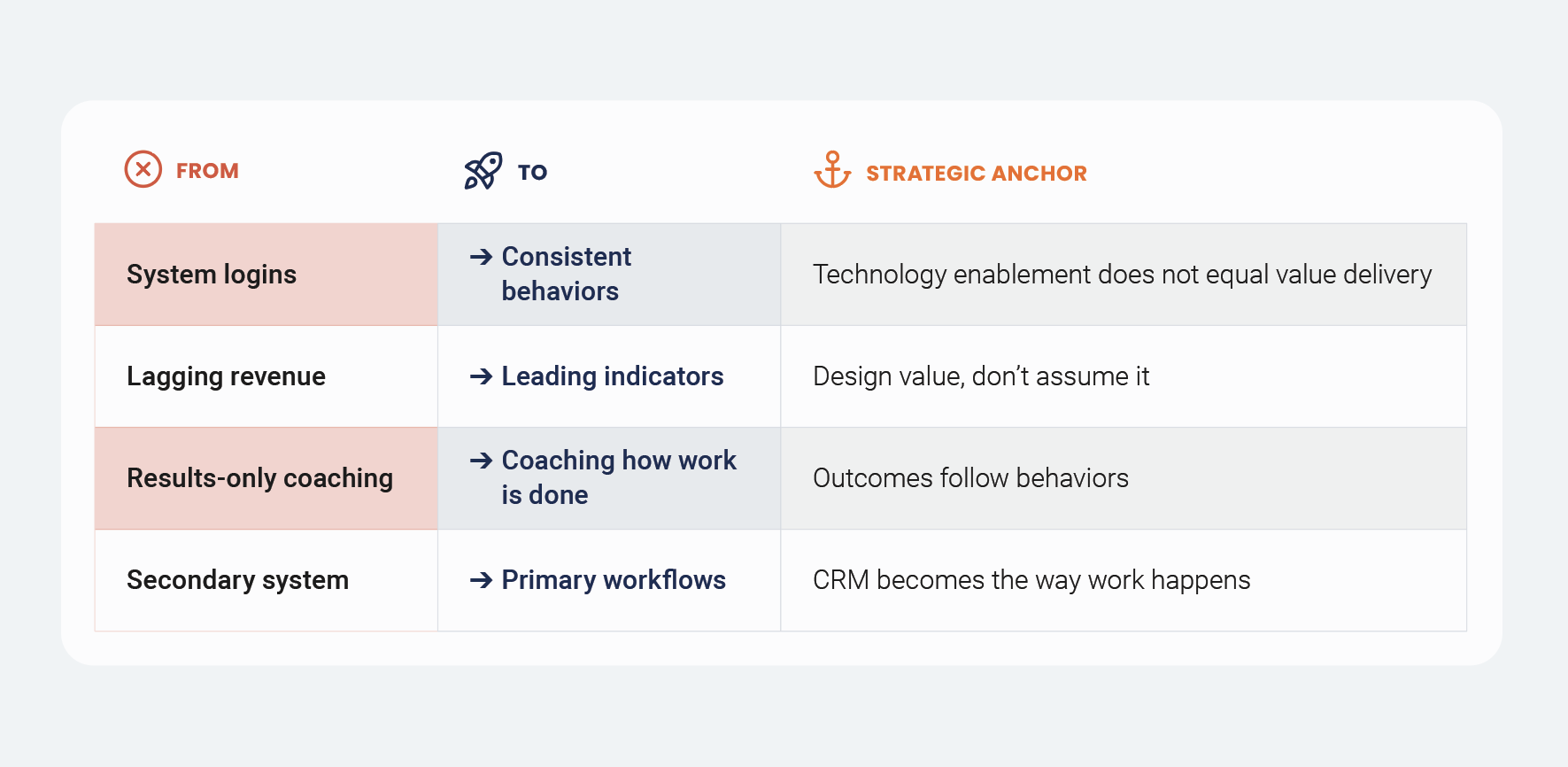
Reframing CRM as a value-engineered transformation
High-performing organizations reframe CRM around three principles:
01. Business ownership is non-negotiable
The business — not IT or digital alone — should own the CRM. Commercial, medical, and leadership teams define:
- What success looks like
- Which decisions should change
- Which behaviors must become standard
Technology teams enable this vision — they do not define it.
“Partnering with Veeva shows us what's achievable when you have strong alignment between business, IT, and the vendor. And with that, we enable business excellence.”
02. Value is engineered, not assumed
Link business outcomes to explicitly design value:
Business outcomes → Value drivers → Target behaviors → Behavioral KPIs → Business enablement
Without this chain, adoption becomes an activity without impact.
03. Behavior is the unit of change
The smallest meaningful unit of CRM value is a changed behavior:
- A different planning habit
- A coordinated follow-up
- A data-informed decision
- A timely cross-functional action
If behaviors do not change, outcomes will not either.
From outcomes to adoption: The value engineering lens
Figure 2: Veeva Value Engineering Approach
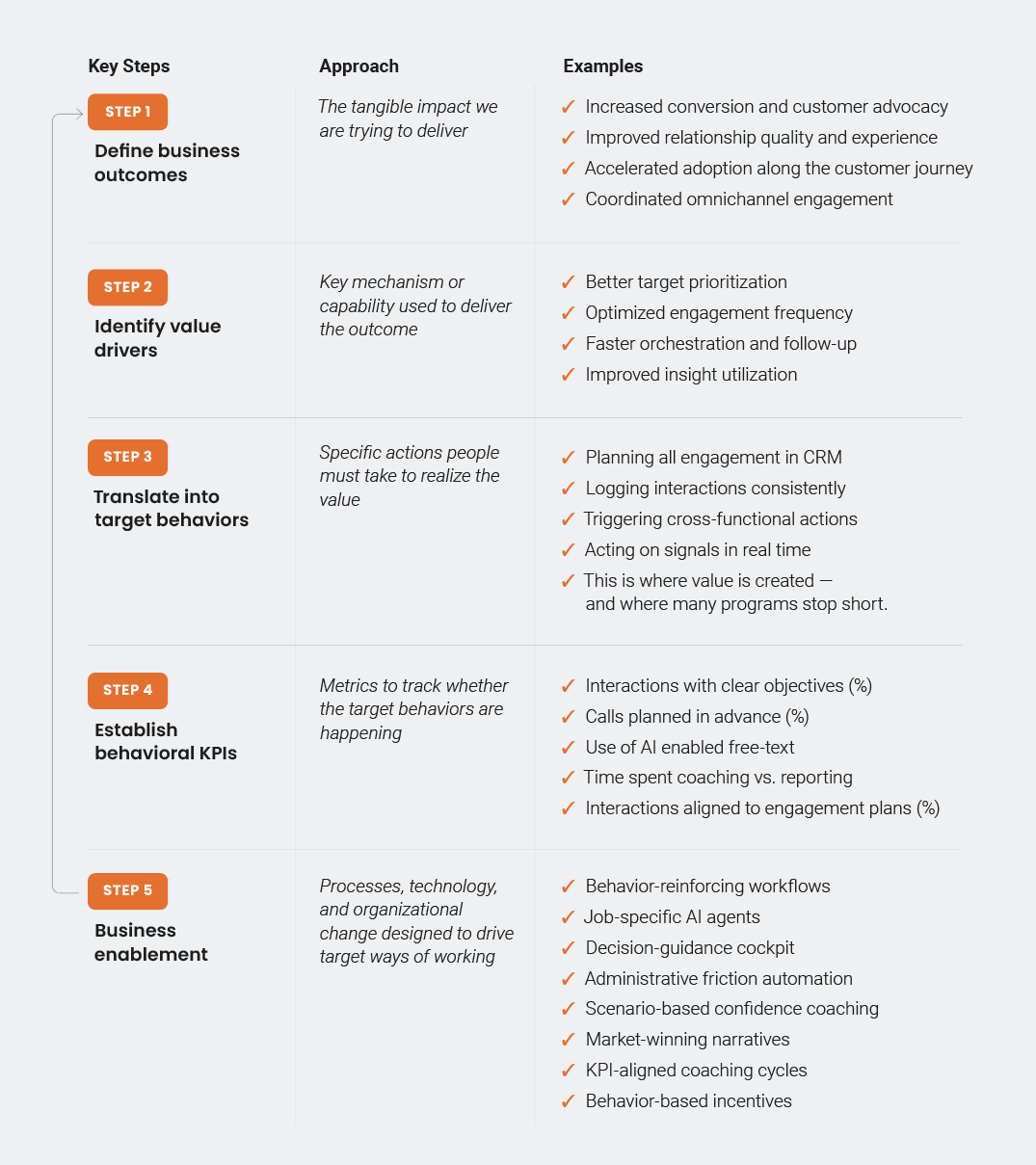
A value-engineered CRM programme works backwards from impact. Only once you’ve defined business outcomes, identified value drivers, translated into target behaviors, and established behavioral KPIs, does the work of business enablement begin. This is not merely a technical exercise; it is the holistic design of the environment required to make the new way of working inevitable. True enablement ensures that every organizational lever is pulling in the same direction to support the target behaviors:
- Workflows that reinforce desired behaviors
- AI agents that support specific 'jobs to be done'
- Cockpits or dashboards that guide decisions
- Automation that removes administrative friction
- Scenario-based coaching to build competence and confidence
- Manager coaching cycles aligned to behavioral KPIs
- Incentives that reward the execution of target behaviors
In this model, technology is the final piece of the puzzle — the engine that powers a business environment already primed for change, ultimately making the right behaviors the easiest behaviors.
Why training alone is insufficient
Traditional change approaches assume people behave rationally once informed. Behavioral science shows otherwise.
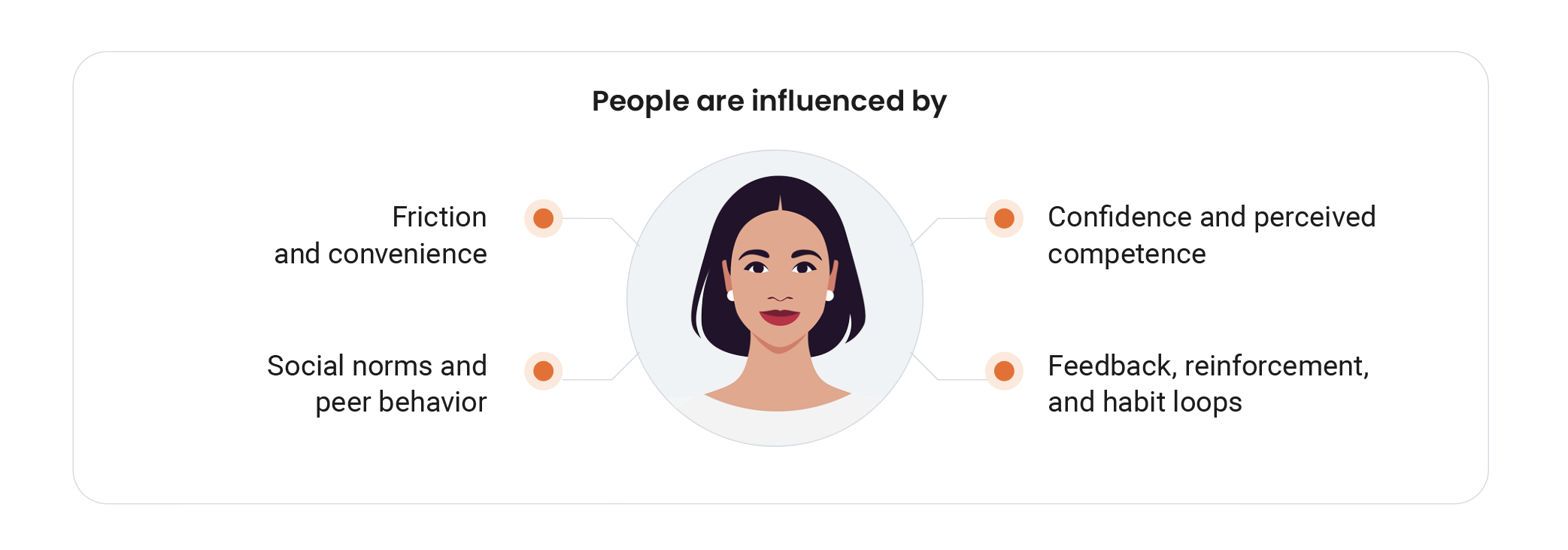
To drive sustained CRM adoption, organizations design for human behavior, instead of fighting it.
From delivery to value creation
CRM programs do not fail because the technology is inadequate. They fail because organizations confuse implementation with transformation.
Unlocking sustained CRM value
- Anchor CRM in business outcomes
- Engineer value through explicit behavior design
- Measure what people do — not just what systems record
- Reinforce new ways of working through leadership and governance
This shifts CRM from a system people are asked to use into a way of working the business depends on.
But defining and measuring behaviors is still not enough. To make them stick — day after day, team by team — organizations deliberately design the environment in which those behaviors occur.
That is where behavioral science becomes decisive and where we move our focus to in Part 3: Making CRM Stick - A Behavioral Science Playbook for Lasting Adoption.
Rethinking CRM in Life Sciences: From System Implementation to Value Creation.
Making CRM Stick: Applying Behavioral Science to Drive Adoption at Scale.
For more information, visit Veeva Business Consulting Services.