White Paper
Why Business Ownership Is the Key to AI Success
Move beyond function-led AI projects to a P&L-driven strategy to enable the business transformation required for Agentic Commercial.
Shifting AI ownership to the business
Biopharma leaders often position AI as a technology or commercial excellence initiative, but this approach can limit long-term success: 89% of organizations are unable to scale more than half of their AI projects. While advanced models and accurate data are the necessary foundation for AI, the primary lever for sustained value is the business operating model.
In an industry where decision-making is distributed across markets, brands, and functions, fragmentation creates a significant structural challenge. In fact, legacy operating models actively prevent collaboration for 14 of the top 20 biopharmas. When AI tools are deployed within isolated departments, AI amplifies the functional disconnect.
The new Agentic CommercialTM model leverages AI to get the right medicines to more patients with digital, AI agents, field teams, and content working together. Because this model relies on interconnected workflows, only business leaders can define the strategic direction and underlying decision logic to drive cross-functional alignment. Organizations that succeed treat AI as a business transformation topic rather than a technology, function-led program. This requires reevaluating four dimensions:
|
01.
AI ownership
|
When profit and loss (P&L) leaders delegate AI to IT or commercial functions, they are unintentionally outsourcing the strategic vision. AI can optimize execution, but it cannot determine what good looks like in a complex biopharma portfolio. As long as enablement functions lead AI initiatives in isolation, the technology will remain a tactical optimization layer rather than a driver of transformation. |
|
02.
AI value-first mindset
|
Business leaders define performance standards upfront; if the logic is not measurable or explainable, the AI initiative cannot scale. While the majority of CEOs now see AI as their direct responsibility, ownership alone does not address the challenges of execution. Success requires pivoting from an 'AI-first' to a 'value-first' mindset, where the key question is not how to deploy AI, but why use it for a given initiative. |
|
03.
AI integration in the operating model
|
AI is not an add-on; rather, organizations embed it directly into the workflows of field teams, key account managers (KAMs), and medical science liaisons (MSLs). AI creates value only when it fundamentally improves daily decision-making. Leveraging AI to streamline tasks helps teams work faster, but using it to optimize decisions ensures that strategic purpose backs every action. |
|
04.
AI activation
|
Sustained value depends on a relentless focus on adoption and behavior change. Organizations move beyond the rollout phase to ensure that AI-driven workflows become permanent habits rather than optional innovation. |
Ultimately, AI can optimize execution, but only the business can decide what is worth optimizing.
Your strategic path to AI value
This perspective is aimed at P&L owners, such as general managers (GMs) and business unit (BU) heads, alongside commercial, medical, and IT leaders supporting AI initiatives at biopharma organizations.
The objective is to challenge a common pattern and elevate the ownership question: AI is currently treated as a technology initiative, while the real lever for value sits with the business and its operating model.
01. The structural challenge: Why function-led AI stalls
In many organizations, leadership delegates AI to siloed commercial, digital, or IT functions. While AI can create operational efficiencies for these teams, such as improved targeting, next best actions, and engagement planning, enablement functions do not own revenue and lack the authority to enforce strategic trade-offs. This creates a structural limitation where AI initiatives focus on tools, dashboards, and incremental improvements instead of reinventing resource allocation or the go-to-market model.
When leadership abdicates and functions are not aligned, AI magnifies existing silos by optimizing competing KPIs. For example, biopharmas continue to create more content despite the fact that field teams leave 77% of approved materials unused. As long as AI sits outside the P&L remit, it may improve efficiency but will fail to drive change in business-wide performance.
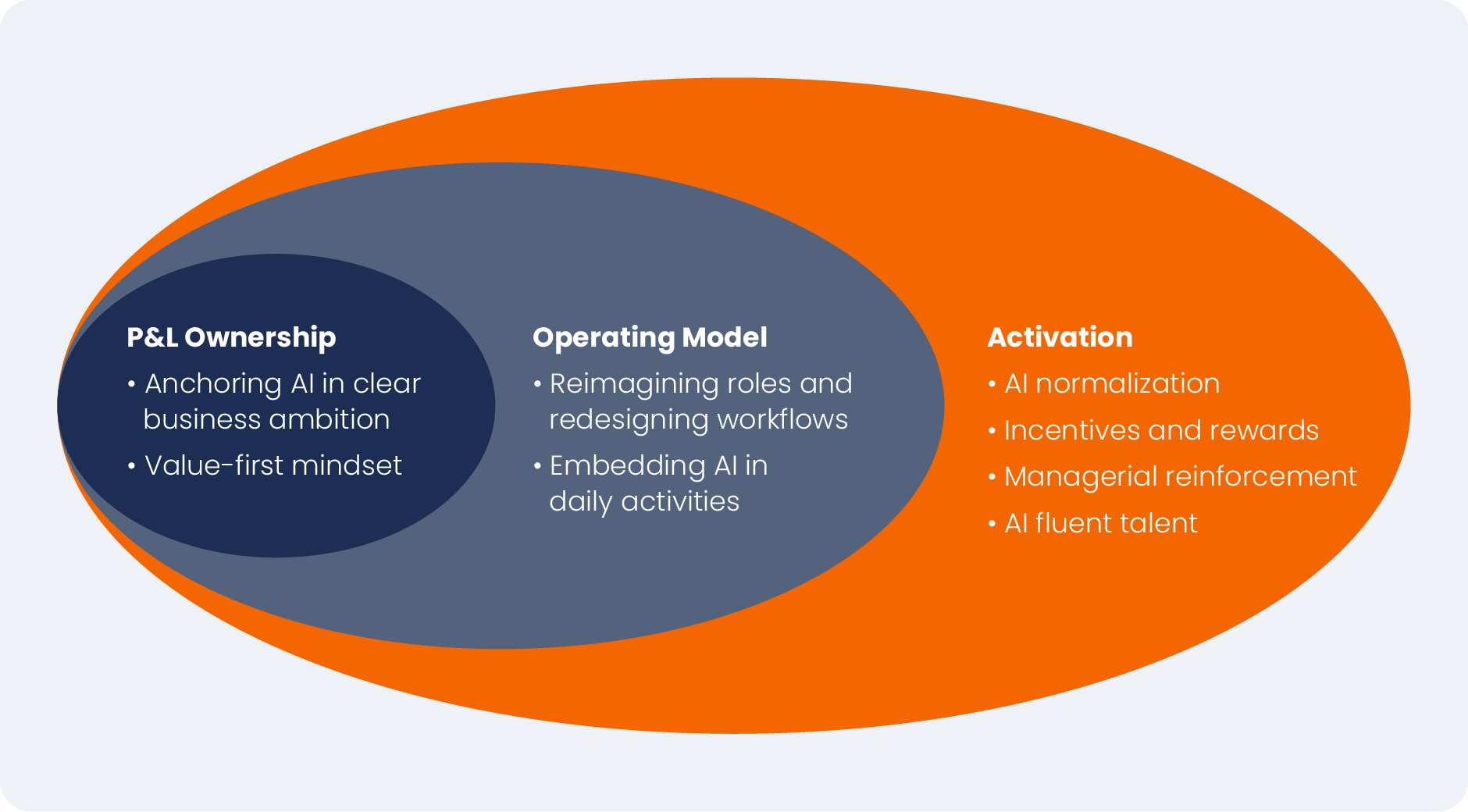
The shift of AI ownership to CEOs and business leaders reflects a new reality: AI is becoming a core lever for performance, not just a supporting tool. AI success requires more than just sponsorship; it requires the ability to articulate, quantify, and direct the logic of business decisions. Leadership is now accountable for anchoring AI in clear business ambition, such as which brands or indications to prioritize and how to balance growth with compliance. If the business does not lead the decision logic, AI will optimize isolated tasks without changing overall performance.
| Enablement Functions Leading AI | P&L Executives Leading AI |
|---|---|
|
Passive P&L
|
Active P&L
|
|
Siloed enablement functions
|
Orchestrated enablement functions
|
|
Overwhelmed HCPs
|
Engaged HCPs
|

Architecting the AI-ready enterprise
02. Value-first mindset: The ‘why AI’ decision is a business responsibility
Organizations are often racing to incorporate AI before asking: ‘What problem are we trying to solve, and is AI the right solution?’ Adopting a value-first mindset is critical to making AI a thoughtful, conditional choice rather than a technical requirement. The failure of many initiatives is not technical in nature, but rather a result of misapplied ambition. AI is most effective for challenges that involve judgment, rely on unstructured data, or where deterministic rules cannot capture the solution.
In many cases, better results come from process redesign, improved execution discipline, or better use of existing systems. For example, instead of using AI to automate a fragmented manual process, a more effective path may be to harmonize the underlying workflow. Otherwise, AI merely automates existing inefficiencies.
Evaluating AI’s value is fundamentally a business responsibility because AI’s impact is not always inherent. It requires explicit definition, measurement, and interpretation. Because AI systems operate on likelihoods rather than certainties, executive leaders need to determine what ‘good’ looks like, which metrics matter, and what trade-offs are acceptable. If leadership cannot measure the outcome or explain the underlying logic, the initiative cannot effectively improve or scale.
A prime example of this value-first AI approach is how biopharma uncovers field insights. While traditional CRM call reports rely on restrictive drop-down menus, Agentic Call ReportTM enables field teams to compliantly input their call notes using free text or spoken natural language using voice. HCP misinformation or formulary hurdles that were previously undocumented and lost to the organization become known, giving commercial teams unprecedented clarity on what is stopping therapies and why. In fact, 65% of Agentic Call Reports identified actionable prescribing barriers, something Veeva refers to as Commercial EvidenceTM. Leaders feed Commercial Evidence back into the broader organization to directly inform content strategy, pricing, or market access decisions.
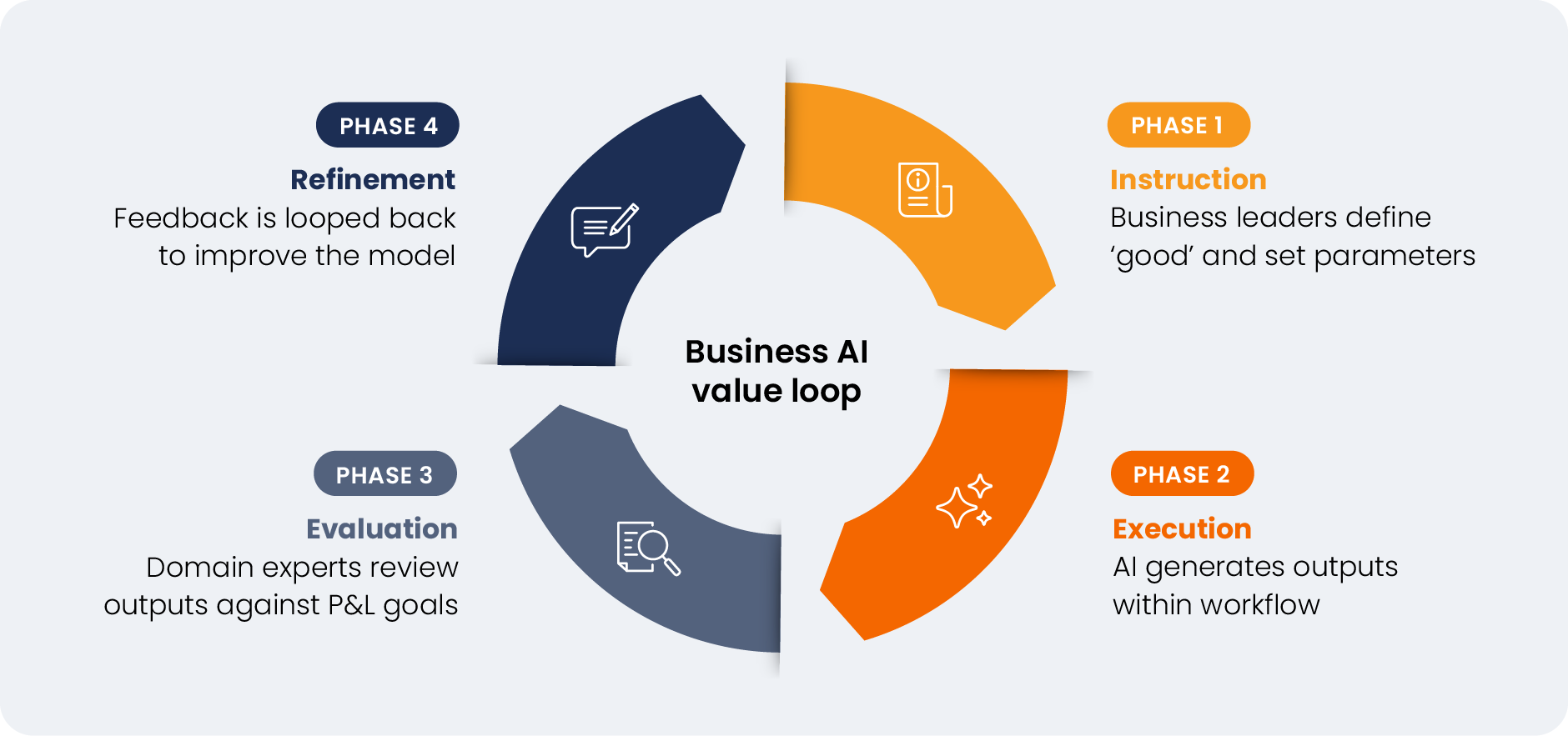
Successful implementation of AI demands a continuous loop of instruction and evaluation. Both require deep domain expertise to ensure AI remains aligned with strategic goals. Without business ownership of value definition, AI will merely automate existing inefficiencies rather than driving a step- change in performance.
"Moving to Vault CRM early was a strategic choice to secure an AI-ready foundation because while technology is already here, true transformation requires the discipline to embed a data-centric mindset into every end-to-end process." Kieron Scrutton SVP, Enterprise Systems, and Digital & Tech Risk Management, GSK
03. Closing the strategy-execution gap: Rewiring the operating model
Organizations that succeed with AI distinguish themselves not by superior technology, but by stronger business integration. While many AI initiatives focus on generating insights, dashboards, or recommendations, they often fail because they are not integrated into daily activities. This creates an extra step for teams to access data, resulting in insights that are generated but rarely acted upon. AI creates value only when it improves workflows and fundamentally changes what field teams, KAMs, and MSLs do on a daily basis.
In commercial biopharma, effective engagement depends on coordinated interaction across sales, marketing, and medical. For example, synchronizing field activities and digital advertising boosts campaign effectiveness by 23%. The key lever for this impact is not more data, but how teams orchestrate engagement in practice. If AI does not enhance the customer experience while moving the business forward, it offers little strategic value. Embedding AI into workflows is therefore a business design challenge rather than a technical one.
"To be truly successful with AI, don’t just layer it on top; take the opportunity to reimagine the process." Dr. Sheuli Porkess Co-author, Ethos Onyx AI in Pharma, Ethos
Generating sustainable returns from AI requires an operating model shift that reimagines roles, processes, and governance. While ‘workflow AI’ can automate discrete tasks, ‘operational AI’ requires a conscious rethinking of how work should be done. AI cannot fix a broken operating model; it requires a business-led redesign to ensure the technology drives specific, cross-functional behavior changes. Success comes from bridging the gap between strategy and execution by ensuring AI is the path of least resistance — embedded directly in workflows where teams live.
Engineering CRM Value: Linking Business Outcomes to Behavior Change
Biopharma decentralized operating model: Why standard AI rollouts fail
Unlike other regulated industries with highly centralized processes enforced by system constraints, biopharma execution happens in thousands of independent micro-moments that the field force owns. Biopharmas operate with a high degree of ‘distributed agency’ — sales reps and MSLs have significant autonomy over how they spend their time and which insights they prioritize.
Standard top-down technology rollouts often fail in this environment because teams perceive AI as an add-on to an already busy day, creating friction. Successfully driving AI adoption requires business leaders to view the operating model not as a static flowchart but as an ecosystem of incentives. Avoid simply giving the field a tool; instead, recalibrate the default behavior. True adoption occurs only when the operating model is redesigned so that leveraging AI-driven insights becomes the easiest and most rewarding path to individual and team success.
04. AI activation: Four levers to make it stick
Once AI intent (the ‘why’) and AI ownership (the ‘who’) are established, AI activation (the ‘how’) ensures lasting adoption. In a fragmented industry, leaders drive impact by designing an environment where the right behaviors become easy, obvious, and socially reinforced. Sustainable value requires moving beyond the initial rollout to ensure AI-driven workflows become permanent organizational habits. Success depends on four critical levers:

|
Executive normalization: Leaders stop framing AI as an experimental innovation project and start treating it as the standard way of working. When AI is positioned as innovation, it remains optional; when treated as business as usual, it becomes a core expectation for performance. |

|
Reward structures: Organizations incentivize outcomes over activity. This involves shifting reward structures from volume-based metrics, such as coverage and frequency, toward customer progression and AI process adherence. High-performing teams are recognized not just for the number of calls made, but for how effectively they use AI-driven insights to move a prescriber along the adoption curve. |

|
Managerial reinforcement: Because AI adoption often stalls at the middle-management layer, managers require coaching to identify and address 'quiet opt-outs.' Reinforcing the AI-enabled workflow with the same rigor as any other performance standard prevents the technology from becoming a tactical add-on. |

|
AI-fluent talent: Organizations code AI literacy into the company culture as a baseline competency rather than a specialty. Selection and promotion criteria favor talent that embodies the data-centric mindset required to lead within a redesigned operating model. |
By aligning these levers, leaders ensure that strategic ambition translates into field-level execution. Competitive advantage does not come from access to technology, but from the discipline with which AI is embedded into these daily organizational habits.
AI business transformation: From strategic ambition to field execution
What is worth optimizing with AI
AI is no longer something that can be delegated. In the new Agentic Commercial model, AI is central to how biopharmas operate, compete, and allocate resources. This shift raises the bar for leadership. Ownership alone is not enough; the real challenge lies in turning that responsibility into execution and measurable impact.
AI will transform commercial biopharma when business leaders move beyond sponsorship and take ownership of ambition, value definition, operating model redesign, and adoption.
AI can optimize execution, but only the business can decide what is worth optimizing.
How Veeva Business Consulting can help
Veeva Business Consulting supports organizations in translating AI ambition into measurable business impact. We’re helping biopharma define AI ambition anchored in P&L priorities; apply a ‘why AI’ discipline to focus investments; redesign field and engagement workflows end-to-end; embed AI into CRM, content, and data ecosystems; drive AI adoption through change management and governance; and establish value measurement and continuous improvement loops. Contact us.